Have you ever typed out a text, paused, and stared at the word “tomorrow” wondering if you spelled it right? You are not alone. The tomorrow vs tommorow mix-up is one of the most common spelling slip-ups in English, and it trips up native speakers just as often as learners.
The confusion usually comes from how the word sounds when we say it fast. We rush through “tomorrow” in daily speech, and that rushed sound tricks our brain into adding an extra letter where it does not belong. Add in autocorrect fatigue and muscle memory from typing quickly, and “tommorow” sneaks into emails, texts, and social posts constantly.
Getting this right matters more than people think. A misspelled word in a work email or a job application can make you look careless, even if your message is perfect otherwise. This guide breaks down the tomorrow vs tommorow debate for good, with simple rules, memory tricks, and real examples you can use starting today.
Tomorrow vs Tommorow: Quick Answer
Tomorrow is the correct spelling. Tommorow is a common spelling mistake and should not be used in formal or professional writing.
✅ Correct: I will call you tomorrow.
❌ Incorrect: I will call you tommorow.
💡 Easy Tip: Remember that tomorrow has one “m” and two “r”s: to-mor-row.
Why I Found It’s Spelled This Way?
The word “tomorrow” comes from Middle English, where it was written as “to morwen” or “to morwe,” meaning “on the morrow” or “on the following day.” Over centuries, English speakers merged these two words into one.
The root word “morrow” traces back to Old English “morgen,” which meant morning. So “tomorrow” literally builds on the idea of “toward the next morning.” As the language evolved, the phrase fused into a single word and settled into the spelling we use now: t-o-m-o-r-r-o-w, with one “m” and two “r’s.”
The mistaken spelling “tommorow” likely happens because people mentally split the word into “tom” and “morrow,” doubling the “m” instead of the “r.” Understanding this history makes the correct pattern easier to remember.
The Simple Rule for Stopping the Confusion
Here is a one-second mental test you can run every time you are unsure: count the letters, not the sounds.
Say this phrase in your head: “one M, two R’s.” Tomorrow has a single “m” right after the “to,” followed by double “r” before the final “ow.”
💡Quick Tip: If you find yourself typing two m’s anywhere in this word, stop. That is your signal you have written “tommorow” by mistake.
This tiny mental checklist works faster than trying to sound out the word, since the pronunciation is exactly where the confusion starts.
Pronunciation Guide I Use
Knowing how to say “tomorrow” correctly can actually help you spell it correctly too. Here is a simple breakdown.
| Word | Phonetic Spelling | Sound Focus |
| Tomorrow (correct) | tuh-MOR-oh | Stress falls on the second syllable, “MOR” |
| Tommorow (incorrect) | Not a real word, no standard pronunciation | N/A |
When you say “tomorrow” out loud, notice that your tongue taps once for the “m” sound and then rolls briefly for the double “r” sound. Practicing this slowly, syllable by syllable (tuh-mor-row), trains your muscle memory so your fingers naturally follow the correct pattern when typing.
Tomorrow vs Tommorow: Definitions with Examples & Top Queries
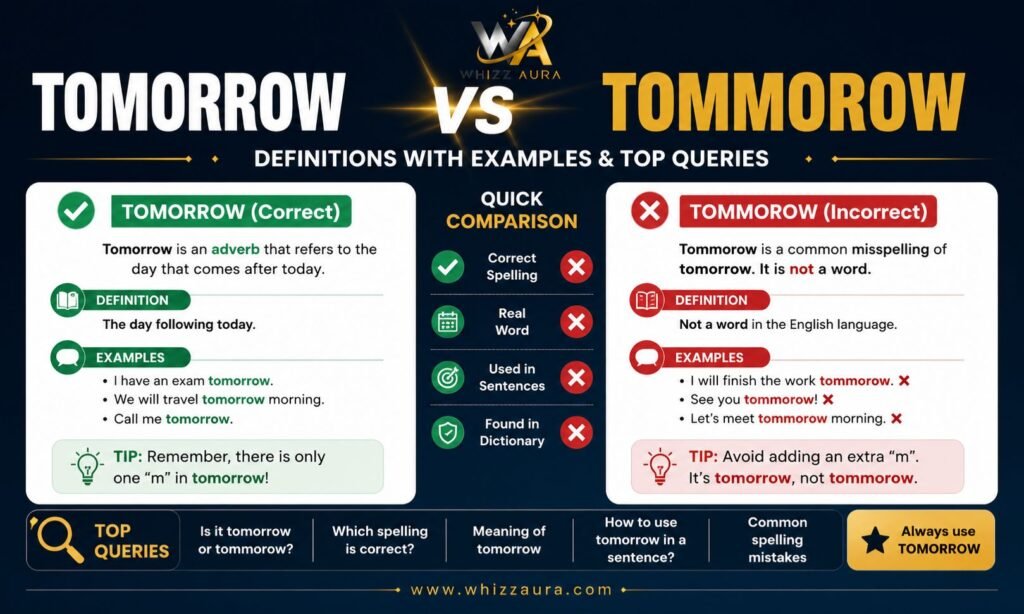
Tomorrow is an adverb and a noun that refers to the day after today.
As an adverb, it modifies a verb to show when an action will happen:
- We are leaving tomorrow.
- She starts her new job tomorrow.
- Call me tomorrow if you have questions.
- The store reopens tomorrow at nine.
- Let’s finish this conversation tomorrow.
As a noun, it refers to the day itself or the future in general:
- Tomorrow is going to be busy.
- Nobody knows what tomorrow holds.
- Today’s effort shapes tomorrow’s success.
- Tomorrow marks the start of the new quarter.
- I am not looking forward to tomorrow’s meeting.
Tommorow has no definition. It is not recognized in any English dictionary and holds no grammatical function. It is purely a spelling error.
People commonly search for these related queries:
- Is tommorow a word
- How do you spell tomorrow correctly
- Tomorrow vs tommorow vs tomorow
- Correct spelling of tomorrow in English
- Tomorrow morning spelling check
British English vs American English Spelling
Good news here: this spelling is identical across British and American English. Unlike words such as “color” and “colour,” there is no regional variation for “tomorrow.”
| Feature | British English | American English |
| Spelling | Tomorrow | Tomorrow |
| Pronunciation | tuh-MOR-oh | tuh-MOR-oh |
| Usage as adverb | Same | Same |
| Usage as noun | Same | Same |
Both dialects treat this word the same way in formal writing, casual writing, and speech. There is no need to adjust your spelling based on your audience’s location.
Explore More Grammar Guides
Leaped vs Leapt: What’s the Difference? Meaning, Usage & Examples
My Memory Tricks and Tips
Here are three tricks that make this spelling stick for good.
- The “TO-MORE-OW” split. Break the word into three chunks: “to,” “mor,” and “ow.” This helps you visualize just one “m” and two “r’s” without overthinking it.
- The “Tomorrow has TWO ROOMS” trick. Picture the double “r” as two rooms next to each other. One “m,” two “r” rooms.
- The replacement test. Swap in the word “morning.” Since “tomorrow” contains “morning’s” cousin word “morrow,” and “morning” only has one “m,” your brain links the single “m” pattern automatically.
💡Pro Tip: Pick just one memory trick and repeat it daily for a week. Overloading yourself with all three at once tends to backfire.
Tomorrow vs Tommorow: Which One Should You Use?
- Use tomorrow in every single context: emails, texts, essays, business reports, casual conversation, and formal documents.
- Never use tommorow anywhere. It is always incorrect, regardless of tone or setting.
- Use tomorrow when referring to the day after today, a future event, or the concept of the future in general.
- Double-check autocorrect suggestions, since some keyboards do not catch this specific error.
Common Mistakes with Tomorrow vs Tommorow
Mistake 1: Doubling the wrong letter
Incorrect: See you tommorow at the office.
Correct: See you tomorrow at the office.
Mistake 2: Dropping a letter entirely
Incorrect: The event starts tomorow evening.
Correct: The event starts tomorrow evening.
Mistake 3: Confusing it with “the morrow” in formal writing
Incorrect: We shall discuss it upon tommorow.
Correct: We shall discuss it tomorrow.
Tomorrow vs Tommorow in Everyday Examples
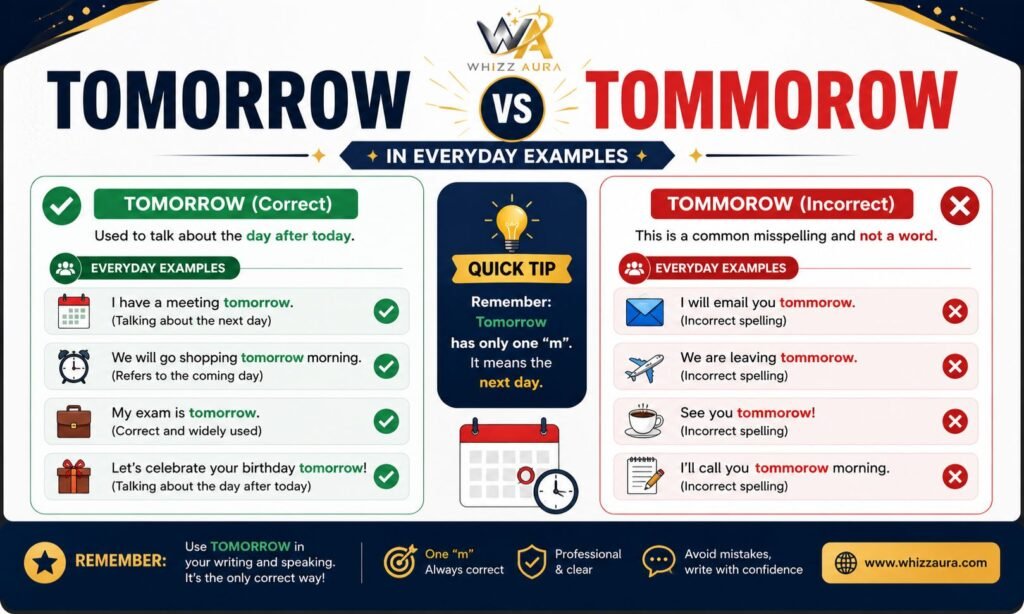
Texting: “omw tomorrow around 3, that ok?”
Emails: “I wanted to follow up and confirm our call for tomorrow morning at 10 AM.”
Social Media: “Big announcement dropping tomorrow, stay tuned!”
Business Writing: “Please submit the finalized proposal no later than tomorrow at 5 PM EST.”
Comparison Table: Tomorrow vs Tommorow
| Category | Tomorrow | Tommorow |
| Part of speech | Adverb, noun | Not applicable (misspelling) |
| Used for | The day after today, future events | Never correct in any context |
| Example | I’ll see you tomorrow. | Not used |
| Memory hook | One “m,” two “r’s” | N/A |
Comparison Table: Tomorrow vs Tommorow (Quick Reference)
| Question to Ask | If Yes, Use |
| Am I referring to the day after today? | Tomorrow |
| Did I type two m’s in a row? | Fix it to Tomorrow |
| Am I unsure of the spelling? | Tomorrow (it is always correct) |
| Is this for formal writing? | Tomorrow |
Pro Tip I Learned
The best editing hack I use is reading my sentence out loud, backward, word by word. When you hit “tomorrow” in reverse, your brain stops autopiloting and actually looks at each letter, making it much easier to spot a stray extra “m.”
Text-to-speech tools work well too. If your device mispronounces or flags the word, that is often a sign of a typo.
Quick Test I Created: Tomorrow vs Tommorow Quiz
Fill in the blank with the correct spelling.
- I will call you ______.
- ______ is a new day.
- The meeting is set for ______ afternoon.
- Nobody can predict ______.
- She leaves for Paris ______.
- Let’s talk about it ______.
- The store closes early ______.
- We start training ______ morning.
- His flight departs ______ night.
- ______ never comes, they say.
- The deadline is ______ at noon.
- I promise to reply ______.
- Our team meets again ______.
- The package arrives ______.
- Please confirm by ______.
- The concert is ______ evening.
- I’ll finish the essay ______.
- See you bright and early ______.
- The results post ______.
- Let’s celebrate ______ instead.
Answer Key: All twenty blanks are filled with “tomorrow.”
Frequently Asked Questions
Is tommorow a real word?
No, “tommorow” is not a real word. It is a common misspelling of “tomorrow” and does not appear in any English dictionary.
How do you spell tomorrow correctly?
The correct spelling is “tomorrow,” with one “m” and two “r’s” (t-o-m-o-r-r-o-w).
Why do people misspell tomorrow as tommorow?
People often misspell it because the double “r” sound gets mentally shifted to the “m,” causing them to add an extra “m” instead.
Is tomorrow spelled the same in British and American English?
Yes, “tomorrow” is spelled identically in both British and American English, with no regional variation.
What part of speech is tomorrow?
“Tomorrow” functions as both an adverb, describing when something happens, and a noun, referring to the day itself.
Conclusion
The tomorrow vs tommorow debate really comes down to one simple fact: only “tomorrow” is correct. With one “m” and two “r’s,” this word trips people up because of how quickly we say it, not because English grammar is being unfair.
Once you lock in a memory trick, like picturing “two rooms” for the double “r,” this spelling becomes second nature. Whether you are writing a quick text, a formal business email, or a school essay, using the correct spelling shows attention to detail and builds trust with your reader.

Shoaib Ahmad is an SEO and digital content professional with experience in creating helpful, easy-to-understand online content. At Whizz Aura, he focuses on English grammar, vocabulary, word meanings, sentence structure, and practical language tips. His goal is to make learning English simple, clear, and useful for everyday communication.