
Have you ever typed a word, stared at it, and thought “wait, does that look right”? That’s exactly what happens with organizing vs organising. Both words mean the exact same thing, but your spell checker might flag one of them depending on where you live or what settings your computer uses.
This mix-up trips up students, professionals, and even seasoned writers. It’s not because the rule is complicated. It’s because English has two major flavors, American and British, and they don’t always agree on how to spell words that end in “-ize” or “-ise.”
Getting this right matters more than you might think. A resume sent to a London firm with American spelling can look careless. A blog post aimed at a US audience with British spelling can feel oddly formal. This guide breaks down everything you need to know about organizing vs organising, so you never second-guess yourself again.
Organizing vs Organising: Quick Answer
Organizing is the preferred spelling in American English, while organising is the common British English spelling. Both mean arranging, planning, or putting things into a useful system.
✅Correct: I am organizing my files.
✅Correct: I am organising my files.
⚠️ Incorrect: Mixing both styles in the same document without a reason.
Why I Found It’s Spelled This Way?
The root of both words traces back to the Greek word “organizein,” which passed through Latin and French before landing in English. The core meaning always centered on arranging parts into a working whole.
English inherited two competing spelling patterns from this history. French influence pushed toward “-ise,” while Greek-based scholarly Latin pushed toward “-ize.” For centuries, British writers used both somewhat interchangeably.
In the 1700s and 1800s, Noah Webster set out to simplify and standardize American spelling. He favored “-ize” because it matched the word’s Greek origin more directly. Meanwhile, British publishers, especially newspapers like The Times, leaned toward “-ise” for consistency with French-derived spelling patterns. That split is why organizing vs organising still splits opinion today.
The Simple Rule for Stopping the Confusion
Here’s a one-second mental test. Ask yourself: “Am I writing for a US audience or a UK audience?”
- If the answer is US, Canada (mostly), or a global American-style brand, use organizing.
- If the answer is UK, Australia, or most Commonwealth countries, use organising.
💡Quick Tip: When in doubt, check your document’s language setting. If it says “English (United States),” use the Z. If it says “English (United Kingdom),” use the S.
Pronunciation Guide I Use
Here’s the surprising part. Both words sound exactly the same when spoken out loud.
| Word | Phonetic Spelling | Sound Focus |
| Organizing | /ˈɔːr.ɡə.naɪ.zɪŋ/ | Emphasis on the “or-guh” start, soft Z sound in the middle |
| Organising | /ˈɔːr.ɡə.naɪ.zɪŋ/ | Identical pronunciation, spelling difference is silent |
Even though the letter differs on the page, both the “z” in organizing and the “s” in organising make a “z” sound when spoken. Try saying “orga-NIGH-zing” slowly and you’ll notice your mouth never actually forms a hard “s” sound, no matter which spelling you’re picturing.
Organizing vs Organising: Definitions with Examples & Top Queries
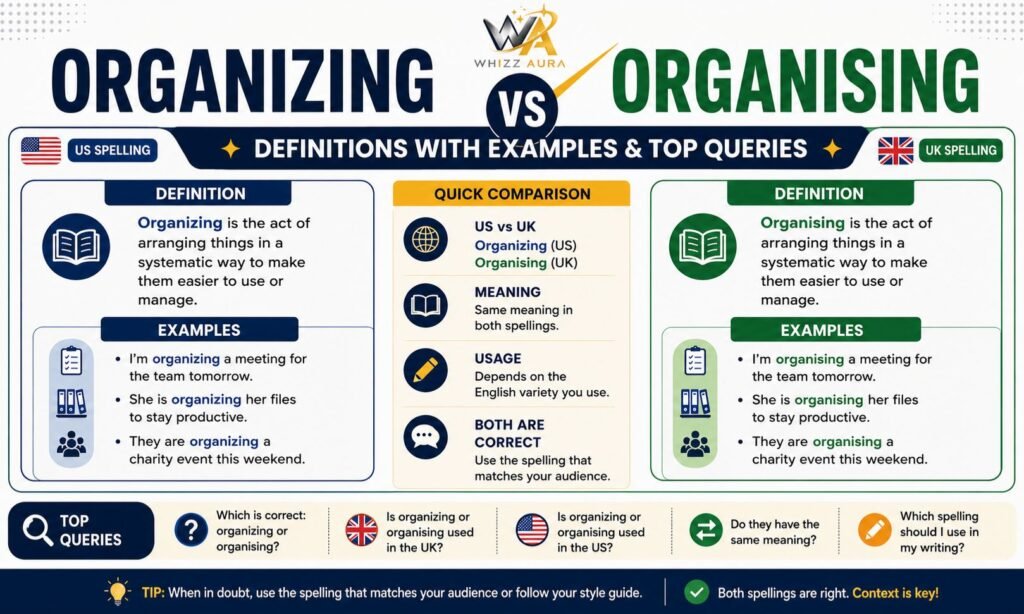
Organizing (verb, present participle of “organize”) means arranging, structuring, or coordinating people, items, or tasks into an orderly system, used in American English.
- I spent my Saturday organizing the garage.
- The committee is organizing a fundraiser for the school.
- She has a talent for organizing large events.
- We’re organizing our files by date and category.
- He kept organizing and reorganizing his desk until it felt right.
Organising (verb, present participle of “organise”) carries the identical meaning and grammatical function, but follows British English spelling conventions.
- I spent my Saturday organising the garage.
- The committee is organising a fundraiser for the school.
- She has a talent for organising large events.
- We’re organising our files by date and category.
- He kept organising and reorganising his desk until it felt right.
Popular related searches people ask about this topic:
- Is organizing or organising correct in English?
- Organizing vs organising Grammarly
- Organizing vs organising Canada
- Which spelling does Microsoft Word prefer?
- Organizing vs organising in academic writing
British English vs American English Spelling
This is not a case where the meaning shifts. It’s purely a spelling convention tied to regional dialect, similar to “color” versus “colour” or “realize” versus “realise.”
| Feature | British English | American English |
| Spelling | Organising | Organizing |
| Root Pattern | -ise ending | -ize ending |
| Common Regions | UK, Australia, New Zealand, India | United States, Philippines |
| Style Guides | Oxford style (allows both, prefers -ize actually) | AP Style, Chicago Manual |
| Pronunciation | Same | Same |
Interestingly, Oxford University Press itself often recommends “-ize” spellings, including “organize,” even in British contexts, because it reflects the Greek root more accurately. Still, “organising” remains the dominant everyday choice across the UK.
Explore More Grammar Guides
Leaped vs Leapt: What’s the Difference? Meaning, Usage & Examples
Tomorrow vs Tommorow: What’s the Difference? Meaning, Usage & Examples
My Memory Tricks and Tips
Here are three tricks I personally use to lock in the right spelling every time.
- The “Z is for Zebra, USA” trick. Zebras roam free and wild, just like American English breaks from British tradition. Z equals USA.
- The “S is for Sunday roast” trick. Sunday roast is a British tradition, and so is the letter S in organising. Both scream “UK.”
- The flag swap test. Picture a small American flag next to the Z and a British Union Jack next to the S. Whichever flag matches your audience tells you the letter to use.
💡Pro Tip: If you write for international audiences often, keep a sticky note on your monitor with just “US = Z, UK = S.” It sounds silly, but it works.
Organizing vs Organising: Which One Should You Use?
Use organizing when:
- You’re writing for a US-based company, client, or publication.
- Your audience is primarily American or Canadian.
- Your software or CMS defaults to US English.
- You’re submitting content to an American academic journal.
Use organising when:
- You’re writing for a UK, Australian, or Commonwealth audience.
- Your client specifically requests British English.
- You’re submitting to a UK-based publication or university.
- Your brand style guide follows Oxford or British spelling rules.
Common Mistakes with Organizing vs Organising
Mistake 1: Mixing spellings within the same document
Incorrect: We are organizing the event, and the organising committee will meet Friday.
Correct: We are organizing the event, and the organizing committee will meet Friday.
Mistake 2: Assuming the meaning changes
Incorrect: Organising means planning, while organizing means arranging physical items.
Correct: Organising and organizing mean exactly the same thing, just spelled differently by region.
Mistake 3: Misspelling the root word entirely
Incorrect: She is orginizing the files.
Correct: She is organizing the files (or organising, depending on dialect).
Organizing vs Organising in Everyday Examples
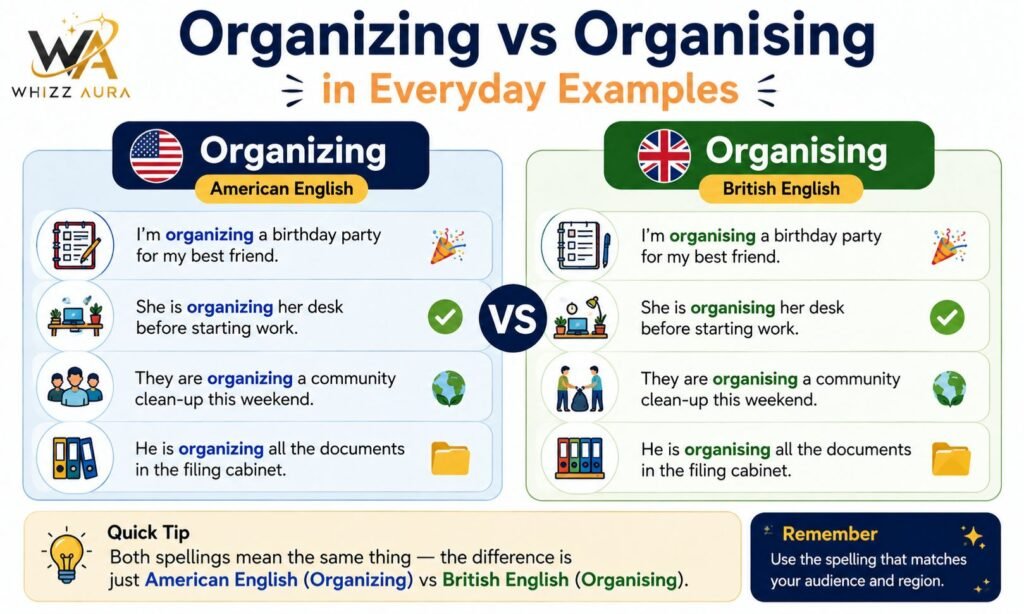
Texting: “hey can u help me start organizing the trip lol” (US) versus “hey can u help me start organising the trip lol” (UK)
Emails: “I am currently organizing next quarter’s budget review.” (US) versus “I am currently organising next quarter’s budget review.” (UK)
Social Media: “Big weekend project: organizing my entire closet! #organized” (US) versus “Big weekend project: organising my entire wardrobe! #organised” (UK)
Business Writing: “Our team is organizing a company-wide training session for Q3.” (US) versus “Our team is organising a company-wide training session for Q3.” (UK)
Comparison Table: Organizing vs Organising
| Category | Organizing | Organising |
| Part of Speech | Verb (gerund/present participle) | Verb (gerund/present participle) |
| Dialect | American English | British English |
| Used For | Arranging, structuring, planning | Arranging, structuring, planning |
| Example Sentence | She’s organizing the team meeting. | She’s organising the team meeting. |
| Memory Hook | Z equals USA | S equals British Sunday |
| Common Regions | US, Canada | UK, Australia, India |
Comparison Table: Organizing vs Organising (Quick Reference)
| Question to Ask | If Yes, Use |
| Is my audience American? | Organizing |
| Is my audience British or Commonwealth? | Organising |
| Does my style guide say AP or Chicago? | Organizing |
| Does my style guide say Oxford or British Council? | Organising |
| Am I unsure and writing casually? | Either is acceptable, just stay consistent |
Pro Tip I Learned
The best editing hack I’ve found is using text-to-speech to catch inconsistency. Since both words sound identical, your ears won’t catch a spelling mismatch, but your eyes will if you follow along with the highlighted text while it reads aloud. Combine that with your document’s “Find and Replace” tool to standardize every instance of organizing or organising in one pass before you hit publish.
Quick Test I Created: Organizing vs Organising Quiz
Fill in the blank with the correct spelling based on the dialect noted in parentheses.
- She is _______ her bookshelf. (US)
- The team is _______ a charity event. (UK)
- We need help _______ the warehouse. (US)
- He’s in charge of _______ the conference. (UK)
- I love _______ my planner every Sunday. (US)
- The council is _______ a town meeting. (UK)
- _______ your inbox can reduce stress. (US)
- She’s _______ the wedding seating chart. (UK)
- They spent hours _______ the garage sale. (US)
- Please start _______ the files by date. (UK)
- My New Year goal is _______ my closet. (US)
- The volunteers are _______ the food drive. (UK)
- _______ a move takes serious planning. (US)
- He’s responsible for _______ the schedule. (UK)
- We’re _______ a surprise party this weekend. (US)
- The professor is _______ a study group. (UK)
- _______ your finances early pays off. (US)
- The board is _______ next year’s budget. (UK)
- I’m _______ my digital photos into folders. (US)
- She’s _______ the summer festival lineup. (UK)
Answer Key: (1. organizing, 2. organising, 3. organizing, 4. organising, 5. organizing, 6. organising, 7. Organizing, 8. organising, 9. organizing, 10. organising, 11. organizing, 12. organising, 13. Organizing, 14. organising, 15. organizing, 16. organising, 17. Organizing, 18. organising, 19. organizing, 20. organising)
Frequently Asked Questions
Is organizing or organising correct?
Both are correct, since organizing is the American English spelling and organising is the British English spelling of the same word.
Does Microsoft Word prefer organizing or organising?
Microsoft Word follows whatever language setting is selected in the document, defaulting to organizing for US English and organising for UK English.
Why does organize have two spellings?
Organize has two spellings because American English standardized around the Greek-based “-ize” ending, while British English largely favored the French-influenced “-ise” ending.
Is organising a real word?
Yes, organising is a completely valid, real word and is the standard spelling used throughout the United Kingdom, Australia, and much of the Commonwealth.
Which spelling should I use for a resume?
Match the spelling to the country or company you’re applying to, using organizing for American employers and organising for British or Commonwealth employers.
Conclusion
At the end of the day, organizing vs organising comes down to one simple factor: which English dialect your audience expects. The meaning never changes, the pronunciation never changes, and the grammar rules stay identical. The only thing shifting is a single letter, Z for American English and S for British English.
Once you internalize that one rule, along with a memory trick or two from this guide, you’ll never hesitate over this spelling again. Whether you’re writing an email, a resume, or a blog post, picking the right regional spelling shows attention to detail and respect for your reader.

Shoaib Ahmad is an SEO and digital content professional with experience in creating helpful, easy-to-understand online content. At Whizz Aura, he focuses on English grammar, vocabulary, word meanings, sentence structure, and practical language tips. His goal is to make learning English simple, clear, and useful for everyday communication.