
Have you ever typed “I want to persue my dreams” and then paused, staring at the word like it just grew an extra leg? You’re not alone. This is one of the most commonly misspelled words in English, and it trips up students, professionals, and even seasoned writers.
The confusion makes sense once you think about it. The word sounds like it could be spelled either way, and spellcheck doesn’t always catch it fast enough before you hit send on that important email. Getting persue or pursue right matters more than you might think. A misspelled word in a resume, a business proposal, or a college essay can quietly signal carelessness, even when your ideas are brilliant. Let’s fix that for good.
Persue or Pursue: Quick Answer 🎯✅
Pursue is the only correct spelling in English. Persue is a common misspelling and is never correct in any dictionary or formal writing.
✅ Correct: She decided to pursue a career in medicine.
❌ Incorrect: She decided to persue a career in medicine.
Quick tip: If you remember nothing else, remember this. Pursue starts with “pur,” not “per.”
Why I Found It’s Spelled / Used This Way?
The word pursue comes from the Old French word poursuivre, which itself traces back to the Latin prosequi, meaning “to follow” or “to chase after.” Break that Latin word down and you get pro- (forward) plus sequi (to follow).
Over centuries, as French words entered English after the Norman Conquest, poursuivre evolved into the Middle English pursuen. The spelling settled into pursue by the time English spelling became more standardized in the 1600s and 1700s.
Persue never had any real linguistic history. It’s simply a phonetic misspelling that happens because unstressed vowels (like the “ur” sound in pursue) are easy to mishear or mistype as “er.”
The Simple Rule for Stopping the Confusion
Here’s a one-second mental test you can use every single time.
Think of the word “purse.” You carry a purse, and you pursue your goals. Both start with the same three letters: p-u-r.
If you can picture a purse in your mind, you’ll never write “persue” again. This tiny trick works because your brain already has a strong visual anchor for “purse,” and pursue simply borrows that same beginning.
Pronunciation Guide I Use
Getting the sound right also helps lock in the spelling. Here’s a simple breakdown.
| Word | Phonetic Spelling | Sound Focus |
| Pursue (correct) | per-SOO | Stress falls on the second syllable, “SOO” |
| Persue (incorrect) | Not a real word | N/A, this spelling does not exist |
Mouth-movement tip: When you say “pursue,” your lips round into an “oo” shape at the end, almost like you’re about to whistle. That rounded “oo” sound is your clue that the word ends in “-sue,” not “-sue” spelled any other way.
Persue or Pursue: Definitions with Examples & Top Queries

Since persue isn’t a real word, only pursue has definitions and legitimate use. Let’s dig into it properly.
Pursue (verb) means to follow, chase, or work toward something with effort and determination over time.
Five example sentences:
- The detective decided to pursue the lead despite having little evidence.
- I plan to pursue a master’s degree next year.
- The company will pursue new markets in Asia.
- He chose to pursue his passion for painting instead of accounting.
- The police began to pursue the suspect through the alley.
Popular user queries related to this keyword:
- Is persue a word?
- How do you spell pursue correctly?
- Pursue vs persue vs purse
- What does pursue mean in a sentence?
- Persue or pursue in a resume
British English vs American English Spelling
Here’s some good news: this one is refreshingly simple. Pursue is spelled identically in both British and American English. There is no regional variation, unlike words such as “colour” versus “color.”
| Feature | British English | American English |
| Spelling | Pursue | Pursue |
| Pronunciation | per-SOO | per-SOO |
| Meaning | To follow or chase after | To follow or chase after |
My Memory Tricks and Tips
Here are three creative tricks to permanently lock in the correct spelling.
- The Purse Trick: Remember, you pursue your dreams the same way you carry a purse. Same first three letters.
- The “U before S” Rule: In pursue, the “u” always comes before the “s” in that middle chunk, spelled “ur-s-u-e.” Think of it as “you are so u-nique,” reminding you the “u” shows up twice.
- Replacement Test: Swap in a word you know is spelled correctly, like “purple.” Both “purple” and “pursue” begin with “pur,” never “per.”
Persue or Pursue: Which One Should You Use?
Since only one option is actually a real word, this section is short and sweet.
- Use pursue whenever you’re writing about chasing a goal, career, degree, hobby, or person.
- Use pursue in formal writing, essays, resumes, business emails, and everyday conversation.
- Never use persue in any context. It is always a spelling mistake.
Explore More Grammar Guides
Lable or Label: What’s the Difference? Meaning, Usage & Examples
Take Effect or Take Affect: What’s the Difference? Meaning, Usage & Examples
Long Term or Longterm: What’s the Difference? Meaning, Usage & Examples
As Well or Aswell: What’s the Difference? Meaning, Usage & Examples
Its Called vs It Called: What’s the Difference? Meaning, Usage & Examples
Common Mistakes with Persue or Pursue
Even smart writers slip up here. Let’s break down the three most frequent errors.
Mistake 1: Misspelling in career contexts
❌ Incorrect: I want to persue a job in marketing.
✅ Correct: I want to pursue a job in marketing.
Mistake 2: Confusing it with “peruse”
❌ Incorrect: I like to persue books at the library.
✅ Correct: I like to peruse books at the library. (Peruse means to read carefully, a completely different word.)
Mistake 3: Doubling up letters incorrectly
❌ Incorrect: She will persueee her interests.
✅ Correct: She will pursue her interests.
Persue or Pursue in Everyday Examples
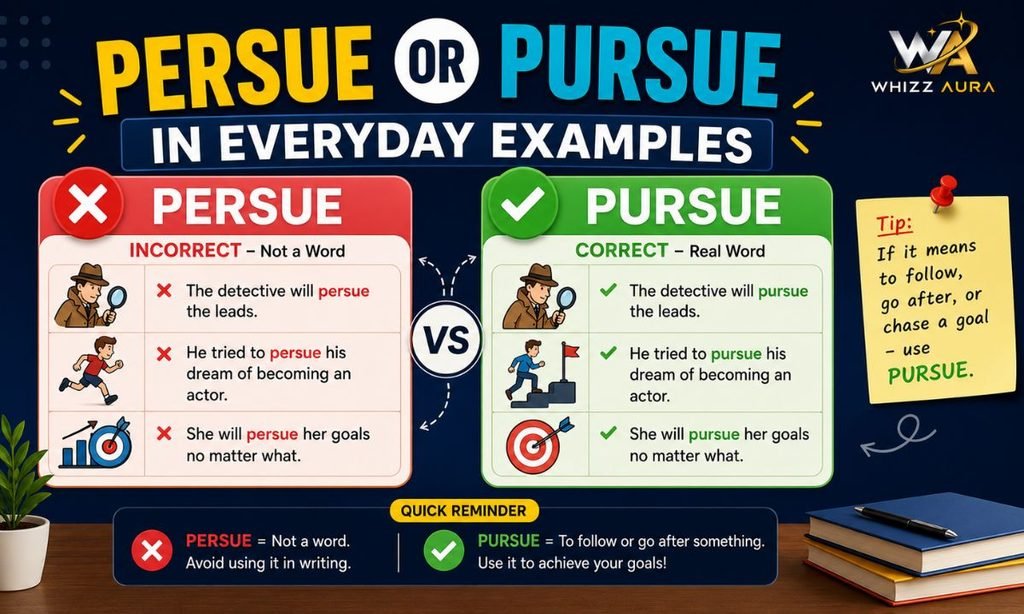
Texting: “Gonna pursue that internship, wish me luck!”
Emails: “After careful consideration, I have decided to pursue this opportunity with your organization.”
Social Media: “Never stop chasing your dreams. Pursue what lights you up. 🔥”
Business Writing: “The board has agreed to pursue a merger with the technology firm by Q3.”
Comparison Table: Persue or Pursue
| Category | Persue | Pursue |
| Part of speech | None, not a real word | Verb |
| Used for | Nothing, always incorrect | Chasing goals, careers, or interests |
| Example | “I will persue my dream” (wrong) | “I will pursue my dream” (correct) |
| Memory hook | None needed, avoid entirely | Think “purse” for the first three letters |
Comparison Table: Persue or Pursue (Quick Reference)
| Question to Ask | If Yes → Use |
| Am I trying to spell a real English word? | Pursue |
| Does spellcheck underline the word in red? | Pursue (fix the spelling) |
| Am I writing about chasing a goal or dream? | Pursue |
| Did I mean “read carefully”? | Peruse (different word entirely) |
Pro Tip I Learned
One editing hack I swear by is reading my sentence out loud, backward, word by word. When you isolate “pursue” on its own instead of reading it in a flowing sentence, your eyes catch spelling errors much faster because your brain can’t autocomplete the word from context.
Text-to-speech tools also work wonders. If your software mispronounces the word or stumbles over it, that’s often a sign something is misspelled.
Quick Test I Created: Persue or Pursue Quiz
Fill in the blank with the correct spelling.
- I want to _______ a career in law.
- She will _______ her studies abroad.
- The dog began to _______ the ball.
- He hopes to _______ his hobby full time.
- They decided to _______ legal action.
- We must _______ every opportunity.
- The company will _______ growth this year.
- My goal is to _______ excellence in my craft.
- The athlete continues to _______ his personal best.
- She chose to _______ her passion for writing.
- The team will _______ a new strategy.
- I refuse to _______ something that doesn’t fulfill me.
- He wants to _______ higher education.
- The startup plans to _______ new investors.
- Let’s _______ this idea further.
- The scientist chose to _______ groundbreaking research.
- I will always _______ honesty in my work.
- They agreed to _______ peace talks.
- She hopes to _______ a career in acting.
- We should _______ our shared goals together.
(Answer key: All twenty blanks are filled with pursue.)
Frequently Asked Questions
Is persue a real word?
No, persue is not a real word in English. It is a common misspelling of pursue.
How do you spell pursue correctly?
The correct spelling is p-u-r-s-u-e, pronounced “per-SOO.”
What is the difference between pursue and peruse?
Pursue means to chase or work toward a goal, while peruse means to read or examine something carefully.
Why do people misspell pursue as persue?
People often misspell pursue as persue because the unstressed “ur” sound is easy to mishear or mistype as “er.”
Is pursue spelled the same in British and American English?
Yes, pursue has the exact same spelling in both British and American English with no regional variation.
Conclusion
The debate over persue or pursue really isn’t much of a debate at all. Pursue is the correct spelling, and persue simply doesn’t exist in any English dictionary. Once you anchor the spelling to a simple trick, like remembering “purse” shares the same first three letters, you’ll never second guess yourself again.
Language mistakes happen to everyone, and this one is easier to fix than most. With the memory tricks, quiz, and quick reference tables in this guide, you now have everything you need to spell it right every single time.

Shoaib Ahmad is an SEO and digital content professional with experience in creating helpful, easy-to-understand online content. At Whizz Aura, he focuses on English grammar, vocabulary, word meanings, sentence structure, and practical language tips. His goal is to make learning English simple, clear, and useful for everyday communication.





3 thoughts on “Persue or Pursue: What’s the Difference? Meaning, Usage & Examples”