
Have you ever typed “longterm” in an email, paused, and wondered if you just made a mistake? You are not alone. This is one of the most commonly mistyped compound terms in American English, and it trips up students, professionals, and even seasoned writers.
The confusion happens because our brains love shortcuts. We hear the phrase spoken quickly, as one smooth sound, so it feels natural to write it as one word. But English spelling does not always follow the rhythm of speech. Getting this right matters because it affects how polished your resume, business report, or blog post looks to a reader, a hiring manager, or a search engine.
Long Term or Longterm: Quick Answer 🎯
Correct spelling: “Long term” is two words when used as a noun phrase, and “long-term” is hyphenated when used as an adjective before a noun. “Longterm” as one word is almost always incorrect in standard American English.
✅ Correct: She is planning for the long term.
✅ Correct: He signed a long-term lease.
❌ Incorrect: He signed a longterm lease.
❌ Incorrect: She is planning for the longterm.
Quick tip: If it comes before a noun, add a hyphen. If it stands alone, keep it as two words.
Why I Found It’s Spelled This Way?
The word “term” comes from the Latin word “terminus,” meaning a boundary or limit. Over centuries, English speakers began pairing “long” with “term” to describe something that stretches across an extended boundary of time.
Compound words in English typically move through three stages: open (two separate words), hyphenated (joined with a dash), and closed (fully merged into one word, like “notebook”). “Long term” is still evolving through the hyphenated stage when it works as an adjective, but it has not fully closed into a single word like “backyard” or “sunflower” did.
Style guides such as the Associated Press Stylebook and Merriam-Webster confirm this pattern. They treat “long term” as an open compound noun and “long-term” as a hyphenated modifier, but neither recognizes “longterm” as a standard, one-word form.
The Simple Rule for Stopping the Confusion
Here is a one-second mental test you can run every single time.
Ask yourself: Does this phrase sit directly before a noun, describing it?
- If yes, hyphenate it: “long-term goal,” “long-term relationship.”
- If no, and it stands on its own, keep it as two separate words: “in the long term,” “over the long term.”
My favorite trick: swap “long term” with “short term.” Whatever spacing feels natural for “short term” or “short-term” works the exact same way for “long term.”
Pronunciation Guide I Use
Pronunciation does not change based on spelling, but knowing the correct stress pattern helps you speak with confidence.
| Word | Phonetic Spelling | Sound Focus |
| Long term | lawng turm | Equal stress on both words |
| Long-term | lawng-turm | Slight blend, stressed like a single unit |
Practical tip: Say “long” and “term” as two crisp, separate beats when using it as a noun. When it works as an adjective, let your voice glide slightly faster between the two words, almost like saying “download.”
Long Term or Longterm: Definitions with Examples & Top Queries
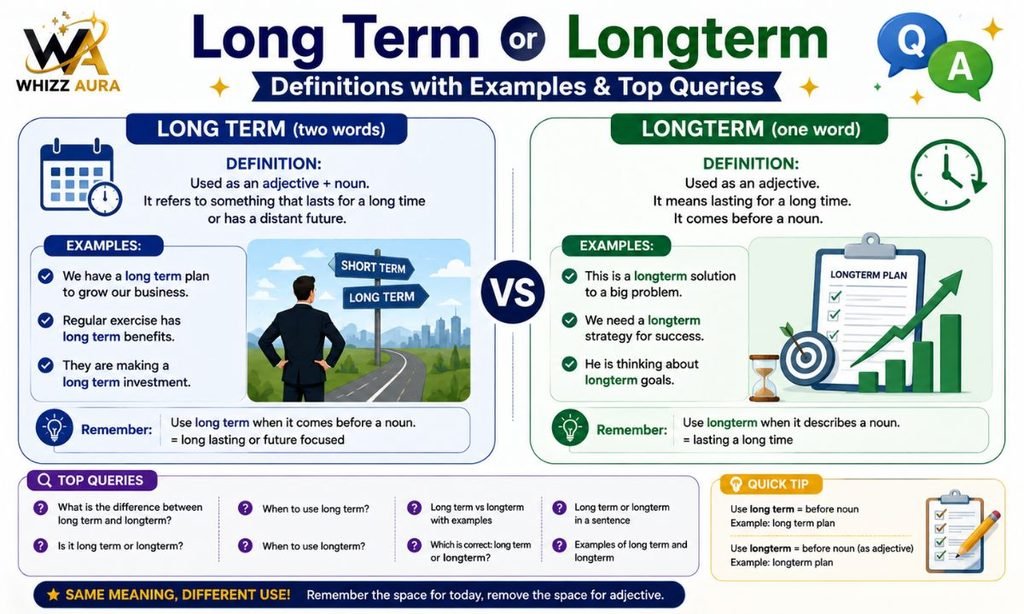
Long term (noun phrase): Refers to an extended period of time in the future.
- We need to think about the long term, not just next month.
- In the long term, this investment will pay off.
- Her health improved over the long term.
- The company focused on the long term instead of quick profits.
- Nothing changes overnight, but in the long term, habits matter.
Long-term (adjective): Describes something that lasts for or applies to an extended period.
- She has a long-term plan for her career.
- He is a long-term employee at the firm.
- They discussed long-term care options for their parents.
- The doctor prescribed a long-term treatment plan.
- Long-term parking is available near the airport.
Popular searches related to this topic include:
- Is “long term” one word or two?
- Long term vs long-term grammar rule
- How do you hyphenate long-term?
- Longterm spelling correct or incorrect?
- Long-term care meaning
British English vs American English Spelling 🇬🇧🇺🇸
This is one of those rare cases where British and American English agree completely. Both dialects treat “long term” as two words when used as a noun and “long-term” with a hyphen when used as an adjective.
| Feature | British English | American English |
| Noun form | long term | long term |
| Adjective form | long-term | long-term |
| One-word “longterm” | Not standard | Not standard |
Neither the Oxford English Dictionary nor Merriam-Webster lists “longterm” as an accepted single-word spelling.
My Memory Tricks and Tips
Here are three tricks that helped me lock this rule into memory for good.
- The Noun Test: If you can put “the” in front of it, like “the long term,” it stays as two words.
- The Hyphen Bridge: Picture the hyphen as a tiny bridge connecting “long” and “term” so they can safely walk together in front of a noun.
- The Twin Rule: Remember “short term” follows identical spacing rules. If you would never write “shortterm,” never write “longterm” either.
Long Term or Longterm: Which One Should You Use?
Use long term (two words) when:
- It follows a verb, like “plan for the long term.”
- It comes after a preposition, like “in the long term” or “over the long term.”
- It functions as the subject or object of a sentence.
Use long-term (hyphenated) when:
- It directly precedes a noun, like “long-term goals.”
- It describes a duration, condition, or plan as an adjective.
- It appears in compound phrases like “long-term care” or “long-term memory.”
Avoid longterm (one word) in almost every professional or academic context, since it is not recognized by major style guides.
Explore More Grammar Guides
In Person vs In Person: What’s the Difference? Meaning, Usage & Examples
Take Effect or Take Affect: What’s the Difference? Meaning, Usage & Examples
Carrer vs Career: What’s the Difference? Meaning, Usage & Examples
Defence or Defense: What’s the Difference? Meaning, Usage & Examples
You Too or You To: What’s the Difference? Meaning, Usage & Examples
Common Mistakes with Long Term or Longterm
Mistake 1: Merging the words together.
❌ Incorrect: We are focused on longterm growth.
✅ Correct: We are focused on long-term growth.
Mistake 2: Adding a hyphen when it is not needed.
❌ Incorrect: This plan works well in the long-term.
✅ Correct: This plan works well in the long term.
Mistake 3: Forgetting the hyphen before a noun.
❌ Incorrect: She has long term goals.
✅ Correct: She has long-term goals.
Long Term or Longterm in Everyday Examples
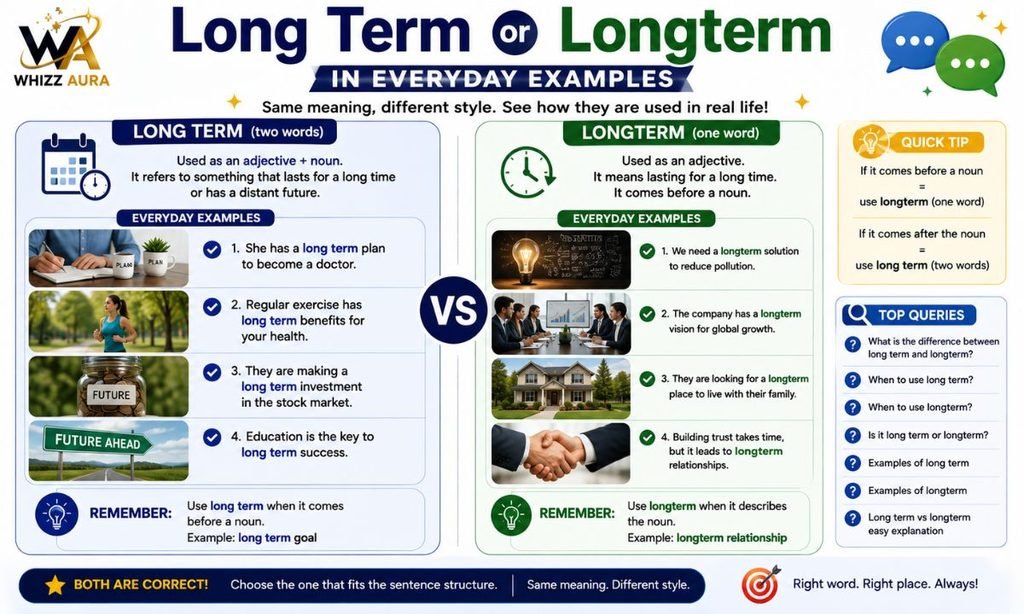
Texting: “Not sure yet, thinking long term tbh.”
Emails: “As discussed, our long-term strategy will focus on customer retention.”
Social Media: “Long-term goals over short-term wins. 💪 #consistency”
Business Writing: “The board approved a long-term investment plan for the next five years.”
Comparison Table: Long Term or Longterm
| Category | Long term (noun) | Long-term (adjective) |
| Part of speech | Noun phrase | Compound adjective |
| Used for | Standing alone in a sentence | Describing a noun directly |
| Example | “Think about the long term.” | “A long-term commitment.” |
| Memory hook | No noun follows, no hyphen | Noun follows, add hyphen |
Comparison Table: Long Term or Longterm (Quick Reference)
| Question to Ask | If Yes, Use |
| Does a noun come right after this phrase? | long-term |
| Does the phrase stand alone in the sentence? | long term |
| Am I describing a plan, goal, or condition? | long-term |
| Am I referring to a general future period? | long term |
Pro Tip I Learned
My favorite editing hack is reading my sentence out loud and asking, “What word comes next?” If a noun follows immediately, my ear naturally wants that quick, blended hyphenated sound. If nothing follows, my voice slows down and separates the words. Text-to-speech tools can help you catch this pattern too, since hearing your writing often reveals errors your eyes skip over.
Quick Test I Created: Long Term or Longterm Quiz
Fill in the blank with the correct form.
- We need a ______ solution to this problem.
- In the ______, this decision will pay off.
- She signed a ______ contract.
- Nothing lasts in the ______ without effort.
- He has ______ plans for the business.
- Over the ______, prices tend to rise.
- This is a ______ investment strategy.
- Their relationship became ______ after college.
- The doctor recommended ______ therapy.
- We are thinking about the ______ future.
- She wants ______ stability in her career.
- In the ______, patience always wins.
- This is a ______ parking option.
- He values ______ friendships over quick connections.
- The company’s ______ vision impressed investors.
- We discussed the ______ effects of the policy.
- Her ______ memory is impressive.
- In the ______, small habits matter most.
- They signed a ______ lease for the apartment.
- This plan works best in the ______.
Answer Key: 1. long-term, 2. long term, 3. long-term, 4. long term, 5. long-term, 6. long term, 7. long-term, 8. long-term, 9. long-term, 10. long term, 11. long-term, 12. long term, 13. long-term, 14. long-term, 15. long-term, 16. long-term, 17. long-term, 18. long term, 19. long-term, 20. long term
Frequently Asked Questions
Is “long term” one word or two?
“Long term” is two words when used as a noun, and it becomes hyphenated as “long-term” only when it functions as an adjective before a noun.
Is “longterm” ever correct?
No, “longterm” as a single word is not recognized by major style guides like AP or Merriam-Webster and should be avoided in formal writing.
When should I hyphenate long-term?
You should hyphenate it whenever it directly precedes and describes a noun, such as “long-term plan” or “long-term care.”
Does British English spell it differently than American English?
No, both British and American English use the same spacing and hyphenation rules for “long term” and “long-term.”
What is a simple trick to remember the rule?
Check if a noun immediately follows the phrase. If yes, add a hyphen; if the phrase stands alone, keep it as two separate words.
Conclusion
Getting “long term” and “long-term” right comes down to one simple habit: checking whether a noun follows the phrase. If it does, bridge the words with a hyphen. If it stands alone, let the two words breathe separately. And no matter the context, “longterm” as one solid word simply is not standard English.
This small grammar rule carries real weight in professional writing, resumes, and business communication. A misplaced hyphen or a merged word can make polished writing look careless, even when the ideas behind it are strong.

Shoaib Ahmad is an SEO and digital content professional with experience in creating helpful, easy-to-understand online content. At Whizz Aura, he focuses on English grammar, vocabulary, word meanings, sentence structure, and practical language tips. His goal is to make learning English simple, clear, and useful for everyday communication.





1 thought on “Long Term or Longterm: What’s the Difference? Meaning, Usage & Examples”