
You are typing an email. You get to a word about protecting something, defending a point, or talking about a legal case, and your fingers freeze. Is it “defence” or “defense”? You are not alone. This is one of the most Googled spelling questions in the English language, and it trips up native speakers just as often as learners.
The confusion is not really your fault. Both spellings are correct, just in different places. Getting it right matters more than you might think, especially if you write for a global audience, submit work to a specific publisher, or want your resume to look polished. This guide breaks down defence or defense so you never have to guess again.
Defence or Defense: Quick Answer 🎯
“Defense” is the American English spelling, and “defence” is the British English spelling. Both mean the same thing: the act of protecting against attack, criticism, or harm. Pick the version that matches your audience.
✅ Correct (American): The lawyer built a strong defense for her client.
✅ Correct (British): The lawyer built a strong defence for her client.
❌ Incorrect: Mixing both spellings in the same document, like writing “defence” in one paragraph and “defense” in the next.
Why I Found It’s Spelled / Used This Way?
The word traces back to the Old French “defens,” which itself came from the Latin verb “defendere,” meaning “to ward off” or “to guard.” When the word entered Middle English, it kept the French “-ence” ending, giving us “defence.”
Fast forward to the 1800s. American lexicographer Noah Webster wanted to simplify and standardize American spelling to set it apart from British English. He swapped many “-ence” endings for “-ense” to match the pronunciation more logically. That single decision is why Americans write “defense,” “offense,” and “license,” while the British keep “defence,” “offence,” and “licence.”
So this is not a random typo issue. It is a documented split between two established spelling systems, and both sides are 100% correct within their own dialect.
The Simple Rule for Stopping the Confusion
Here is a one-second mental test you can use every single time.
Ask yourself: “Am I writing for a British or American audience?” If British, use defence. If American, use defense. If unsure, default to American spelling, since it is the global default for most digital platforms, tech companies, and international business writing.
A quick swap trick: think of the “C” in “defence” as standing for “Commonwealth” (Britain, Canada informally, Australia, and others). Think of the “S” in “defense” as standing for “States” (the United States).
Pronunciation Guide I Use 🔊
Here is the twist: both spellings sound identical. The spelling changes, but your mouth does not.
| Word | Phonetic Spelling | Sound Focus |
| Defence | dih-FENS | Stress falls on the second syllable |
| Defense | dih-FENS | Stress falls on the second syllable |
Practical tip: Say the word out loud right now. Notice your tongue taps the roof of your mouth for the “n” sound, then your teeth almost touch for the “s” sound at the end. That final “s” sound never changes, no matter which spelling you use on paper.
Defence or Defense: Definitions with Examples & Top Queries
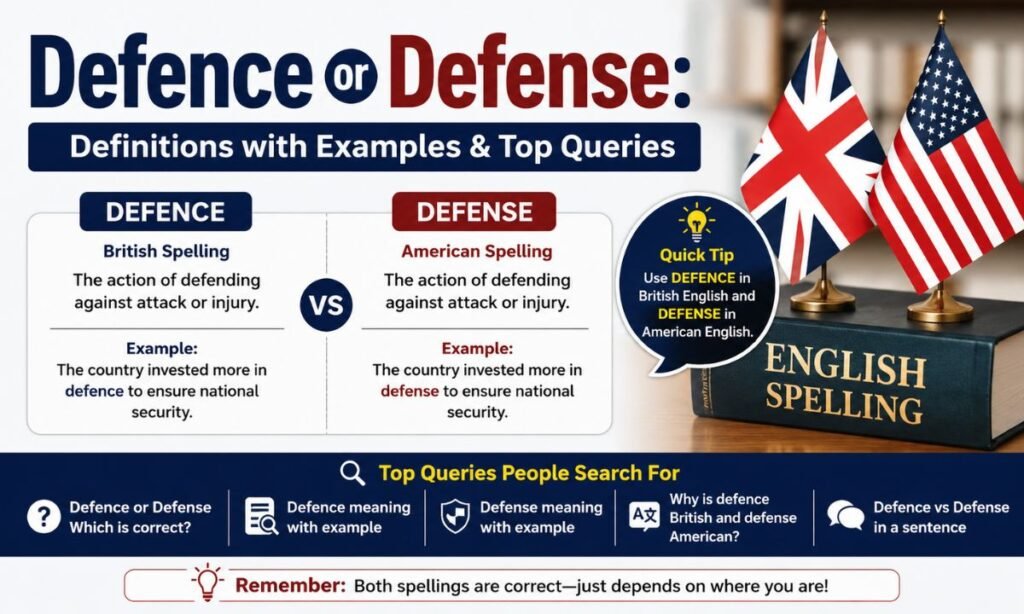
Both words function as nouns most of the time, though “defense” also appears in phrases as an adjective (like “defense attorney”).
Defence (British English)
Definition: The action of protecting someone or something from attack, criticism, or danger.
- The castle’s defence held strong for three months.
- Her defence of the new policy impressed the board.
- The team’s defence was the strongest in the league.
- He spoke in defence of his colleague during the meeting.
- The nation increased its defence budget this year.
Defense (American English)
Definition: The same meaning as “defence,” used exclusively in American English writing and speech.
- The lawyer prepared a solid defense for the trial.
- The soccer team needs a stronger defense this season.
- She wrote an essay in defense of remote work.
- The company invested in cyber defense tools.
- His defense mechanism kicked in during the argument.
Popular user queries related to this topic include:
- Is defence or defense correct in Canada?
- How do you spell defense in a resume?
- Defence vs defense pronunciation
- Which spelling does Microsoft Word autocorrect to?
- Self defence or self defense, which is right?
Explore More Grammar Guides
Transferred vs Transfered: What’s the Difference? Meaning, Usage & Examples
Cocoon or Cacoon: What’s the Difference? Meaning, Usage & Examples
Carrer vs Career: What’s the Difference? Meaning, Usage & Examples
Coaches vs Coachs: What’s the Difference? Meaning, Usage & Examples
Goodmorning or Good Morning: What’s the Difference? Meaning, Usage & Examples
British English vs American English Spelling 🇬🇧🇺🇸
This is not an isolated case. The “-ence” versus “-ense” pattern shows up across several related words, and it is a reliable rule you can apply beyond just this one term.
| Feature | British English | American English |
| Spelling | Defence | Defense |
| Related word: offense/offence | Offence | Offense |
| Related word: license/licence (noun) | Licence | License |
| Pronunciation | Identical | Identical |
| Used in | UK, Australia, India, most Commonwealth countries | United States, and often the Philippines |
My Memory Tricks and Tips
Here are three tricks that stick.
Trick 1: The “C is for Crown” rule. Britain has a monarchy, and “defence” has a “C.” Both start with royal-sounding letters, so let the “C” remind you of the Crown.
Trick 2: The “S is for Stars and Stripes” rule. American English uses “defense,” and America’s flag has stars. Both start with “S,” so “S” links to the “States.”
Trick 3: The replacement test. Swap in “offense” or “license.” If you naturally write those with an “s” because you are American, do the same with “defense.” Your brain already knows the pattern.
Defence or Defense: Which One Should You Use?
Use the spelling that matches your reader, not your personal habit.
- Use “defense” if you are writing for a US-based company, American publication, or US legal or academic audience.
- Use “defence” if you are writing for a UK, Australian, Indian, or other Commonwealth audience.
- Use “defense” if your software or website defaults to American English spellcheck.
- Use “defence” if your style guide specifically requests British spelling (common in UK universities and UK-based publishers).
- Stay consistent within a single document. Never switch between the two spellings midway through.
Common Mistakes with Defence or Defense
Mistake 1: Mixing spellings in one document.
❌ Incorrect: “Our defence strategy improved, and our defense budget grew.”
✅ Correct: “Our defence strategy improved, and our defence budget grew.”
Mistake 2: Assuming the pronunciation changes.
❌ Incorrect belief: “Defence is pronounced differently than defense.”
✅ Correct fact: Both words sound exactly the same when spoken aloud.
Mistake 3: Using the wrong spelling based on the wrong regional guess.
❌ Incorrect: Writing “defence” for a US-based legal brief.
✅ Correct: Writing “defense” for any American legal, business, or academic document.
Defence or Defense in Everyday Examples
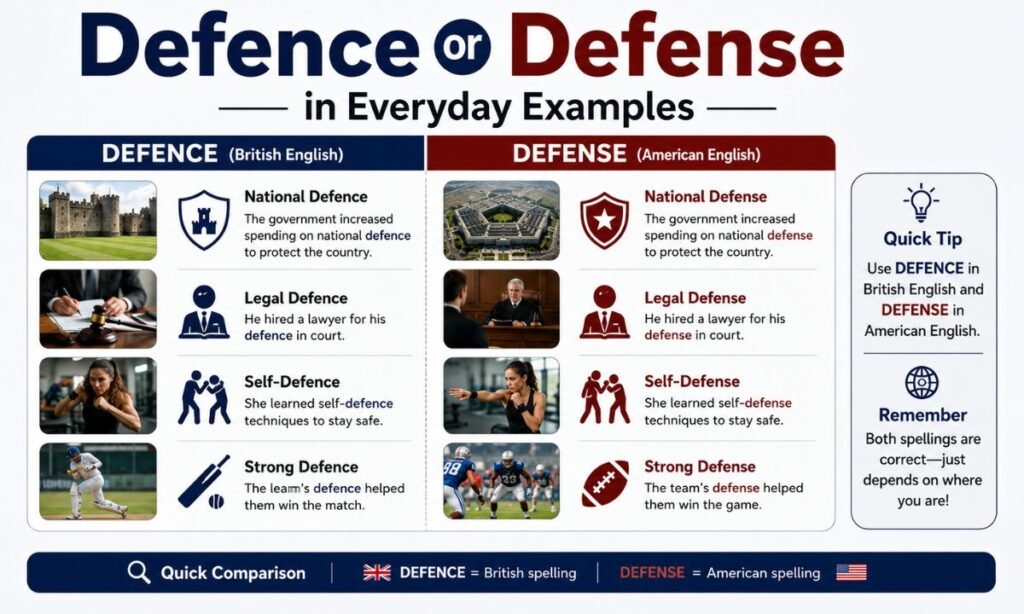
Texting: “lol my defense in that argument was weak, ngl”
Emails: “Please find attached our updated defense strategy for the Q3 review.”
Social Media: “Their defence in tonight’s match was next level. #Football”
Business Writing: “The compliance team recommends strengthening our cyber defense protocols before year end.
Comparison Table: Defence or Defense
| Category | Defence (British) | Defense (American) |
| Part of speech | Noun | Noun (also used adjectivally) |
| Used for | Protection, legal argument, sports | Protection, legal argument, sports |
| Example sentence | “The defence rested its case.” | “The defense rested its case.” |
| Memory hook | “C” for Crown / Commonwealth | “S” for States |
| Common region | UK, Australia, India | United States |
Comparison Table: Defence or Defense (Quick Reference)
| Question to Ask | If Yes → Use |
| Am I writing for a US audience? | Defense |
| Am I writing for a UK or Commonwealth audience? | Defence |
| Is my spellcheck set to American English? | Defense |
| Does my style guide require British spelling? | Defence |
| Am I unsure of my audience? | Defense (global default) |
Pro Tip I Learned 🛠️
One trick that saved me from constant embarrassment: read your document out loud using text-to-speech software before submitting it. Since “defence” and “defense” sound identical, your ears will not catch spelling inconsistencies. Instead, use your word processor’s “Find and Replace” tool to search for both spellings and confirm you used only one throughout the entire piece.
Quick Test I Created: Defence or Defense Quiz
Fill in the blank with the correct spelling based on the audience noted in parentheses.
- The team’s ______ was unbeatable this season. (American blog)
- She wrote a strong ______ of her thesis. (British academic paper)
- His lawyer built a solid ______ strategy. (US courtroom)
- The ______ budget increased sharply this year. (UK news article)
- Cyber ______ is now a top priority. (American tech company)
- The national ______ minister gave a speech. (British government)
- Her ______ mechanism was to stay quiet. (American psychology blog)
- The castle’s ______ crumbled after the siege. (British history book)
- Self ______ classes start next week. (American gym flyer)
- The football club hired a new ______ coach. (British sports site)
- The company’s ______ against the lawsuit failed. (US legal memo)
- He spoke in ______ of the new law. (British parliament)
- The nation’s ______ system was upgraded. (American military report)
- Her ______ of the artwork was passionate. (British art critic)
- The prosecutor challenged the ______ team. (US trial coverage)
- The ______ line held strong in the match. (British football commentary)
- Their cyber ______ tools stopped the hack. (American IT company)
- The professor praised her thesis ______. (British university)
- The ______ rested its case at noon. (US courtroom)
- The country boosted its ______ spending. (British news outlet)
Answer Key: (1. defense, 2. defence, 3. defense, 4. defence, 5. defense, 6. defence, 7. defense, 8. defence, 9. defense, 10. defence, 11. defense, 12. defence, 13. defense, 14. defence, 15. defense, 16. defence, 17. defense, 18. defence, 19. defense, 20. defence)
Frequently Asked Questions
Is defence or defense correct in Canada?
Canadian English typically uses “defence,” following British spelling conventions, though American influence means you may occasionally see “defense” in informal writing.
Does defence or defense sound different when spoken?
No, both words are pronounced exactly the same way, as “dih-FENS,” regardless of which spelling you use.
Which spelling should I use in a resume?
Use “defense” if applying to US-based companies, and “defence” if applying to UK, Australian, or other Commonwealth-based companies.
Why does Microsoft Word keep changing my spelling?
Your spellcheck language setting controls this. If it is set to English (US), it will autocorrect “defence” to “defense,” and you can change this in your language settings.
Is self defence or self defense the correct phrase?
Both are correct within their own dialects. Use “self-defense” for American audiences and “self-defence” for British audiences.
Conclusion
At the end of the day, the debate over defence or defense is not really a debate at all. Both spellings are correct, and the only thing that matters is matching your spelling to your audience. American writers reach for “defense,” while British and Commonwealth writers stick with “defence.”
Remember the simple tricks from this guide: “C” for Crown links to “defence,” and “S” for States links to “defense.” Keep your spelling consistent throughout any single piece of writing, and when in doubt, check your audience or your style guide before you hit publish.

Shoaib Ahmad is an SEO and digital content professional with experience in creating helpful, easy-to-understand online content. At Whizz Aura, he focuses on English grammar, vocabulary, word meanings, sentence structure, and practical language tips. His goal is to make learning English simple, clear, and useful for everyday communication.