
When people search for in person vs in person, they may expect to find two different spellings or grammatical forms. However, this comparison is unusual because both sides are written exactly the same way: in person. The real confusion usually comes from punctuation, capitalization, context, or the difference between in person and similar expressions such as in-person.
Getting this expression right matters because it is common in everyday conversations, emails, meetings, social media posts, and professional writing. Once you understand when to write in person as an adverbial phrase and when to use in-person as a compound adjective, the confusion becomes much easier to solve.
In Person vs In Person: Quick Answer 😊
Quick answer: There is no spelling difference between the two forms in in person vs in person. The standard phrase is in person, while in-person is normally hyphenated when it works as a compound adjective before a noun.
Correct: I want to meet you in person.
Correct: We scheduled an in-person meeting.
Incorrect: I want to meet you in-person.
Incorrect: We scheduled an in person meeting.
Why I Found It’s Spelled / Used This Way
The word person comes from Latin persona, meaning a person, character, or role. It entered English through Old French and developed into the modern English word person.
The expression in person gradually developed to mean that someone is physically present rather than represented by another person, a message, phone call, or digital communication.
English later began combining words into compound modifiers. That is why in-person appears before nouns in expressions such as in-person class, in-person interview, and in-person appointment. The meaning stays closely related, but the grammatical job changes.
The Simple Rule for Stopping the Confusion
Use this one-second test:
If “in person” tells how, where, or in what manner something happens, write “in person.” If it describes a noun immediately after it, “in-person” is usually the better choice.
Try the swap test:
- Meet face-to-face. → Meet in person.
- A face-to-face meeting. → An in-person meeting.
So, if the phrase stands after the verb, in person is usually correct. If it directly modifies a noun, use in-person.
Pronunciation Guide I Use
| Word/Phrase | Phonetic Spelling | Sound Focus |
| in | /ɪn/ | Short “ih” sound |
| person | /ˈpɜːr.sən/ | Stress the first syllable |
| in person | /ɪn ˈpɜːr.sən/ | Keep both words clear |
| in-person | /ˌɪn ˈpɜːr.sən/ | Connect the phrase smoothly |
A useful speaking tip is to say in person naturally without adding extra stress to in. Put your main emphasis on per in person.
When practicing, say: “I met her in person.” Then say: “It was an in-person meeting.” Hearing the difference in sentence structure can help reinforce the grammar.
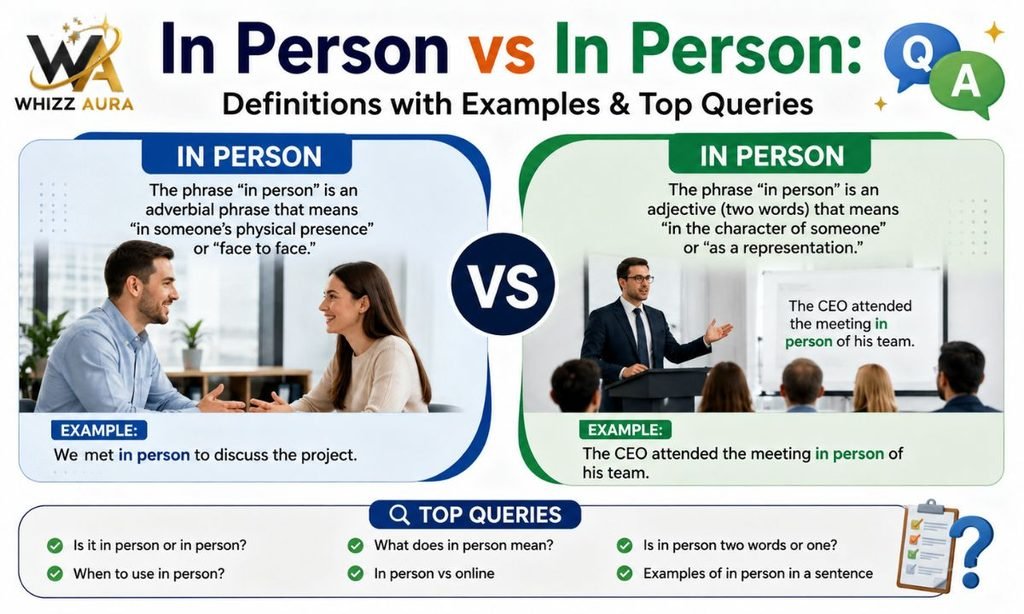
In Person vs In Person: Definitions with Examples & Top Queries
What Does “In Person” Mean?
In person is a phrase that means physically present or physically meeting someone rather than communicating through another method.
Part of speech: Adverbial phrase
Examples:
- I would rather discuss the project in person.
- She met her new manager in person yesterday.
- We need to verify your identity in person.
- They finally spoke in person after months of texting.
- I prefer shopping in person when I need to see the product.
What Does “In-Person” Mean?
In-person is generally a compound adjective used before a noun. It describes something that happens physically rather than online, by phone, or remotely.
Part of speech: Compound adjective
Examples:
- We have an in-person interview tomorrow.
- The company offers in-person training.
- She attended an in-person class.
- They arranged an in-person consultation.
- The school requires an in-person appointment.
Popular User Queries
- Is in person vs in person the same?
- Is it in person or in-person?
- Should in person be hyphenated?
- Is “in person” grammatically correct?
- When should I use “in-person”?
- Is “in-person meeting” correct?
- Do you say “meet in person” or “meet in-person”?
- Is in-person one word or two words?
British English vs American English Spelling
There is no major British-American spelling difference for in person. Both varieties use in person as a phrase and commonly use in-person as a compound modifier.
| Feature | British English | American English |
| Adverbial phrase | in person | in person |
| Compound adjective | in-person | in-person |
| Basic meaning | Physically present | Physically present |
| “Meet in person” | Correct | Correct |
| “In-person meeting” | Correct | Correct |
The key point is that the distinction is grammatical rather than regional. Whether you write American or British English, the same basic rule applies.
My Memory Tricks and Tips
1. The Noun Test
If a noun comes immediately after the expression, think in-person.
in-person interview
in-person meeting
in-person event
2. The Verb Test
If the phrase explains how an action happens, choose in person.
We talked in person.
She interviewed him in person.
3. The Face-to-Face Trick
Replace the phrase with face-to-face.
If it describes the action, use in person:
We talked face-to-face.
→ We talked in person.
If it describes a noun, use in-person:
A face-to-face meeting
→ An in-person meeting
in person vs in person: Which One Should You Use?
Use in person when:
- It follows an action verb.
- You mean physically present.
- You are describing how communication happens.
- You are contrasting physical contact with online communication.
- The phrase does not directly modify a noun.
Use in-person when:
- It directly describes a noun.
- You are writing phrases such as in-person meeting.
- You mean a physical rather than virtual event.
- The phrase functions as a compound adjective.
- Removing the noun would change the grammatical structure.
Explore More Grammar Guides
Transferred vs Transfered: What’s the Difference? Meaning, Usage & Examples
Cocoon or Cacoon: What’s the Difference? Meaning, Usage & Examples
Carrer vs Career: What’s the Difference? Meaning, Usage & Examples
Defence or Defense: What’s the Difference? Meaning, Usage & Examples
You Too or You To: What’s the Difference? Meaning, Usage & Examples
Common Mistakes with in person vs in person
Mistake 1: Hyphenating the Adverbial Phrase
Incorrect: I want to talk to you in-person.
Correct: I want to talk to you in person.
Here, in person follows the verb phrase and explains how the talking will happen.
Mistake 2: Leaving Out the Hyphen Before a Noun
Incorrect: We need an in person meeting.
Correct: We need an in-person meeting.
The hyphen helps show that in-person works together as one adjective modifying meeting.
Mistake 3: Treating “In Person” as One Word
Incorrect: I met her inperson.
Correct: I met her in person.
Inperson is not the standard spelling. The phrase consists of two separate words when it functions adverbially.
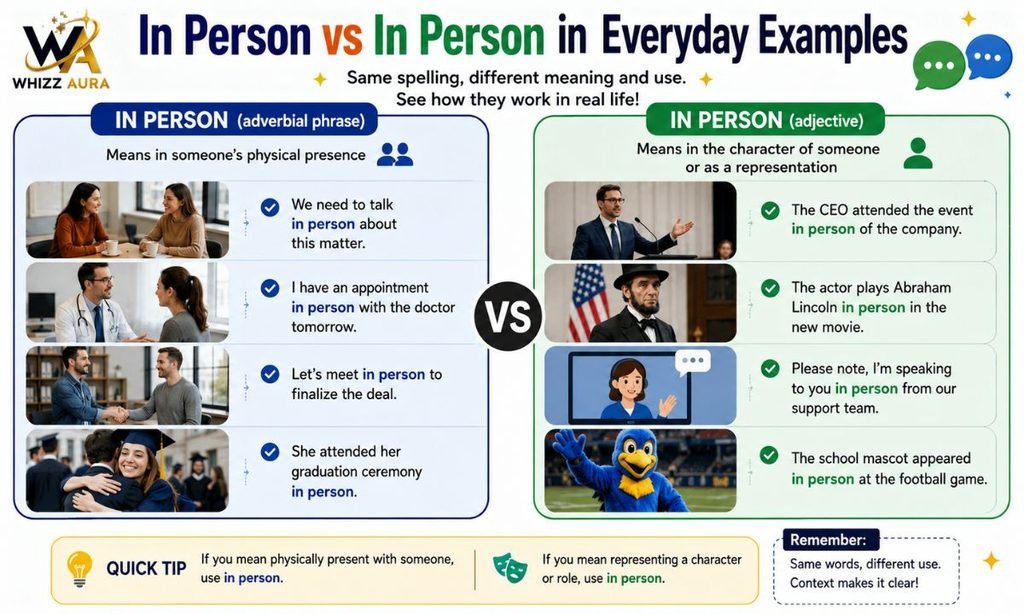
In Person vs In Person in Everyday Examples
Texting
“Can we talk in person?”
This means the speaker wants a face-to-face conversation rather than texting.
Emails
“I would be happy to discuss this issue in person.”
This sounds natural and professional in workplace communication.
Social Media
“Meeting my online friend in person was amazing!”
Here, in person explains how the meeting happened.
Business Writing
“The company offers both online and in-person consultations.”
Here, in-person directly modifies consultations, so the hyphen is appropriate.
Comparison Table: in person vs in person
| Category | In person | In-person |
| Part of speech | Adverbial phrase | Compound adjective |
| Used for | Describing an action or manner | Describing a noun |
| Typical position | Usually after a verb | Usually before a noun |
| Example | We met in person. | We had an in-person meeting. |
| Memory hook | How did it happen? | What kind of thing? |
Comparison Table: in person vs in person (Quick Reference)
| Question to Ask | If Yes → Use |
| Does it describe how an action happens? | in person |
| Does it follow a verb such as meet or talk? | in person |
| Does it directly modify a noun? | in-person |
| Is it before “meeting”? | in-person |
| Is it before “interview”? | in-person |
| Can you replace it with “face-to-face” after a verb? | in person |
| Is it describing an event, class, or consultation? | in-person |
Pro Tip I Learned
My fastest editing hack is to look at the word immediately after “in person.” If a noun comes right after it, check whether “in-person” should be hyphenated. If the phrase follows a verb and describes the action, keep the words separate.
Text-to-speech can also help. Read both versions aloud and listen to how the phrase functions in the entire sentence. The sound will not always reveal the punctuation, but the sentence structure usually will.
Quick Test I Created: in person vs in person Quiz
Fill in each blank with in person, in-person, or inperson.
- I would like to meet you ______.
- We have an ______ interview tomorrow.
- She prefers to speak ______.
- The company offers ______ training.
- They finally met ______.
- We scheduled an ______ appointment.
- Can we discuss this ______?
- He attended an ______ event.
- I need to see the doctor ______.
- The school offers both online and ______ classes.
- We talked ______ about the problem.
- She requested an ______ consultation.
- I hope we can meet ______ soon.
- They arranged an ______ meeting.
- Please verify your identity ______.
- The business provides ______ support.
- We discussed the contract ______.
- He applied for an ______ interview.
- I prefer communicating ______ for important matters.
- The company requires ______ attendance.
Answer Key: (1. in person, 2. in-person, 3. in person, 4. in-person, 5. in person, 6. in-person, 7. in person, 8. in-person, 9. in person, 10. in-person, 11. in person, 12. in-person, 13. in person, 14. in-person, 15. in person, 16. in-person, 17. in person, 18. in-person, 19. in person, 20. in-person)
Frequently Asked Questions
Is in person vs in person actually different?
No. In person is the standard two-word phrase, while in-person is a hyphenated compound adjective used before a noun.
Is it in person or in-person?
Use in person after a verb and in-person when it directly modifies a noun, such as in-person meeting.
Should I write “meet in person” or “meet in-person”?
Write meet in person because the phrase describes how the meeting occurs.
Is “in-person meeting” grammatically correct?
Yes. In-person meeting is correct because in-person functions as a compound adjective describing meeting.
Is “inperson” one word?
No. Inperson is not the standard form. Use in person or in-person, depending on the sentence.
Conclusion
The main lesson from in person vs in person is simple: there are not actually two different spellings of the phrase. In person is used when the expression functions as an adverbial phrase, while in-person is normally used as a compound adjective before a noun.
Remember the quick rule: “How did it happen?” means in person. “What kind of noun?” usually means in-person. For example, “We talked in person” is correct, while “We had an in-person meeting” is also correct.

Shoaib Ahmad is an SEO and digital content professional with experience in creating helpful, easy-to-understand online content. At Whizz Aura, he focuses on English grammar, vocabulary, word meanings, sentence structure, and practical language tips. His goal is to make learning English simple, clear, and useful for everyday communication.





5 thoughts on “In Person vs In Person: What’s the Difference? Meaning, Usage & Examples”