
Legal words trip people up all the time, and the suing or sueing question is one of the most common spelling stumbles in American English. You are trying to write a serious sentence about a lawsuit, your fingers hesitate over the keyboard, and suddenly that “e” feels like it might or might not belong.
Here is why it matters. If you are drafting an email to a lawyer, posting on social media about a dispute, or writing a school paper on civil law, a spelling slip can make your message look careless right when you need to sound credible. This guide clears up the suing or sueing confusion for good, with rules, examples, and memory tricks you will actually remember.
Suing or Sueing: Quick Answer
The correct spelling is “suing.” The word “sueing” is a common misspelling and is never correct in standard English.
✅ Correct: She is suing her landlord for the deposit.
❌ Incorrect: She is sueing her landlord for the deposit.
Whenever you are debating suing or sueing, remember that only one of these is a real word. “Suing” wins every time.
Why I Found It’s Spelled This Way?
English spelling rules explain exactly why “suing” drops the “e.” The verb comes from “sue,” which traces back to Old French suer or sivre, meaning to follow or pursue, and further back to Latin sequi, meaning to follow.
When you add “-ing” to a verb that ends in a silent “e,” standard spelling convention says you drop that final “e” before attaching the suffix. Think of “write” becoming “writing” or “hope” becoming “hoping.” The same rule applies to “sue,” so it becomes “suing,” not “sueing.”
This is not a random exception. It is one of the most consistent patterns in English grammar, which is exactly why “suing” is the version you see in newspapers, legal documents, and dictionaries.
The Simple Rule for Stopping the Confusion
Here is a one-second mental test you can use every time you face the suing or sueing dilemma.
💡 Quick Tip: Take the base verb “sue.” Drop the silent “e” at the end. Add “-ing.” You get “suing.” Done.
If you ever forget, just picture other silent-e verbs you already know how to spell correctly, like “use” becoming “using” or “cue” becoming “cuing.” “Sue” follows the exact same pattern, so “suing” is the only logical result.
Pronunciation Guide I Use
Getting the spelling right is only half the battle. Saying it correctly helps cement the spelling in your memory too.
| Word | Phonetic Spelling | Sound Focus |
| Suing | SOO-ing | Long “oo” sound blends smoothly into “ing” |
| Sueing (incorrect) | Not a real word | N/A, this spelling does not exist |
When you say “suing” out loud, notice your mouth stays rounded through the “oo” sound and then relaxes for the “ing.” There is no separate “eh” sound in the middle, which is a helpful clue that the “e” does not belong in the spelling either.
Suing or Sueing: Definitions with Examples & Top Queries
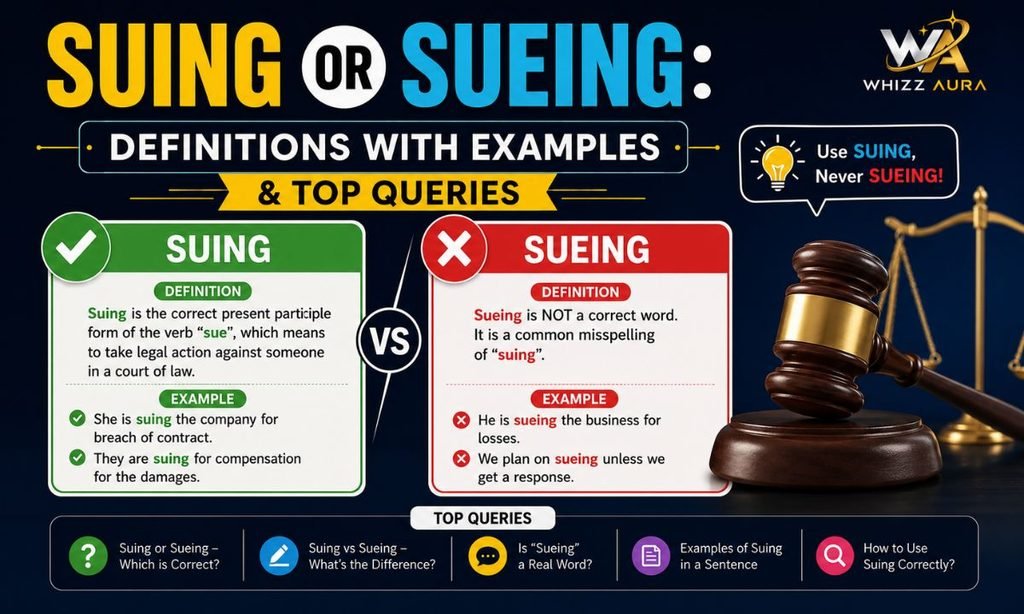
Since “sueing” is not a legitimate word, this section focuses on “sue” and its correct form “suing,” so you understand exactly how to use them.
Sue (verb, base form) means to take legal action against a person or organization, usually to seek money or another remedy through the court system.
- I plan to sue the company for false advertising.
- They decided not to sue after reaching a settlement.
- You cannot sue someone without solid evidence.
- The tenant threatened to sue over unsafe living conditions.
- Small businesses often sue to protect their trademarks.
Suing (verb, present participle) is the ongoing or continuous form of “sue,” used with helping verbs like “is,” “are,” or “was.”
- She is suing her former employer for wrongful termination.
- They are suing the manufacturer over a defective product.
- He was suing his neighbor over the property line.
- The city is suing several contractors for breach of contract.
- We are suing to recover the money we lost.
People searching for suing or sueing online often type in these related questions:
- Is it suing or sueing?
- How do you spell suing correctly?
- What does suing someone mean?
- Can you sue for emotional distress?
- How long does a sueing process take?
British English vs American English Spelling
Good news here: the suing or sueing spelling question has the same answer in both dialects. “Suing” is correct in British English and American English alike.
| Feature | British English | American English |
| Correct spelling | Suing | Suing |
| Common misspelling | Sueing | Sueing |
| Pronunciation | SOO-ing | SOO-ing |
| Usage in legal writing | Standard | Standard |
Unlike words such as “colour” versus “color,” there is no regional variation for this particular term. “Suing” is universal.
Explore More Grammar Guides
Lable or Label: What’s the Difference? Meaning, Usage & Examples
Persue or Pursue: What’s the Difference? Meaning, Usage & Examples
Long Term or Longterm: What’s the Difference? Meaning, Usage & Examples
As Well or Aswell: What’s the Difference? Meaning, Usage & Examples
Its Called vs It Called: What’s the Difference? Meaning, Usage & Examples
My Memory Tricks and Tips
These three tricks make the suing or sueing spelling stick for good.
🧠 Trick 1: The “Use” Twin. “Sue” rhymes with “use.” Just like “using” drops the e, “suing” drops the e too. If you can spell “using,” you can spell “suing.”
🧠 Trick 2: No Double Vowel Rule. Real English words rarely stack “u-e-i” together in that order. Seeing “sueing” should visually look wrong, almost like a typo, because it breaks a pattern your brain already knows.
🧠 Trick 3: The Silent E Goodbye. Picture the silent “e” waving goodbye whenever “-ing” walks in the door. “Sue” waves bye to its “e,” and “suing” walks out the other side.
Suing or Sueing: Which One Should You Use?
Since only one of these spellings is real, the choice is simple once you know the rule.
- Use “sue” when describing the basic action, as in “I will sue.”
- Use “suing” when describing an ongoing or continuous action, as in “I am suing.”
- Use “sued” when describing a completed past action, as in “I sued last year.”
- Never use “sueing” in any context, formal or informal, because it is not a standard English word.
Common Mistakes with Suing or Sueing
Here are three specific errors people make when writing about legal action.
Mistake 1: Adding the extra “e” before “-ing.”
❌ Incorrect: They are sueing the company.
✅ Correct: They are suing the company.
Mistake 2: Confusing “sue” with “sew.”
❌ Incorrect: She is going to sew the restaurant for the injury.
✅ Correct: She is going to sue the restaurant for the injury.
Mistake 3: Misusing “suit” instead of “sue” as a verb.
❌ Incorrect: He wants to suit his boss.
✅ Correct: He wants to sue his boss. (You file a “lawsuit,” but the verb is “sue.”)
Suing or Sueing in Everyday Examples
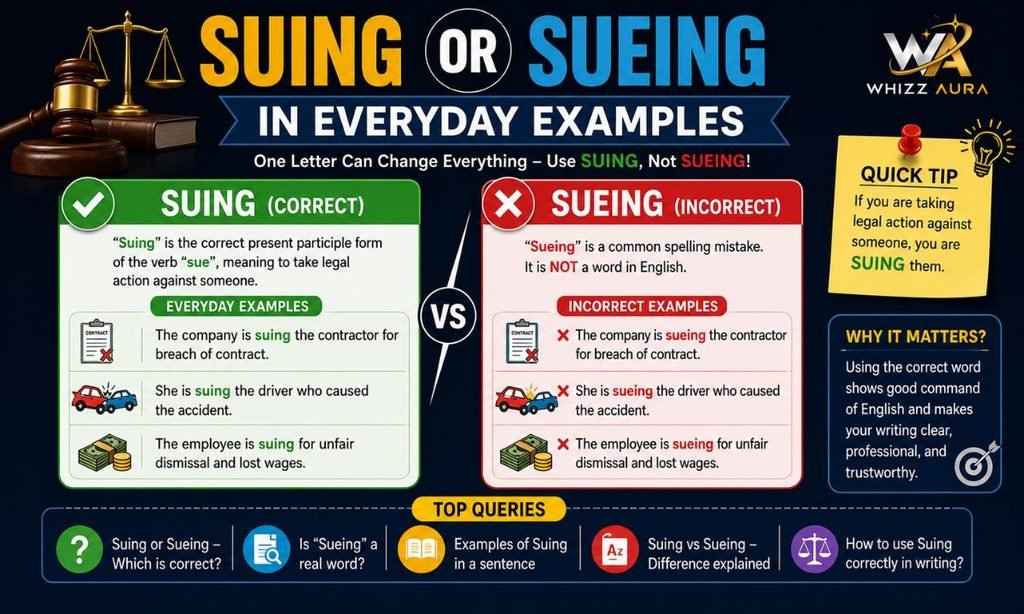
Texting: “omg he’s actually suing them lol good”
Emails: “Please be advised that our client is suing your company for breach of contract, effective immediately.”
Social Media: “Just heard the influencer is suing her old manager over unpaid royalties. 👀”
Business Writing: “Our legal team recommends suing the vendor for failure to deliver goods as outlined in the signed agreement.”
Comparison Table: Suing or Sueing
| Category | Suing (Correct) | Sueing (Incorrect) |
| Part of speech | Verb, present participle | Not a real word |
| Used for | Ongoing legal action | Never used correctly |
| Example | She is suing the company. | She is sueing the company. |
| Memory hook | Drop the e, just like “using” | No memory hook needed, it is simply wrong |
Comparison Table: Suing or Sueing (Quick Reference)
| Question to Ask | If Yes, Use |
| Are you describing an ongoing legal action? | Suing |
| Are you unsure how to spell the base verb? | Sue |
| Are you tempted to keep the silent “e” before “-ing”? | Drop it, use Suing |
| Are you writing “sueing” anywhere in your draft? | Stop and correct it to Suing |
Pro Tip I Learned
🎧 Editing Hack: Turn on text-to-speech and listen to your sentence out loud. If the software stumbles or mispronounces “sueing,” that is your signal something is off. Real words flow smoothly through text-to-speech tools, and “suing” always does.
Quick Test I Created: Suing or Sueing Quiz
Fill in each blank with the correct word: sue, sues, sued, or suing.
- She is __________ her old employer.
- They __________ him for damages last year.
- He wants to __________ the airline.
- We are __________ over the broken contract.
- The company __________ its competitor regularly.
- I might __________ if this continues.
- She __________ them in 2023.
- Are you __________ the landlord?
- He __________ everyone who wrongs him.
- They are __________ for a full refund.
- The lawyer said we could __________ tomorrow.
- He was __________ his neighbor for months.
- She decided to __________ after the accident.
- The city is __________ three contractors.
- We __________ them successfully last spring.
- Is he still __________ his business partner?
- They will __________ if the issue is not resolved.
- I am __________ for lost wages.
- He __________ the hospital for malpractice.
- Are they __________ the right people?
(Answer Key: 1. suing, 2. sued, 3. sue, 4. suing, 5. sues, 6. sue, 7. sued, 8. suing, 9. sues, 10. suing, 11. sue, 12. suing, 13. sue, 14. suing, 15. sued, 16. suing, 17. sue, 18. suing, 19. sued, 20. suing)
Frequently Asked Questions
Is it suing or sueing?
The correct spelling is suing. “Sueing” is a common misspelling that does not appear in any standard English dictionary.
How do you spell the present tense of sue?
The present participle of “sue” is spelled suing, formed by dropping the silent “e” before adding “-ing.”
Why do people misspell suing as sueing?
Many writers assume the silent “e” should stay before “-ing,” but standard English spelling rules require dropping it, similar to “use” becoming “using.”
Is sueing ever correct in British English?
No, “sueing” is incorrect in both British and American English. The word “suing” is the only accepted spelling in every English-speaking region.
What is the past tense of sue?
The past tense of “sue” is sued, used for completed legal actions such as “She sued the company last year.”
Conclusion
The suing or sueing debate has a clean, simple answer: “suing” is correct, and “sueing” is not a real word in any form of English. This comes down to one of the most reliable spelling rules in the language, where silent “e” verbs drop that final letter before adding “-ing.”
Whether you are writing a legal email, a text to a friend, or a business report, using “suing” correctly signals attention to detail and builds trust with your reader. Small spelling choices like this one add up to a stronger, more polished writing style overall.

Shoaib Ahmad is an SEO and digital content professional with experience in creating helpful, easy-to-understand online content. At Whizz Aura, he focuses on English grammar, vocabulary, word meanings, sentence structure, and practical language tips. His goal is to make learning English simple, clear, and useful for everyday communication.





1 thought on “Suing or Sueing: What’s the Difference? Meaning, Usage & Examples”