
Have you ever typed “guidence” into an email, paused, and thought something looked off? You are not alone. This is one of the most common spelling mix ups in professional and everyday English, and it trips up native speakers just as often as English learners.
The confusion usually comes down to sound. Many English words that end in the “-ance” sound are actually spelled with different endings, like “-ence,” “-ence,” or “-ance,” depending on their Latin roots. Since “guidance” sounds like it could end either way, people guess, and they often guess wrong.
Getting this right matters more than you might think. A misspelled word like “guidence” in a resume, business email, or school paper can quietly signal carelessness, even if your ideas are excellent. This guide breaks down exactly why “guidance” is correct, why “guidence” is not a real word, and how to lock in the right spelling for good.
Guidance vs Guidence: Quick Answer
“Guidance” is the only correct spelling. It is a noun that means help, advice, or direction. “Guidence” is simply a common misspelling and is not a recognized word in any English dictionary.
Correct: She asked her teacher for guidance on the assignment. Incorrect: She asked her teacher for guidence on the assignment.
Correct: The manual provides step-by-step guidance. Incorrect: The manual provides step-by-step guidence.
Why I Found It’s Spelled This Way
“Guidance” comes from the verb “guide,” which traces back to Old French “guider” and further back to a Germanic root related to showing the way or leading. When English speakers added the noun-forming suffix to “guide,” they used “-ance,” a common ending borrowed from French and Latin patterns used to turn verbs into nouns.
You can see the same pattern in other words built from a base verb plus “-ance,” such as “assist” becoming “assistance” and “perform” becoming “performance.” Because “guide” already ends in a hard consonant sound before adding the suffix, “guidance” follows the standard “-ance” pattern rather than the “-ence” pattern used in words like “existence” or “reference.”
There is no historical version, dialect, or older spelling where “guidence” was ever considered correct. It is purely a modern misspelling that happens because “-ance” and “-ence” sound nearly identical when spoken quickly.
The Simple Rule for Stopping the Confusion
Here is a fast mental test you can use every time.
Think of the word “guide.” You already know how to spell that correctly. Simply add “ance” to the end: guide plus ance equals guidance.
Quick tip: If you can spell the base word “guide” correctly, you can always rebuild “guidance” correctly by adding “ance,” never “ence.”
This trick works because “guidance” is a direct extension of “guide,” not a separate vocabulary word you need to memorize from scratch.
Pronunciation Guide I Use
Both words, if “guidence” were real, would sound almost identical when spoken. That overlap in sound is exactly why the misspelling happens so often.
| Word | Phonetic Spelling | Sound Focus |
| Guidance (correct) | GAHY-duhns | Focus on the soft “duhns” ending, not “dens” |
| Guidence (incorrect) | Not a real word | N/A, this spelling does not exist |
Mouth movement tip: When you say “guidance” out loud, notice your mouth barely opens for the final syllable. It is a quick, relaxed “-unce” sound, not a sharp “-ence” sound like in “sentence.” Practicing this out loud can help your brain connect the correct sound to the correct spelling.
Guidance vs Guidence: Definitions with Examples & Top Queries
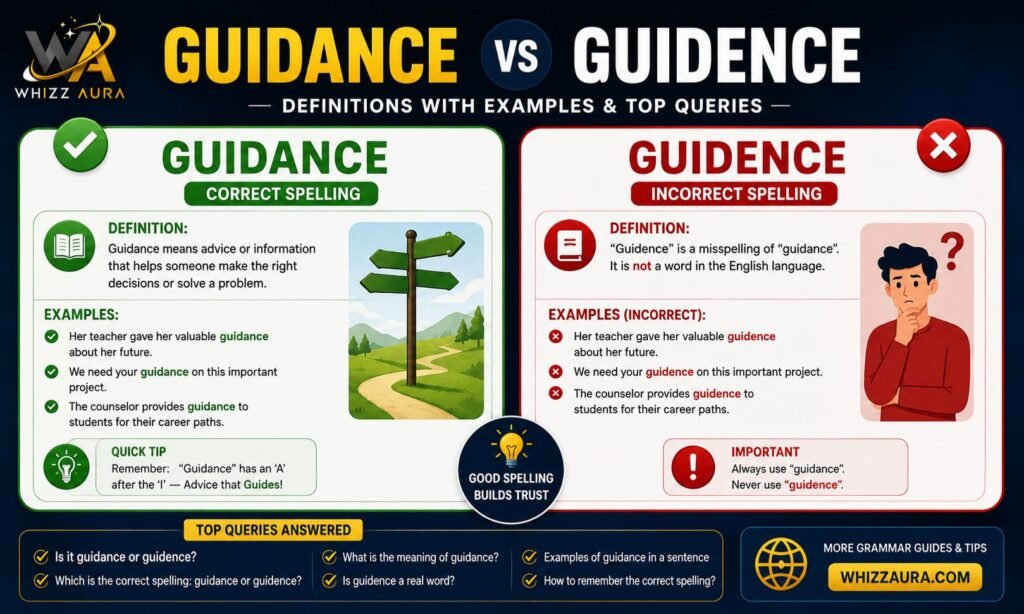
Guidance (noun): Help, advice, or direction given to someone, especially to help them make a decision or solve a problem.
Five example sentences using “guidance”:
- New employees receive guidance from a mentor during their first month.
- I always appreciate my sister’s guidance when I’m feeling stuck.
- The GPS app gives turn-by-turn guidance during the drive.
- Parents play a huge role in providing guidance to their children.
- The counselor’s guidance helped him choose the right college.
Guidence is not a word. It has no definition, no part of speech, and no accepted use in any English dictionary. It should always be corrected to “guidance.”
Popular user queries related to this topic include:
- Is “guidence” a real word?
- How do you spell guidance correctly?
- Guidance vs guidence, which is right?
- What is the plural of guidance?
- Guidance meaning in a sentence
British English vs American English Spelling
Good news here: this spelling is identical across British and American English. There is no regional variation for this word, unlike words such as “color” versus “colour.”
| Feature | British English | American English |
| Correct spelling | Guidance | Guidance |
| Common misspelling | Guidence | Guidence |
| Pronunciation | GAHY-duhns | GAHY-duhns |
| Meaning | Help or advice | Help or advice |
No matter which side of the Atlantic you are writing for, “guidance” is always the correct choice.
My Memory Tricks and Tips
Here are three simple tricks to help the correct spelling stick in your memory for good.
- The “Guide” Trick: Remember that “guidance” always starts with the word “guide” fully intact. If you can spell “guide,” you can spell “guidance.”
- The “A” for “Advice” Trick: Both “guidance” and “advice” contain the letter “A” as their key vowel sound near the ending. Linking these two related words in your mind reinforces the “-ance” spelling.
- The Replacement Test: Swap in a word you already know follows this pattern, like “assistance.” If “assistance” ends in “-ance,” so does “guidance.” They follow the exact same building pattern.
Pro tip from Clara: I tell my students to picture a tour guide holding a map. The guide gives you guidance. Same root word, same spelling family.
Guidance vs Guidence: Which One Should You Use?
Since only one of these is a real word, the choice is always simple.
- Use guidance any time you mean advice, direction, or help toward a decision.
- Use guidance in professional writing, emails, resumes, and academic papers.
- Use guidance in phrases like “career guidance,” “parental guidance,” or “guidance counselor.”
- Never use guidence in any context. It is always a spelling error and should be corrected.
Explore More Grammar Guides
Annually Vs Annualy: What’s the Difference? Meaning, Usage & Examples
Organizing vs Organising: What’s the Difference? Meaning, Usage & Examples
Tomorrow vs Tommorow: What’s the Difference? Meaning, Usage & Examples
Leaped vs Leapt: What’s the Difference? Meaning, Usage & Examples
Common Mistakes with Guidance vs Guidence
Mistake 1: Confusing the ending sound
Incorrect: I need some guidence on this project.
Correct: I need some guidance on this project.
Mistake 2: Autocorrect not catching it in casual typing
Incorrect: Thanks for your guidence, it really helped.
Correct: Thanks for your guidance, it really helped.
Mistake 3: Misspelling it in formal titles
Incorrect: She works as a guidence counselor at the school.
Correct: She works as a guidance counselor at the school.
Guidance vs Guidence in Everyday Examples
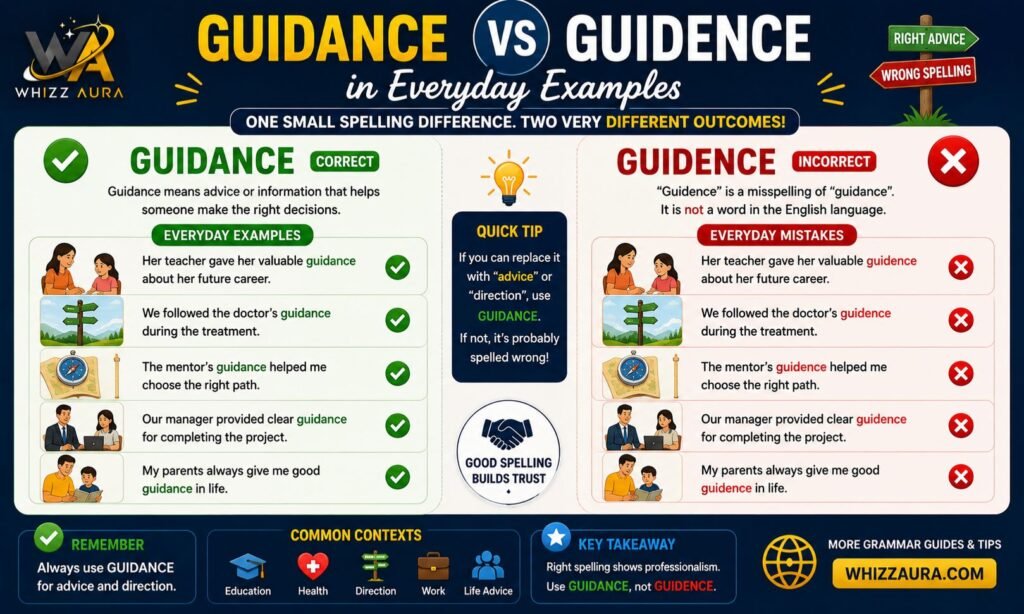
Texting: “Hey, can you give me some guidance on what to wear tonight?”
Emails: “Thank you for your guidance during the onboarding process. I feel much more confident in my new role.”
Social Media: “Grateful for the guidance from my mentors this year. Couldn’t have grown without them.”
Business Writing: “Please provide guidance on the next steps for the Q3 budget proposal before Friday’s meeting.”
Comparison Table: Guidance vs Guidence
| Category | Guidance (Option A) | Guidence (Option B) |
| Part of speech | Noun | Not applicable, not a real word |
| Used for | Advice, direction, or help | Never, this spelling is always incorrect |
| Example sentence | The coach gave clear guidance before the game. | Not used in correct English |
| Memory hook | Starts with “guide” plus “ance” | Remember this spelling does not exist |
Comparison Table: Guidance vs Guidence (Quick Reference)
| Question to Ask | If Yes, Use |
| Am I talking about advice or direction? | Guidance |
| Am I unsure how to end the word? | Guidance, always “-ance” |
| Did autocorrect suggest “guidence”? | Ignore it and type Guidance |
| Am I writing “guidance counselor”? | Guidance |
| Is there ever a correct use for “guidence”? | No, always use Guidance |
Pro Tip I Learned
One editing hack that has saved me countless times is reading my writing out loud slowly, syllable by syllable. When I hit a word like “guidance,” slowing down forces my brain to actually process the spelling instead of skimming past a typo. Text-to-speech tools work well too, since hearing the word separately from typing it can help you catch mistakes your eyes might miss.
Quick Test I Created: Guidance vs Guidence Quiz
Fill in the blank with the correct word.
- I need some ______ on choosing a career path.
- The ______ counselor met with every senior student.
- Thank you for your ______ during my first week.
- Parental ______ is required for this movie.
- Please offer ______ on how to fix this issue.
- Her ______ helped me pass the exam.
- The app provides ______ for new users.
- We appreciate your continued ______ and support.
- He sought professional ______ before investing.
- The manual lacked clear ______ for beginners.
- My mentor’s ______ changed my career direction.
- The team needed ______ to finish the project on time.
- Without proper ______, the project failed.
- The pilot followed radar ______ during landing.
- Students often need extra ______ during exam season.
- The therapist offered gentle ______ throughout the session.
- New hires receive ______ from their supervisors.
- I always trust my father’s ______ on big decisions.
- The website offers ______ for small business owners.
- Clear ______ can prevent costly mistakes.
(Answer key: All twenty blanks should be filled with “guidance.” There is no correct instance of “guidence” in standard English.)
Frequently Asked Questions
Is “guidence” a real word?
No, “guidence” is not a real word in any English dictionary. It is a common misspelling of “guidance.”
How do you spell guidance correctly?
The correct spelling is “guidance,” built from the word “guide” plus the suffix “ance.”
What does guidance mean in a sentence?
Guidance means help, advice, or direction given to someone, such as “She offered guidance on how to improve the report.”
Is guidance spelled the same in British and American English?
Yes, “guidance” is spelled identically in both British English and American English with no regional variation.
Why do people misspell guidance as guidence?
People misspell it because the “-ance” and “-ence” endings sound almost identical when spoken, leading to guesswork when typing.
Conclusion
When it comes to guidance vs guidence, there is really only one winner. “Guidance” is the correct, dictionary approved spelling, while “guidence” is simply a spelling mistake that shows up often because of how similar the ending sounds to “-ence” words.
The easiest way to remember it for good is to think of the base word “guide” and simply add “ance.” Whether you are writing a text message, a business email, or a school essay, sticking to this one simple rule will keep your writing polished and accurate every time.

Shoaib Ahmad is an SEO and digital content professional with experience in creating helpful, easy-to-understand online content. At Whizz Aura, he focuses on English grammar, vocabulary, word meanings, sentence structure, and practical language tips. His goal is to make learning English simple, clear, and useful for everyday communication.