
Have you ever typed a sentence, stared at it, and thought “wait, is that right?” You’re not alone. The phrase its called vs it called trips up even careful writers because English loves to sneak tiny words into big traps. One letter can shift the whole meaning of a sentence, and apostrophes are some of the sneakiest culprits in the language.
Here’s why this matters more than you might think. If you’re writing an email to a client, a caption for social media, or a school essay, a mixed-up “its” and “it’s” can make you look careless, even if your ideas are sharp. Getting this right isn’t about being a grammar snob. It’s about making sure your reader understands you the first time, without stumbling over a typo that wasn’t supposed to be there.
Its Called vs It Called: Quick Answer 🎯
Quick Answer: “It’s called” is the grammatically correct phrase you use when introducing a name or label (short for “it is called”). “Its called” is a common misspelling, and “it called” is only correct in specific situations, like describing a past action where something (an animal, a phone, a person) made a call.
✅ Correct: This dish is called lasagna. / It’s called a “sonnet.”
❌ Incorrect: This dish its called lasagna.
✅ Correct: The bird called from the treetop.
❌ Incorrect: The bird’s called from the treetop. (when describing an action, not a label)
💡 Quick Tip: If you can replace the word with “it is” and the sentence still makes sense, you need the apostrophe. If not, drop it.
Why I Found It’s Spelled / Used This Way?
English apostrophes trace back to Old and Middle English contractions, where scribes started squishing two words together to speed up writing and speech. “It is” became “it’s” the same way “do not” became “don’t.”
The confusing part is that possession usually does use an apostrophe, like in “the dog’s bone.” But its (no apostrophe) is a pronoun, just like “his,” “hers,” and “theirs,” and none of those get an apostrophe either. Grammarians settled on this rule centuries ago specifically to separate possessive pronouns from contractions, even though it feels inconsistent at first glance.
Meanwhile, “called” on its own is simply the past tense of the verb “to call.” When you say “it called,” you’re describing an action that already happened, like a phone ringing or an animal making a sound.
The Simple Rule for Stopping the Confusion
Here’s a one-second mental test you can run every single time.
Say the sentence out loud and mentally expand “it’s” into “it is.”
If the sentence still makes sense, use the apostrophe. If it sounds wrong or clunky, drop the apostrophe and use “its.”
💡 Try this: “It’s called a hurricane” becomes “It is called a hurricane.” That works, so the apostrophe stays. “The engine lost its power” becomes “The engine lost it is power.” That’s nonsense, so no apostrophe.
This single swap test solves about 95% of the confusion around its called vs it called in everyday writing.
Pronunciation Guide I Use
Even though “its,” “it’s,” and “it called” look different on paper, they sound almost identical when spoken quickly. That’s actually part of why people mix them up in writing.
| Word/Phrase | Phonetic Spelling | Sound Focus |
| Its | /ɪts/ | Short, single sharp “its” sound, like “bits” |
| It’s | /ɪts/ | Same sound as “its,” but mentally means “it is” |
| It called | /ɪt kɔːld/ | Two distinct beats: “it” then “called” |
Mouth-movement tip: When you say “it’s” or “its,” your tongue taps the roof of your mouth once for the “t” sound and releases quickly into the “s.” For “it called,” you’ll notice a small pause between the words, almost like two separate breaths, because they’re two separate words doing two separate jobs.
Its Called vs It Called: Definitions with Examples & Top Queries
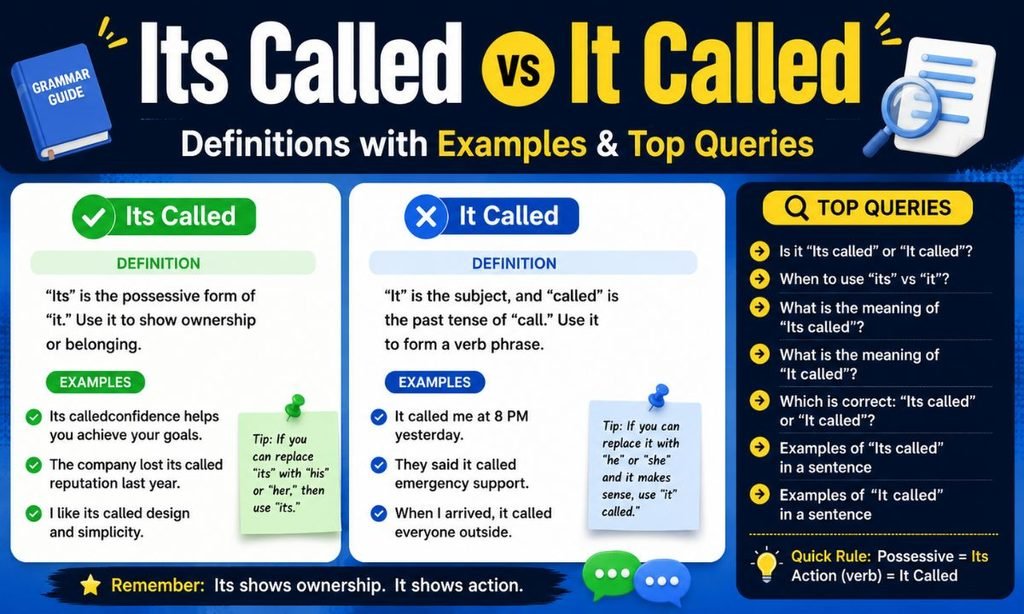
Let’s break down each term completely so there’s zero confusion left.
“It’s called” is a contraction of “it is called.” It’s used to introduce a name, term, or label for something. The word “called” here acts as a passive verb form (part of speech: verb phrase, passive voice).
Five example sentences:
- It’s called a “google” when you search something online.
- This flower is beautiful. It’s called a peony.
- In cooking, it’s called deglazing when you add liquid to a hot pan.
- It’s called the golden hour, right before sunset.
- That move in basketball? It’s called a crossover.
“It called” uses “called” as a simple past-tense verb (part of speech: verb, past tense) describing an action that “it” (a thing, animal, or entity) performed.
Five example sentences:
- The phone rang twice, then it called again.
- The dog barked once, and it called out to the others.
- My computer glitched, but it called the update server anyway.
- The whale surfaced, and it called across the water.
- The system failed, but it called for backup automatically.
Popular queries people search related to this topic include:
- “its called or it’s called grammar”
- “is it its called or it’s called”
- “the bird its called or it’s called”
- “difference between its and it’s called”
- “its called vs it’s called examples”
British English vs American English Spelling
Good news here: this one is identical across both dialects. Its called vs it called rules don’t change whether you’re writing in London or Los Angeles.
The apostrophe rule for “its” versus “it’s” is a universal English grammar rule, not a regional spelling variant like “colour” versus “color.”
| Feature | British English | American English |
| Possessive form | Its (no apostrophe) | Its (no apostrophe) |
| Contraction form | It’s (with apostrophe) | It’s (with apostrophe) |
| Verb phrase “it called” | It called | It called |
My Memory Tricks and Tips
Over years of editing, I’ve collected a few tricks that actually stick in people’s heads.
Trick 1: The “His, Hers, Its” Family Rule Possessive pronouns like “his” and “hers” never get an apostrophe, and “its” belongs to that same family. If you wouldn’t write “hi’s” or “her’s,” don’t write “it’s” for possession.
Trick 2: The Expansion Test Every time you’re unsure, expand it. “It’s” always means “it is” or “it has.” If the sentence breaks when you expand it, you need “its” instead.
Trick 3: The A-I-T Acronym Remember: Apostrophe Is Two words. The apostrophe in “it’s” signals that two words got squished together. No apostrophe means one single possessive word.
Its Called vs It Called: Which One Should You Use?
Use “it’s called” when:
- You’re naming or labeling something for the first time
- You’re explaining a term, product, or phenomenon
- You could naturally say “it is called” in the sentence
Use “it called” when:
- You’re describing a past action performed by a thing, animal, or entity
- The sentence needs a simple past-tense verb, not a naming phrase
- You could naturally say “it did something” in the sentence
Use “its” (no apostrophe) when:
- You’re showing possession or ownership by a non-human thing
- The word directly precedes a noun, like “its color” or “its purpose”
Explore More Grammar Guides
In Person vs In Person: What’s the Difference? Meaning, Usage & Examples
Take Effect or Take Affect: What’s the Difference? Meaning, Usage & Examples
Long Term or Longterm: What’s the Difference? Meaning, Usage & Examples
As Well or Aswell: What’s the Difference? Meaning, Usage & Examples
You Too or You To: What’s the Difference? Meaning, Usage & Examples
Common Mistakes with Its Called vs It Called
Mistake 1: Using “its” instead of “it’s” for a contraction
❌ Incorrect: Its called a boomerang.
✅ Correct: It’s called a boomerang.
Mistake 2: Using “it’s” instead of “its” for possession
❌ Incorrect: The company changed it’s logo.
✅ Correct: The company changed its logo.
Mistake 3: Confusing “it’s called” with “it called” in past-tense storytelling
❌ Incorrect: Yesterday, the bird it’s called from the tree.
✅ Correct: Yesterday, the bird called from the tree.
Its Called vs It Called in Everyday Examples
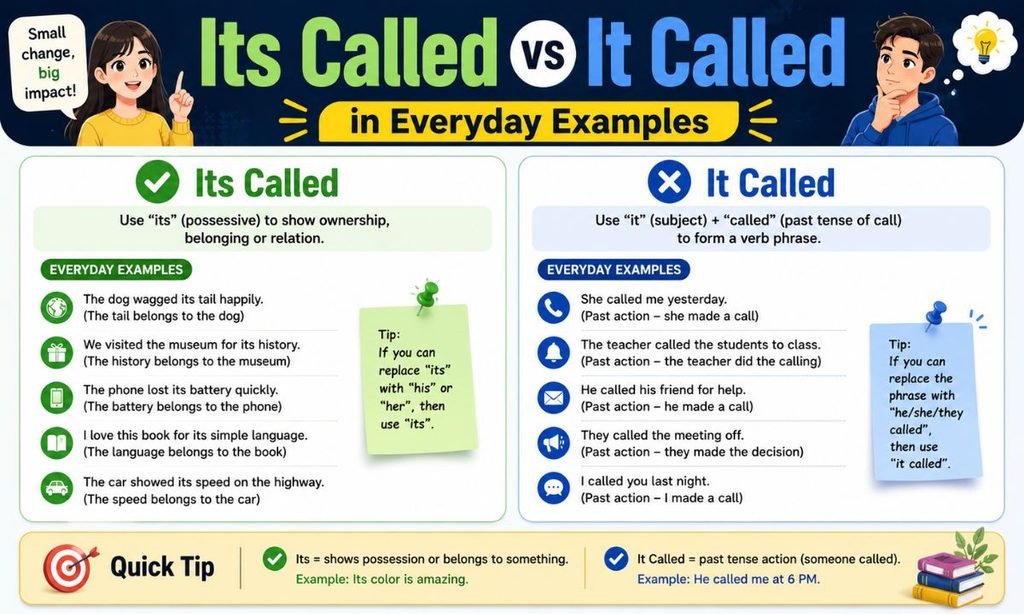
Texting: “omg it’s called a fidget spinner, everyone has one lol”
Emails: “Please note that this process is what we call quarterly reconciliation; it’s called that because it happens every three months.”
Social Media: “New drink alert! It’s called the Sunset Spritz and it’s basically summer in a glass 🍹”
Business Writing: “The updated software module lost its previous compatibility settings after the last patch.”
Comparison Table: Its Called vs It Called
| Category | It’s Called | Its Called |
| Part of speech | Contraction + verb phrase | Incorrect combination |
| Used for | Naming or labeling something | Never grammatically correct |
| Example | It’s called a metaphor. | (Avoid this spelling entirely) |
| Memory hook | “It’s” always expands to “it is” | “Its called” is always a typo |
Comparison Table: Its Called vs It Called (Quick Reference)
| Question to Ask | If Yes → Use |
| Can you expand it to “it is called”? | It’s called |
| Are you showing possession before a noun? | Its |
| Are you describing a past action or sound? | It called |
| Are you unsure and just guessing? | Stop and run the expansion test |
Pro Tip I Learned💡
Read your sentence backward, word by word. It sounds strange, but it forces your brain to stop autopiloting through familiar phrases like “its called” and actually notice the apostrophe (or missing one). Text-to-speech tools work well too, since hearing the sentence read aloud often exposes awkward phrasing that your eyes glossed right over.
Quick Test I Created: Its Called vs It Called Quiz
Fill in the blank with “it’s,” “its,” or “it called.”
- ______ time to leave.
- The cat licked ______ paw.
- ______ a beautiful sunset tonight.
- The machine lost ______ power suddenly.
- Yesterday, the phone rang and ______ twice.
- ______ called a peninsula.
- The company updated ______ website.
- ______ raining outside.
- The dog wagged ______ tail happily.
- ______ called an eclipse.
- My laptop overheated, so ______ shut down.
- ______ been a long day.
- The bird flew to ______ nest.
- ______ called karma.
- The alarm went off, and ______ for help.
- ______ important to double check your work.
- The team celebrated ______ victory.
- ______ called a paradox.
- The engine lost ______ spark suddenly.
- ______ a great idea!
Answer Key: (1. It’s, 2. its, 3. It’s, 4. its, 5. it called, 6. It’s, 7. its, 8. It’s, 9. its, 10. It’s, 11. it called, 12. It’s, 13. its, 14. It’s, 15. it called, 16. It’s, 17. its, 18. It’s, 19. its, 20. It’s)
Frequently Asked Questions
Is it “its called” or “it’s called”?
The correct phrase is “it’s called,” because it’s a contraction of “it is called,” used to name or label something.
What is the difference between its and it’s called?
“Its” shows possession before a noun, while “it’s called” introduces a name or term for something, expanding to “it is called.”
Can I ever use “it called” as a phrase?
Yes, “it called” is correct when describing a past action, such as a phone or animal making a sound or call.
Why do people confuse its and it’s so often?
People confuse them because apostrophes usually signal possession, but “its” breaks that pattern by following the same rule as other possessive pronouns like “his” and “hers.”
Is “its called” ever grammatically correct?
No, “its called” is never correct; it’s always either “it’s called” (contraction) or simply “called” without “its” attached.
Conclusion
The debate over its called vs it called really comes down to one small apostrophe carrying a lot of weight. Once you internalize the expansion test, expanding “it’s” into “it is” to check if the sentence still makes sense, you’ll never second-guess yourself again.
Remember that “its” behaves like other possessive pronouns such as “his” and “hers,” while “it’s” is always a contraction, and “it called” is simply the past tense of a verb describing an action. These three forms look nearly identical but serve completely different jobs in a sentence.

Shoaib Ahmad is an SEO and digital content professional with experience in creating helpful, easy-to-understand online content. At Whizz Aura, he focuses on English grammar, vocabulary, word meanings, sentence structure, and practical language tips. His goal is to make learning English simple, clear, and useful for everyday communication.





1 thought on “Its Called vs It Called: What’s the Difference? Meaning, Usage & Examples”