
If you have ever typed a sentence like “the costs are totaling up fast” and then paused, finger hovering over the keyboard, wondering if you just made a typo, you are not alone. Totaling vs Totalling is one of those sneaky spelling questions that trips up even confident writers. It looks like a simple extra letter, but that one “l” can make your writing look off to half your audience depending on where they live.
The confusion happens because English is really two cousins wearing the same outfit: American English and British English. They share almost every word, but they split on small spelling rules, especially when it comes to doubling consonants before adding an ending like “-ing” or “-ed.” “Totaling” and “totalling” are a textbook example of this split, and once you see the pattern, you will never second guess it again.
Getting this right actually matters more than people think. If you are writing a business report for a UK client, a resume for a Canadian company, or a blog post aimed at a global audience, the wrong spelling can look careless. This guide breaks down Totaling vs Totalling completely, so you can write with total confidence, no matter who is reading.
Totaling vs Totalling: Quick Answer with emojies
🇺🇸 Totaling is the American English spelling, while 🇬🇧 totalling is the British English spelling. Both mean the same thing: adding up to a certain amount or summing something.
✅ Correct (American): The invoice is totaling $450 this month.
✅ Correct (British): The invoice is totalling £450 this month.
❌ Incorrect (American): The invoice is totalling $450 this month.
❌ Incorrect (British): The invoice is totaling £450 this month.
Quick tip: Neither spelling is “wrong” on its own. The mistake only happens when you mix dialects within the same document.
Why I Found It’s Spelled / Used This Way?
The root word here is total, which comes from the Latin word “totalis,” meaning “entire” or “whole.” It entered English through French in the late Middle Ages and settled in as both a noun and a verb by the 1500s.
The spelling split happened much later, thanks to one man: Noah Webster. In the early 1800s, Webster wrote an American dictionary designed to simplify and standardize English spelling for the newly independent United States. He trimmed a lot of “unnecessary” letters, including extra consonants before suffixes.
British English kept the older convention, which doubles a final consonant before adding “-ing” or “-ed” when the word ends in a single vowel plus a single consonant, even if the last syllable is not stressed. American English dropped that extra doubling in many cases, which is exactly why totaling lost a letter while totalling kept it.
The Simple Rule for Stopping the Confusion
Here is a one second mental test you can run every time you are unsure.
Ask yourself: “Am I writing for a British or American audience?”
If the answer is American (US audience, US company, US publication), use totaling with one “l.”
If the answer is British (UK, Australia, most Commonwealth countries), use totalling with two “l’s.”
Pro tip: If you genuinely do not know your audience, default to American English. It is the more common spelling used in global business and most online content, including major search engines.
This same rule applies to similar words like “traveling/travelling,” “modeling/modelling,” and “canceling/cancelling.” Learn it once, and you have solved a whole category of spelling headaches.
Pronunciation Guide I Use
Here is the good news: totaling and totalling sound exactly the same. The spelling difference does not change how you say the word out loud.
| Word | Phonetic Spelling | Sound Focus |
| Totaling | TOH-tuh-ling | Stress falls on the first syllable, “TOH” |
| Totalling | TOH-tuh-ling | Identical stress and rhythm to “totaling” |
Mouth movement tip: Say “total” first, then simply add “ing” onto the end without pausing. Your tongue taps the roof of your mouth once for the “l” sound, no matter how many l’s are on the page. If you are practicing out loud, do not worry about the spelling at all, since your mouth will not know the difference.
Totaling vs Totalling: Definitions with Examples & Top Queries
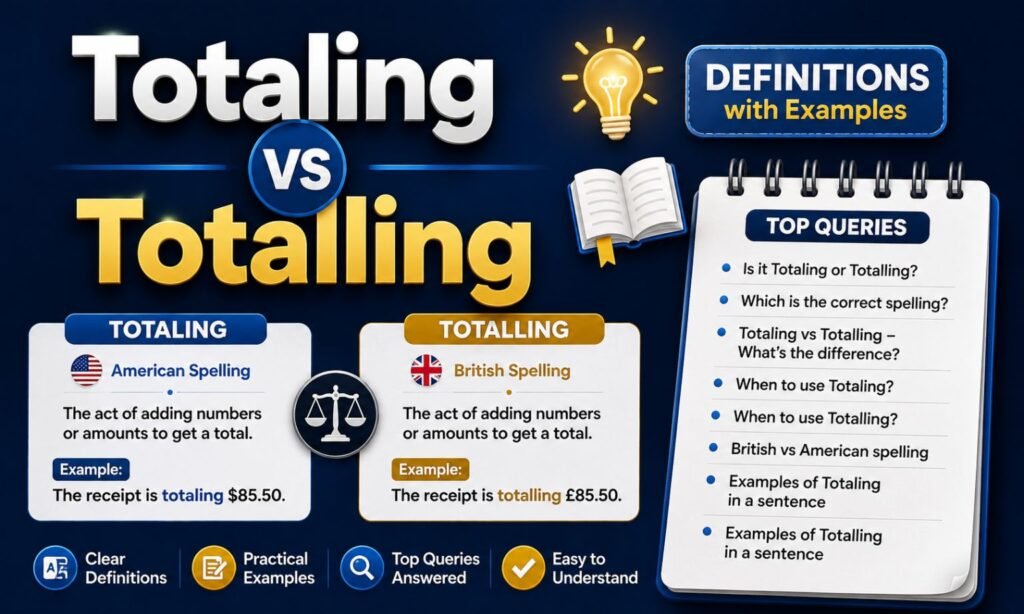
Both words share one definition, so let’s look at each spelling in its natural habitat.
Totaling (American English)
Part of speech: verb, present participle or gerund form of “to total”
Definition: the act of adding numbers or items together to reach a final sum, or being on track to reach a certain amount.
Example sentences:
- She spent the afternoon totaling the receipts from the fundraiser.
- Our sales are totaling more than last quarter’s numbers.
- He kept totaling up the score after every round.
- The app is totaling your monthly expenses automatically.
- By Friday, the donations were totaling nearly ten thousand dollars.
Totalling (British English)
Part of speech: verb, present participle or gerund form of “to total”
Definition: identical meaning to “totaling,” just spelled with the doubled consonant favored in British English.
Example sentences:
- The accountant spent hours totalling the quarterly figures.
- Damages are totalling well over a million pounds.
- She was totalling the votes as they came in.
- The bill kept totalling higher with every extra item.
- Our stock is totalling more units than expected this year.
Popular user queries related to this topic:
- Is it totaling or totalling in American English?
- Totaling vs totalling grammar rule
- How do you spell totaling with one l or two?
- Totalling meaning in British English
- Correct spelling of total plusing
British English vs American English Spelling
This is not a case of two different words. It is one word, total, spelled two accepted ways depending on the dialect. Both are correct, but they belong to different regional standards.
| Feature | British English | American English |
| Spelling | Totalling | Totaling |
| Consonant Doubling | Doubles the “l” before “-ing” | Keeps a single “l” before “-ing” |
| Common Regions | UK, Ireland, Australia, New Zealand, India | United States, and often Canada |
| Dictionary Standard | Oxford English Dictionary | Merriam-Webster |
| Past Tense Version | Totalled | Totaled |
My Memory Tricks and Tips
Here are three tricks that make this rule stick for good.
1. The “USA has one L” trick. The word “American” and the word “total” both feel short and efficient. Picture the US flag with a single star pattern, one flag, one extra “l.” America keeps it simple: one “l.”
2. The “Double Decker Bus” trick. British buses are famously double decker. British spelling loves to double letters too. Whenever you picture a red London bus, remember: British English doubles up, so it’s totalling.
3. The swap test. Replace “total” with another verb that follows the same US and UK pattern, like “travel.” If you already know “traveling” is American and “travelling” is British, then “totaling” and “totalling” follow the exact same split. One rule, many words.
Totaling vs Totalling: Which One Should You Use?
Use totaling when:
- You are writing for a US based company, publication, or audience.
- You are following the AP Stylebook or Chicago Manual of Style, both American standards.
- Your document uses other American spellings like “color,” “organize,” or “traveling.”
- You are unsure of your audience and want the more globally common option.
Use totalling when:
- You are writing for a UK, Australian, Irish, or New Zealand audience.
- Your document uses other British spellings like “colour,” “organise,” or “travelling.”
- You are following a British style guide, such as the Oxford Style Manual.
- You work for a company headquartered in a Commonwealth country.
Common Mistakes with Totaling vs Totalling
Mistake 1: Mixing dialects in the same document
❌ Incorrect: The report uses colour schemes while totaling the budget.
✅ Correct: The report uses colour schemes while totalling the budget.
Mistake 2: Using both spellings interchangeably in one piece
❌ Incorrect: Sales are totaling nicely, but expenses keep totalling up too.
✅ Correct: Sales are totaling nicely, but expenses keep totaling up too.
Mistake 3: Applying the double “l” rule to every “-ing” word without checking
❌ Incorrect: She is trying to be more organised while totalling her workout minutes.
✅ Correct: She is trying to be more organized while totaling her workout minutes. (Consistent American spelling throughout)
Explore More Grammar Guides
Annually Vs Annualy: What’s the Difference? Meaning, Usage & Examples
Organizing vs Organising: What’s the Difference? Meaning, Usage & Examples
Tomorrow vs Tommorow: What’s the Difference? Meaning, Usage & Examples
Leaped vs Leapt: What’s the Difference? Meaning, Usage & Examples
Guidance vs Guidence: What’s the Difference? Meaning, Usage & Examples
Totaling vs Totalling in Everyday Examples
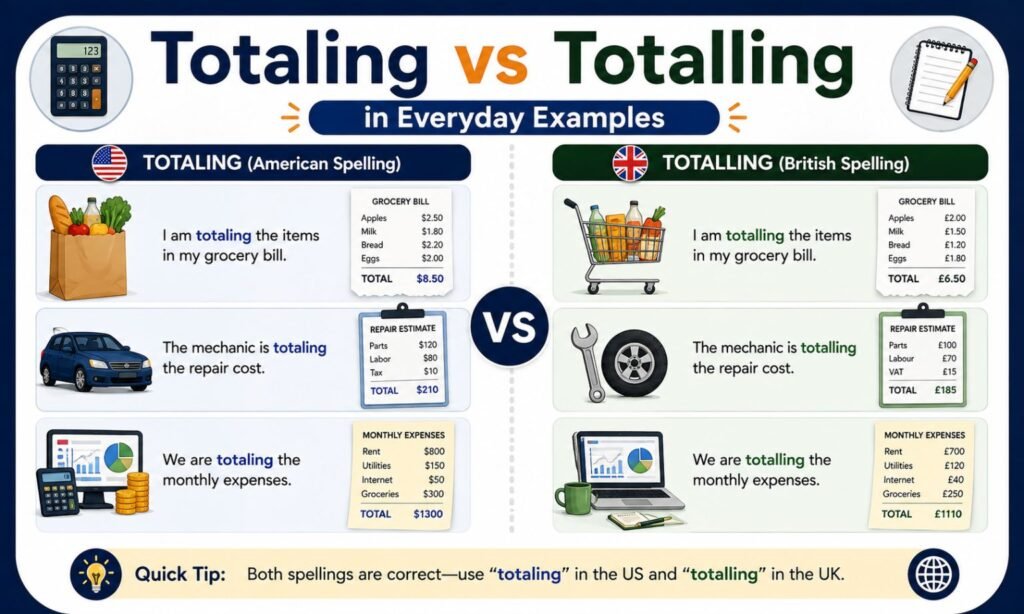
Texting: “omg my grocery bill is totaling like $80 rn 😩”
Emails: “Please confirm the invoice, which is currently totaling $3,200 for this billing cycle.”
Social Media: “Our community fundraiser is officially totalling over £5,000 this weekend! Thank you all! 🎉”
Business Writing: “Year to date expenses are totaling 12% above projections, requiring a budget review before Q3.”
Comparison Table: Totaling vs Totalling
| Category | Totaling | Totalling |
| Part of speech | Verb (gerund/present participle) | Verb (gerund/present participle) |
| Used for | Adding up amounts, American English | Adding up amounts, British English |
| Example | The bill is totaling $200. | The bill is totalling £200. |
| Memory hook | America keeps it simple, one “l” | Britain doubles down, two “l’s” |
| Dialect | US, and commonly Canada | UK, Australia, Ireland, NZ |
Comparison Table: Totaling vs Totalling (Quick Reference)
| Question to Ask | If Yes, Use |
| Am I writing for a US audience? | Totaling |
| Am I writing for a UK or Commonwealth audience? | Totalling |
| Does my document already use “color” and “organize”? | Totaling |
| Does my document already use “colour” and “organise”? | Totalling |
| Am I unsure and want the safer global default? | Totaling |
Pro Tip I Learned
My favorite editing hack is running my document through a text-to-speech reader before I submit anything important. Since totaling and totalling sound identical, this trick will not catch the spelling itself, but it forces me to slow down and actually notice the word on screen instead of skimming past it. I pair this with my browser’s language setting, switching between US and UK English dictionaries, so red squiggly lines catch anything that does not match my target dialect.
Quick Test I Created: Totaling vs Totalling Quiz
Fill in each blank with the correct spelling based on the dialect noted in parentheses.
- The cashier kept _______ the items one by one. (American)
- Her monthly savings are _______ more than expected. (British)
- The committee is _______ the votes right now. (American)
- Damages from the storm are _______ millions of pounds. (British)
- He spent all night _______ the spreadsheet numbers. (American)
- Our subscribers are _______ over ten thousand this year. (British)
- The app automatically starts _______ your expenses. (American)
- She was _______ the guest list for the wedding. (British)
- Sales figures are _______ higher every quarter. (American)
- The auditor is _______ the company’s assets. (British)
- I love _______ up my points after every game. (American)
- The scoreboard kept _______ throughout the match. (British)
- Their charity drive is _______ close to its goal. (American)
- The invoice ended up _______ far more than quoted. (British)
- We are _______ the miles for our road trip. (American)
- The council is _______ the votes from each ward. (British)
- My grocery bill is _______ way too fast this week. (American)
- The insurance claim is _______ several thousand pounds. (British)
- The teacher is _______ everyone’s final grades. (American)
- Ticket sales are _______ nicely for the concert. (British)
Answer Key: (1. totaling, 2. totalling, 3. totaling, 4. totalling, 5. totaling, 6. totalling, 7. totaling, 8. totalling, 9. totaling, 10. totalling, 11. totaling, 12. totalling, 13. totaling, 14. totalling, 15. totaling, 16. totalling, 17. totaling, 18. totalling, 19. totaling, 20. totalling)
Frequently Asked Questions
Is totaling or totalling correct?
Both are correct. Totaling is the standard American English spelling, while totalling is the standard British English spelling.
Why does totalling have two l’s?
Totalling has two l’s because British English doubles the final consonant before adding “-ing” to certain words, a convention that predates American spelling reforms.
Which spelling does the AP Stylebook use?
The AP Stylebook, which follows American English conventions, uses totaling with a single “l.”
Is totaling used in Canada?
Canada often blends American and British spelling, so both totaling and totalling appear, though American style is common in business writing.
Does the spelling change the pronunciation?
No, totaling and totalling are pronounced exactly the same way, since the spelling difference is purely a regional writing convention.
Conclusion
At the end of the day, Totaling vs Totalling is not really a grammar rule you need to stress over, it is a dialect choice. Pick American English and use totaling, or pick British English and use totalling, then stay consistent with that choice throughout your entire document.
The real key to mastering this is consistency. Mixing spelling conventions is what makes writing look sloppy, not the choice of dialect itself. Once you know your audience, the correct spelling becomes automatic.

Shoaib Ahmad is an SEO and digital content professional with experience in creating helpful, easy-to-understand online content. At Whizz Aura, he focuses on English grammar, vocabulary, word meanings, sentence structure, and practical language tips. His goal is to make learning English simple, clear, and useful for everyday communication.





3 thoughts on “Totaling vs Totalling: What’s the Difference? Meaning, Usage & Examples”