
Ever typed out a sentence, stared at the word “habbit,” and thought, “wait, does that look right”? You are not alone. This is one of the most common spelling mix-ups in the English language, and it trips up native speakers and learners alike.
The confusion mostly comes down to how our brains process double letters. English is full of words like “rabbit” and “bobbit” that double their consonants, so it feels natural to assume “habit” should follow the same pattern. Spoiler alert: it does not, and understanding why will save you from a small but noticeable writing error.
Getting this right matters more than you might think. A misspelled word in an email, resume, or blog post can quietly chip away at your credibility, even if your ideas are solid. In this guide, we will settle the Habit vs Habbit debate once and for all, with clear rules, memory tricks, and a fun quiz to lock it in.
Habit vs Habbit: Quick Answer
Quick Answer: “Habit” is the only correct spelling in English. “Habbit” is simply a common misspelling and has no accepted meaning or use in standard writing.
✅ Correct: She has a habit of checking her phone first thing in the morning.
❌ Incorrect: She has a habbit of checking her phone first thing in the morning.
When comparing Habit vs Habbit, remember there is really no contest. Only one of these words exists in the dictionary, and it is “habit.”
Why I Found It’s Spelled / Used This Way
The word “habit” traces back to the Old French word “habit” or “abit,” which itself came from the Latin word “habitus,” meaning “condition” or “appearance.” The Latin root “habere” means “to have or hold,” which makes sense since a habit is something you “hold onto” through repeated behavior.
When this word moved into Middle English around the 13th century, it kept its single-“b” spelling. English spelling has never been perfectly consistent, but “habit” has remained stable across centuries of use, unlike many other words that shifted spelling over time.
“Habbit,” on the other hand, has no historical or linguistic root at all. It is a modern misspelling, likely influenced by double-consonant words like “rabbit,” “hobbit,” or “gabbit” (British slang for chatting). There is no version of English, old or new, where “habbit” was ever the accepted spelling.
The Simple Rule for Stopping the Confusion
Here is a 1-second mental test you can use every time: think of the word “habitat.” You already know a habitat is an animal’s natural home, and it has one “b.” Since “habit” and “habitat” share the same root, they share the same spelling pattern.
Quick Tip: If you can spell “habitat” correctly, you can spell “habit” correctly. Just chop off the “-at” and you are done.
Another fast trick is to say the word slowly out loud. “Hab-it” only has one clear “b” sound, unlike words like “rabbit,” where the double “b” creates a slightly harder, punchier sound in the middle.
Pronunciation Guide I Use
Pronunciation is actually one of the easiest ways to remember the correct spelling, since “habit” and “habbit” would sound almost identical if “habbit” were real. Here is a simple breakdown.
| Word | Phonetic Spelling | Sound Focus |
| Habit (correct) | HAB-it | Short “a” sound, soft single “b” |
| Habbit (incorrect) | N/A (not a real word) | Would sound the same as “habit,” but has no valid spelling |
Practical tip: Say “hab” like the start of “happen,” then add “it.” Your mouth should move quickly from the “b” sound straight into “it,” with no pause or emphasis, which reflects the single-consonant spelling.
Habit vs Habbit: Definitions with Examples & Top Queries
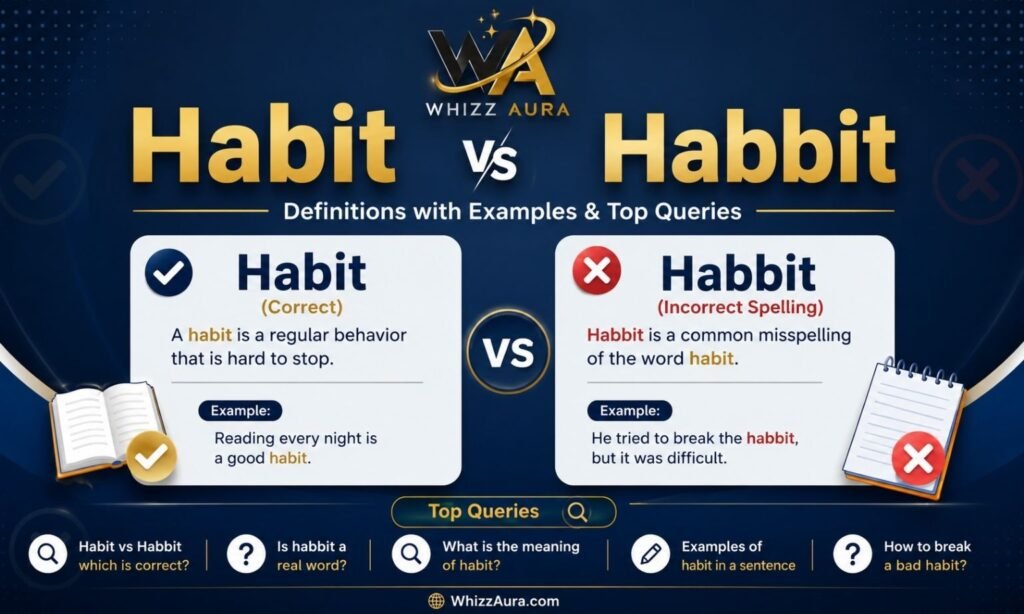
Understanding Habit vs Habbit starts with knowing that only one of these terms has an actual definition. Let’s break both down clearly.
Habit (noun): a settled or regular tendency or practice, often one that is hard to give up, especially one that is repeated regularly and often unconsciously.
Five example sentences using “habit”:
- Reading before bed has become a nightly habit for me.
- Breaking a bad habit takes patience and consistency.
- His habit of biting his nails started when he was a kid.
- Building a good exercise habit can improve your mood.
- Out of habit, she locked the door twice before leaving.
Habbit: this word does not exist in standard, formal, or informal English. It has no part of speech, no dictionary entry, and no accepted meaning. It is purely a spelling error.
Popular user queries related to this topic include:
- Is “habbit” a real word?
- How do you spell habit correctly?
- Habit vs habbit meaning
- Why do people misspell habit as habbit?
- Habit synonym and definition
British English vs American English Spelling 🇬🇧🇺🇸
Good news here: this is one of the rare cases where spelling stays identical across the pond. Both British English and American English spell the word the exact same way, with a single “b.”
| Feature | British English | American English |
| Correct Spelling | Habit | Habit |
| Pronunciation | HAB-it | HAB-it |
| “Habbit” Accepted? | No | No |
Unlike words such as “colour” versus “color” or “organise” versus “organize,” Habit vs Habbit is not a regional spelling debate. There is simply one correct spelling worldwide.
Explore More Grammar Guides
Totaling vs Totalling: What’s the Difference? Meaning, Usage & Examples
Humorous vs Humerous: What’s the Difference? Meaning, Usage & Examples
Friend vs Freind: What’s the Difference? Meaning, Usage & Examples
Gauge Vs Guage: What’s the Difference? Meaning, Usage & Examples
Putting vs Puting: What’s the Difference? Meaning, Usage & Examples
My Memory Tricks and Tips
Here are three creative ways I remember this rule, and they work whether you are a student, a professional writer, or just someone who wants to stop second-guessing themselves.
- The “Habitat” Hookup: Remember that “habit” is hiding inside “habitat.” Since you already know habitats have one “b,” your habits do too.
- The Rabbit Reversal: Picture a rabbit hopping away from the word “habit.” That extra “b” belongs to the rabbit, not to your habits. This visual keeps the double “b” out of your spelling.
- The One-and-Done Rule: Tell yourself “one behavior, one b.” Since a habit is a single repeated behavior, let that single “b” reinforce the idea.
Pro Tip: Repetition builds habits, and repetition also builds spelling memory. Write the correct word “habit” five times right now, and it will stick faster than you expect.
Habit vs Habbit: Which One Should You Use?
This section is short and simple because there is only one correct choice.
- Use “habit” when describing any repeated behavior, routine, or tendency, whether good or bad.
- Use “habit” in academic writing, business communication, casual texting, and creative writing.
- Never use “habbit”, since it is not recognized as a word in any context, formal or informal.
Common Mistakes with Habit vs Habbit
Even careful writers slip up sometimes. Here are three specific mistakes to watch for.
Mistake 1: Doubling the “b” out of habit (pun intended).
❌ Incorrect: I need to break this bad habbit.
✅ Correct: I need to break this bad habit.
Mistake 2: Confusing it with similar-looking words like “rabbit” or “hobbit.”
❌ Incorrect: My habbit is drinking coffee every morning.
✅ Correct: My habit is drinking coffee every morning.
Mistake 3: Autocorrect or spellcheck creating false confidence.
❌ Incorrect: Assuming “habbit” is fine because it “looks close enough.”
✅ Correct: Always double-check with a dictionary or trusted spellcheck tool before publishing.
Habit vs Habbit in Everyday Examples
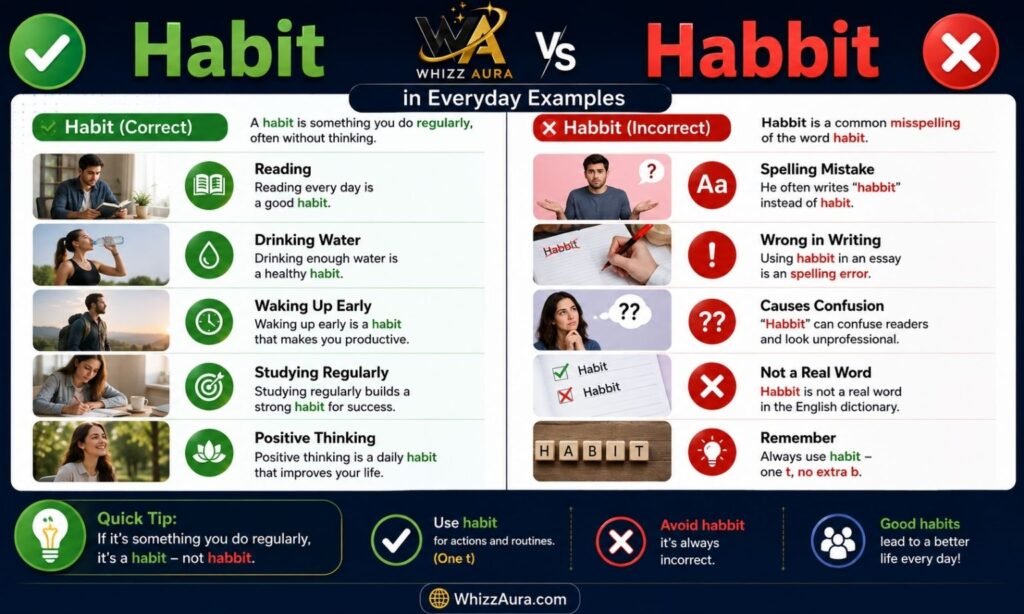
Texting: “omg I have such a bad habit of snoozing my alarm lol”
Emails: “As part of our new wellness initiative, we encourage employees to build a daily habit of taking short breaks.”
Social Media: “Day 30 of my new morning habit, feeling stronger every day! #consistency”
Business Writing: “Our research shows that customer habit formation is a key driver of long-term brand loyalty.”
Comparison Table: Habit vs Habbit
| Category | Habit (Correct) | Habbit (Incorrect) |
| Part of Speech | Noun | Not applicable |
| Used For | Describing repeated behavior or routine | Never, it is a misspelling |
| Example Sentence | “Journaling is a healthy habit.” | Not a valid sentence |
| Memory Hook | Think “habitat,” one “b” | Think “rabbit” to remember what NOT to copy |
Comparison Table: Habit vs Habbit (Quick Reference)
| Question to Ask | If Yes, Use |
| Am I describing a repeated behavior or routine? | Habit |
| Am I unsure how to spell it? | Habit (always, since “habbit” is never correct) |
| Did autocorrect suggest “habbit”? | Ignore it and use Habit |
Pro Tip I Learned 💡
One editing hack that has saved me countless times is reading my writing out loud using text-to-speech software. When a fake word like “habbit” gets read aloud, it often sounds slightly off or gets mispronounced by the software, which is an instant red flag that something is wrong.
Another version of this trick is reading your sentence backward, word by word. It forces your brain to focus on spelling rather than context, making errors like “habbit” much easier to spot.
Quick Test I Created: Habit vs Habbit Quiz
Fill in the blank with the correct word.
- She has a morning ______ of drinking green tea.
- Breaking a ______ takes about 21 days, according to popular belief.
- His ______ of interrupting people is annoying.
- I’m trying to build a reading ______.
- That’s just an old ______ of mine.
- Smoking is a hard ______ to quit.
- Good study ______ lead to better grades.
- A ______ can be formed through repetition.
- Her ______ of humming while working is cute.
- He fell back into his old ______.
- Exercise should become a daily ______.
- Nail-biting is a nervous ______.
- This app helps track your ______.
- Building a savings ______ is smart.
- Out of ______, I checked my email again.
- A bad ______ is hard to break.
- Healthy eating ______ improve energy levels.
- She developed a ______ of journaling nightly.
- Procrastination is a common ______.
- A positive ______ can change your life.
Answer Key: (1. habit, 2. habit, 3. habit, 4. habit, 5. habit, 6. habit, 7. habits, 8. habit, 9. habit, 10. habit, 11. habit, 12. habit, 13. habits, 14. habit, 15. habit, 16. habit, 17. habits, 18. habit, 19. habit, 20. habit)
Frequently Asked Questions
Is “habbit” a real word?
No, “habbit” is not a real word. It is a common misspelling of “habit” and has no dictionary definition.
How do you spell habit correctly?
The correct spelling is “habit,” with only one “b.” It comes from the Latin word “habitus.”
Why do people misspell habit as habbit?
People often misspell it because of similar-sounding double-consonant words like “rabbit” and “hobbit,” which creates a false pattern in the brain.
Is habit spelled differently in British and American English?
No, “habit” is spelled the same way in both British English and American English, with no regional variation.
What is a simple trick to remember how to spell habit?
Think of the word “habitat,” which also has one “b.” Since “habit” and “habitat” share the same root, they share the same spelling.
Conclusion
At the end of the day, the Habit vs Habbit debate has a clear winner: “habit” is the only correct spelling, and “habbit” simply does not exist in standard English. Understanding the Latin roots, the pronunciation pattern, and a few simple memory tricks can help this spelling stick for good.
Whether you are writing a text message, a business email, or a blog post, using the correct spelling shows attention to detail and builds trust with your reader. Small errors like this one are easy to fix once you know the rule.

Shoaib Ahmad is an SEO and digital content professional with experience in creating helpful, easy-to-understand online content. At Whizz Aura, he focuses on English grammar, vocabulary, word meanings, sentence structure, and practical language tips. His goal is to make learning English simple, clear, and useful for everyday communication.





5 thoughts on “Habit vs Habbit: What’s the Difference? Meaning, Usage & Examples”