
If you have ever typed a text, paused, and stared at the word “friend” wondering if it looks right, you are not alone. The Friend vs Freind mix-up is one of the most common spelling slip-ups in the English language, and it trips up native speakers just as often as English learners.
The confusion usually comes down to a sneaky little spelling rule most of us memorized as kids and then forgot: “i before e, except after c.” The problem is that “friend” doesn’t follow the pattern you’d expect, and your brain’s autopilot often wants to flip those two letters.
Getting this right matters more than you might think. A misspelled word in a text to your best friend is harmless, but the same mistake in a resume, work email, or college essay can quietly hurt your credibility. This guide breaks down Friend vs Freind once and for all, so you never have to second-guess yourself again.
Friend vs Freind: Quick Answer 🎯
Quick Answer: “Friend” is the only correct spelling. 🙌 “Freind” is simply a common misspelling and has no meaning in English. ❌
Correct: She is my best friend from college. ✅
Incorrect: She is my best freind from college. ❌
Correct: We have been friends since third grade. ✅
Incorrect: We have been freinds since third grade. ❌
Why I Found It’s Spelled This Way
The word “friend” comes from the Old English word freond, which meant “one who loves” or “one who is beloved.” It is related to the Old English verb freogan, meaning “to love” or “to favor.”
Over centuries, as English evolved through Middle English, the spelling shifted and settled into the modern “friend” we use today. The “ie” combination stuck around even though the pronunciation changed to sound more like “frend” than “freend.”
This is actually why the word breaks the classic “i before e” rule. The rule works for words like “believe” and “chief,” but “friend” is one of many exceptions English learners just have to memorize separately.
Quick Fact: English has hundreds of “i before e” exceptions, and “friend” is one of the most frequently misspelled among them.
The Simple Rule for Stopping the Confusion
Here is a one-second mental test you can use every single time.
Say the word slowly in your head: “fri-END.” Notice that it ends with the sound “end,” and the word literally contains the smaller word “end” inside it once you place the “i” before the “e.”
Just remember this simple trick:
- Friend = fr + i + end (contains the word “end”)
- Freind = not a real word, no such pattern exists
If you can spot the word “end” sitting inside “friend,” you will never misspell it again.
Pronunciation Guide I Use
| Word | Phonetic Spelling | Sound Focus |
| Friend (correct) | /frɛnd/ (say “FREND”) | Short “e” sound, rhymes with “bend” |
| Freind (incorrect) | Not applicable | This spelling does not exist in English |
Mouth-movement tip: When you say “friend” correctly, your mouth should feel like it’s making a short, quick “eh” sound, almost like the word “bread.” If you catch yourself stretching the vowel into a long “ee” sound, that mismatch is often what causes the spelling mix-up in the first place.
Friend vs Freind: Definitions with Examples & Top Queries
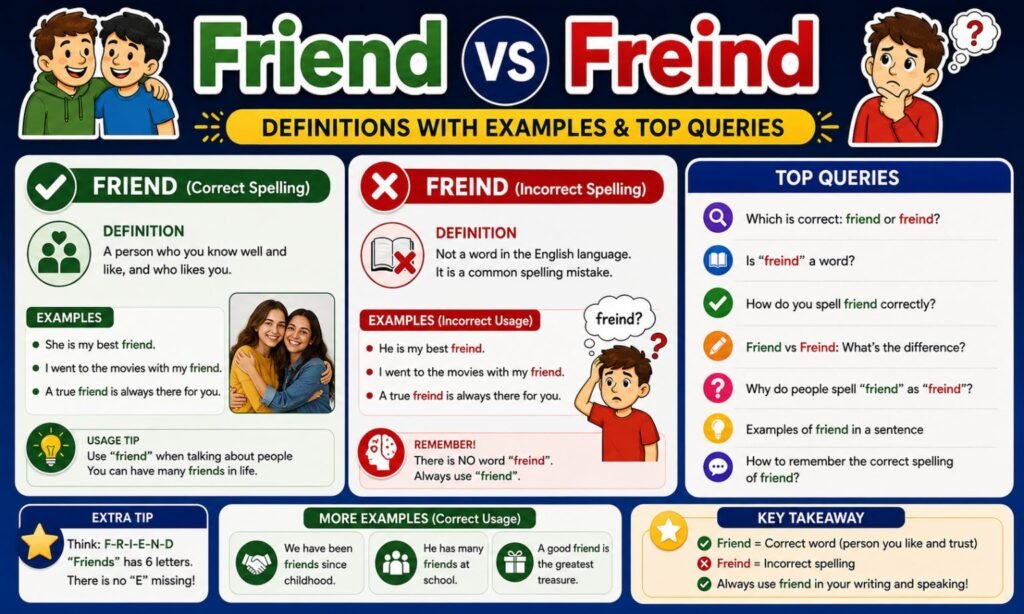
Friend (Correct Spelling)
“Friend” is a noun that refers to a person you know well and regard with affection, trust, or loyalty. It can also function as a verb, especially in the digital age, meaning to add someone as a connection on social media.
Example sentences:
- My friend picked me up from the airport last night.
- He made a new friend on his first day at work.
- I friended her on social media right after we met.
- A true friend tells you the truth, even when it’s hard.
- They have been close friends for over twenty years.
Freind (Incorrect Spelling)
“Freind” has no definition. It is not recognized in any English dictionary, and spell-checkers will always flag it as an error.
Popular user queries related to this topic:
- Is it “friend” or “freind”?
- Why do I always spell friend wrong?
- Friend spelling rule i before e
- How to remember friend spelling
- Correct spelling of best friend
Explore More Grammar Guides
Totaling vs Totalling: What’s the Difference? Meaning, Usage & Examples
Humorous vs Humerous: What’s the Difference? Meaning, Usage & Examples
Tomorrow vs Tommorow: What’s the Difference? Meaning, Usage & Examples
Leaped vs Leapt: What’s the Difference? Meaning, Usage & Examples
Guidance vs Guidence: What’s the Difference? Meaning, Usage & Examples
British English vs American English Spelling
Good news here: the spelling of Friend vs Freind is completely identical across British and American English. There is no regional variation to worry about, unlike words such as “colour” versus “color.”
| Feature | British English | American English |
| Correct Spelling | Friend | Friend |
| Pronunciation | /frɛnd/ | /frɛnd/ |
| Common Misspelling | Freind (incorrect everywhere) | Freind (incorrect everywhere) |
No matter which side of the Atlantic you are writing for, “friend” stays exactly the same.
My Memory Tricks and Tips
Here are three creative tricks that have helped thousands of writers lock in the correct spelling for good.
- The “END” trick: Notice that “friend” contains the word “end.” Fri-END. Once you see it, you can’t unsee it.
- The rhyme trick: “Friend” rhymes with “bend,” “send,” and “trend.” All of these words use “e” before “n,” which mirrors the pattern in “friend.”
- The silly sentence trick: Remember this line: “I will never end my friendship.” The “i” comes first, just like in the correct spelling.
Pro Tip: Pick just one memory trick that clicks for you and repeat it out loud three times. Repetition locks the spelling into muscle memory faster than reading it silently.
Friend vs Freind: Which One Should You Use?
- Use “friend” in any personal, professional, academic, or casual writing context.
- Use “friend” when referring to a person you trust, like, or have a relationship with.
- Use “friend” as a verb when talking about adding someone on social media.
- Never use “freind” anywhere. It is not a word in any context, formal or informal.
Common Mistakes with Friend vs Freind
Mistake 1: Reversing the “i” and “e”
- Incorrect: My freind is coming over tonight.
- Correct: My friend is coming over tonight.
Mistake 2: Applying “i before e except after c” too rigidly
- Incorrect: Writing “freind” because it “feels” like it follows the standard rule.
- Correct: Remembering that “friend” is a well-known exception to that rule.
Mistake 3: Autocorrect confusion when typing fast
- Incorrect: Sending “freind” in a rushed text and not noticing the red underline.
- Correct: Pausing for one second to check that “end” appears inside the word.
Friend vs Freind in Everyday Examples
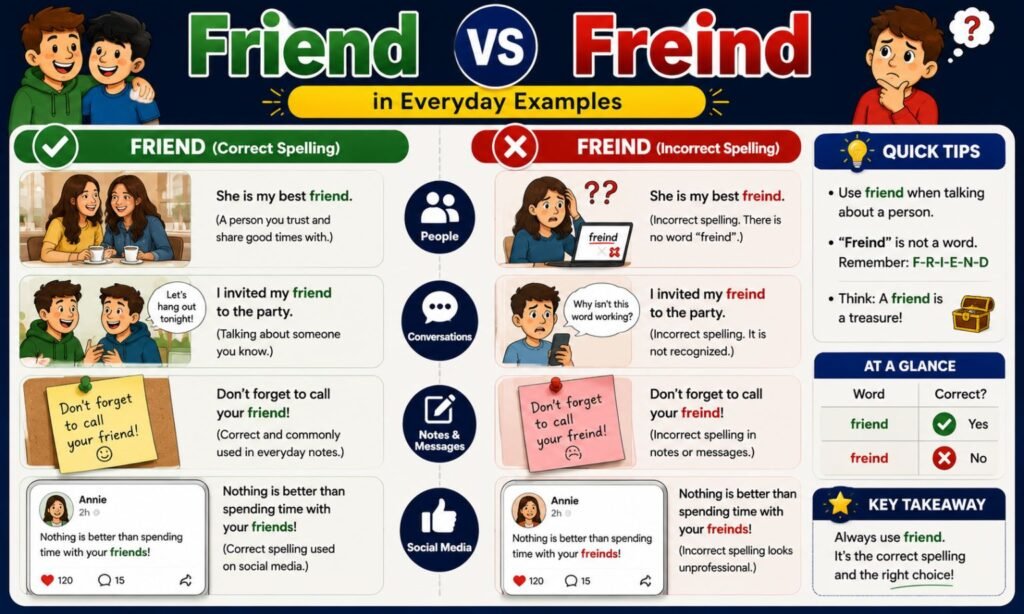
Texting: “Hey, are you free later? My friend wants to grab coffee with us.”
Emails: “Please loop in my colleague and friend, Sarah, who will be joining the call.”
Social Media: “Shoutout to my best friend for always having my back. Love you!”
Business Writing: “As a trusted friend of this organization, your continued partnership means a great deal to our team.”
Comparison Table: Friend vs Freind
| Category | Friend | Freind |
| Part of Speech | Noun / Verb | None (not a real word) |
| Used For | A person you trust or care about | Nothing, always an error |
| Example | “She is my closest friend.” | Not applicable |
| Memory Hook | Contains the word “end” | No valid hook, simply incorrect |
Comparison Table: Friend vs Freind (Quick Reference)
| Question to Ask | If Yes → Use |
| Am I writing about a person I trust or like? | Friend |
| Does the word need to rhyme with “bend” or “send”? | Friend |
| Am I about to type “freind”? | Stop, correct it to “friend” |
| Is spell-check underlining the word in red? | Friend |
Pro Tip I Learned
One of the best editing hacks I ever picked up is using text-to-speech software to read my writing back to me. When “freind” gets read aloud, most apps will either mispronounce it or flag it, which instantly signals something is off. Hearing your writing, not just seeing it, catches mistakes your eyes glide right past.
Quick Test I Created: Friend vs Freind Quiz
Fill in the blank with the correct spelling.
- She is my closest ______.
- We became ______ in high school.
- He ______ed me on social media yesterday.
- My best ______ lives across the street.
- They are lifelong ______s.
- I made a new ______ at the gym.
- Is she a ______ or just an acquaintance?
- My ______ helped me move last weekend.
- We have been ______s for a decade.
- He is a true ______ indeed.
- My childhood ______ still calls me often.
- She considers her coworker a ______.
- I trust my ______ with anything.
- My ______ surprised me on my birthday.
- He is my oldest ______ from college.
- They remained ______s despite the distance.
- My ______ always makes me laugh.
- She is a loyal ______ to everyone she meets.
- I met my best ______ in kindergarten.
- He calls her his closest ______.
Answer Key: (1. friend, 2. friends, 3. friend, 4. friend, 5. friends, 6. friend, 7. friend, 8. friend, 9. friends, 10. friend, 11. friend, 12. friend, 13. friend, 14. friend, 15. friend, 16. friends, 17. friend, 18. friend, 19. friend, 20. friend)
Frequently Asked Questions
Is it spelled friend or freind?
It is always spelled “friend.” “Freind” is a common misspelling with no meaning in English.
Why do people misspell friend as freind?
People misspell it because they misapply the “i before e” rule, forgetting that “friend” is a well-known exception.
What does freind mean?
“Freind” has no meaning because it is not a recognized word in any English dictionary.
How do you remember the spelling of friend?
Remember that “friend” contains the word “end,” which helps you recall the correct order of the letters “i” and “e.”
Is the spelling of friend different in British English?
No, the spelling of “friend” is identical in both British and American English with no regional variation.
Conclusion
The debate between Friend vs Freind really has a simple resolution: “friend” is correct, and “freind” is always a mistake. Once you understand that “friend” breaks the typical “i before e” rule and remember that it contains the word “end,” this spelling becomes second nature.
Small spelling errors like this one can quietly affect how professional and polished your writing looks, whether you’re texting, emailing, or posting on social media. Taking a few extra seconds to double-check now saves you from awkward corrections later.

Shoaib Ahmad is an SEO and digital content professional with experience in creating helpful, easy-to-understand online content. At Whizz Aura, he focuses on English grammar, vocabulary, word meanings, sentence structure, and practical language tips. His goal is to make learning English simple, clear, and useful for everyday communication.





3 thoughts on “Friend vs Freind: What’s the Difference? Meaning, Usage & Examples”