
If you’ve ever stood in the spice aisle squinting at a label, or typed a recipe and paused mid-sentence wondering which word to use, you’re not alone. The Anise vs Aniseed mix-up trips up home cooks, bakers, and writers all the time, and honestly, it makes sense. Both words point to the same little plant, they sound nearly identical, and they get tossed around interchangeably in recipes, product labels, and casual conversation.
But here’s the thing: they aren’t always interchangeable. One word usually refers to the plant and its flavor as a whole, while the other zeroes in specifically on the seed. Mixing them up isn’t a huge crime, but if you’re writing professionally, cooking from a precise recipe, or just want to sound like you know your herbs and spices, getting this right matters.
In this guide, I’ll break down exactly where these two words come from, how to pronounce them, when to use each one, and how to stop second-guessing yourself for good. By the end, you’ll have this locked in permanently.
Anise vs Aniseed: Quick Answer
Quick Answer: “Anise” 🌱 refers to the plant itself and, informally, its flavor, while “aniseed” 🌰 specifically means the seed of that plant. In everyday American English, “anise” is used far more often for both meanings.
Correct: ✅ The cookies have a strong anise flavor.
Correct: ✅ She crushed the aniseed before adding it to the dough.
Incorrect: ❌ The cookies have a strong aniseed flavor. (technically odd since flavor comes from the whole plant/oil, not just the seed)
Incorrect: ❌ Plant anise in your garden. (should specify “anise seeds” for planting, not the vague “anise”)
Why I Found It’s Spelled / Used This Way
The word anise traces back to the Old French “anis,” which came from the Latin “anisum,” and further back to the Greek “anison.” It originally referred to the entire plant, Pimpinella anisum, prized for centuries for its licorice-like flavor.
Aniseed is simply a compound word: “anise” plus “seed.” English speakers naturally combined the two terms because the seed is the part most commonly harvested, dried, and used in cooking. Over time, “aniseed” became its own standalone noun, especially common in British English recipes and candy names like aniseed balls.
So really, aniseed isn’t a separate word with its own history. It’s a practical shorthand that grew out of anise, built to describe one specific part of the plant.
The Simple Rule for Stopping the Confusion
Here’s the fastest mental test I use, and it takes about one second.
Quick Test: Ask yourself, “Am I talking about the seed specifically, or the plant and its flavor in general?” If it’s the seed, “aniseed” works. If it’s the flavor, oil, plant, or a general reference, use “anise.”
If you’re ever unsure, default to anise. It’s the more flexible, more commonly used term in American English and rarely sounds wrong.
Pronunciation Guide I Use
Getting the sound right helps cement the spelling in your memory too.
| Word | Phonetic Spelling | Sound Focus |
| Anise | AN-iss | Stress on the first syllable, soft “s” at the end |
| Aniseed | AN-iss-eed | Same start as anise, then a clear “eed” like the word “seed” |
Mouth-movement tip: Say “an” like you’re starting the word “and,” then snap into “iss” like the start of “issue.” For aniseed, just tack on “seed” at the end, exactly like the word for a plant seed. If you can say “seed” on its own, you already know the second half of “aniseed.”
Anise vs Aniseed: Definitions with Examples & Top Queries
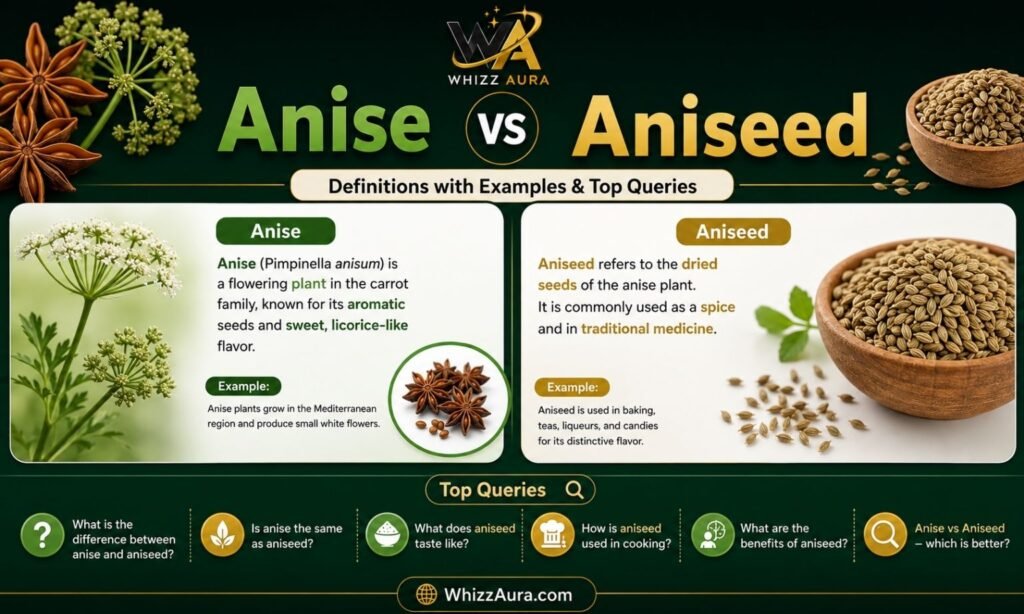
Anise (noun): The plant Pimpinella anisum, or informally, its licorice-flavored essence used in cooking, baking, and liqueurs.
- Anise gives Italian pizzelle cookies their signature flavor.
- I love the smell of anise in holiday baking.
- The chef added a splash of anise extract to the sauce.
- Anise grows well in warm, sunny climates.
- This tea has a subtle anise note.
Aniseed (noun): The dried seed of the anise plant, used whole or ground as a spice or flavoring.
- She sprinkled aniseed over the bread before baking.
- Aniseed balls are a classic British candy.
- Grind the aniseed finely for a smoother flavor.
- The recipe calls for one teaspoon of aniseed.
- Aniseed is often confused with fennel seed at the store.
Popular user queries related to this topic:
- Is anise the same as aniseed?
- Anise vs aniseed vs fennel seed
- What does aniseed taste like?
- Can I substitute anise extract for aniseed?
- Anise vs star anise difference
British English vs American English Spelling
The spelling of both words is identical in British and American English. There’s no “colour vs color” style split here. The difference is about usage frequency, not spelling.
| Feature | British English | American English |
| Spelling | Anise / Aniseed | Anise / Aniseed |
| Common Term | “Aniseed” used frequently | “Anise” used far more often |
| Common Products | Aniseed balls, aniseed twists (candy) | Anise extract, anise seed (labeled as two words sometimes) |
Explore More Grammar Guides
Habit vs Habbit: What’s the Difference? Meaning, Usage & Examples
Humorous vs Humerous: What’s the Difference? Meaning, Usage & Examples
Friend vs Freind: What’s the Difference? Meaning, Usage & Examples
Gauge Vs Guage: What’s the Difference? Meaning, Usage & Examples
Putting vs Puting: What’s the Difference? Meaning, Usage & Examples
My Memory Tricks and Tips
Here are three tricks that have genuinely helped my students and editing clients.
Trick 1: The “Seed Needs a Seed” Rule. If the sentence is about a literal seed, the word “aniseed” already contains the word “seed” inside it. Let the spelling remind you.
Trick 2: “Anise” is the Umbrella. Think of “anise” as the umbrella term covering the plant, the flavor, and the extract. “Aniseed” only fits under one small part of that umbrella.
Trick 3: Swap Test. Try swapping in the word “seed” directly. “I added a seed to the dough” sounds odd unless you mean the literal seed, aka aniseed. “I added an anise flavor” makes sense on its own.
Anise vs Aniseed: Which One Should You Use?
- Use anise when talking about the plant in general.
- Use anise when describing a flavor, scent, or extract.
- Use anise when referring to anise oil or anise liqueur (like ouzo or sambuca).
- Use aniseed when referring specifically to the dried seeds.
- Use aniseed when the recipe instructs you to grind, crush, or toast the seeds.
- Use aniseed in British recipes or candy names where it’s the traditional term.
Common Mistakes with Anise vs Aniseed
Mistake 1: Using “aniseed” for the general flavor.
❌ Incorrect: This candle smells like aniseed.
✅ Correct: This candle smells like anise.
Mistake 2: Using “anise” when the recipe needs literal seeds.
❌ Incorrect: Add one tablespoon of anise to the dough.
✅ Correct: Add one tablespoon of aniseed to the dough.
Mistake 3: Confusing anise with star anise, a completely different plant.
❌ Incorrect: Star anise and anise are the exact same spice.
✅ Correct: Star anise comes from a different plant but has a similar licorice flavor to anise.
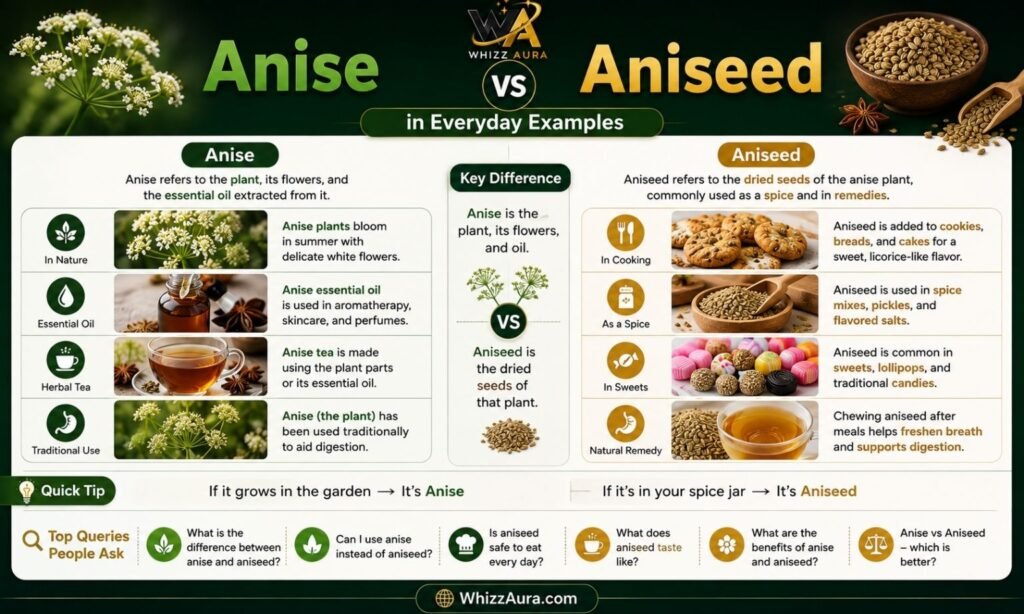
Anise vs Aniseed in Everyday Examples
Texting: “omg this tea tastes like anise, kinda like licorice lol”
Emails: “Please confirm whether the recipe requires whole aniseed or ground anise extract before we finalize the ingredient list.”
Social Media: “Baking pizzelle today and the whole house smells like anise 😍🍪”
Business Writing: “Our supplier has confirmed a steady stock of aniseed for the Q3 spice blend production run.”
Comparison Table: Anise vs Aniseed
| Category | Anise | Aniseed |
| Part of Speech | Noun | Noun (compound) |
| Refers To | The plant, flavor, or extract | The dried seed specifically |
| Common In | American English | British English, baking recipes |
| Example | “Anise gives this drink its flavor.” | “Crush the aniseed before use.” |
| Memory Hook | The broad, umbrella term | Contains “seed,” so think seeds only |
Comparison Table: Anise vs Aniseed (Quick Reference)
| Question to Ask | If Yes → Use |
| Am I talking about the whole plant? | Anise |
| Am I describing a flavor or scent? | Anise |
| Am I referring to literal dried seeds? | Aniseed |
| Is this a British candy or traditional recipe term? | Aniseed |
| Am I unsure which one fits? | Anise (safer default) |
Pro Tip I Learned
My favorite editing hack for catching this mistake is reading the sentence out loud and replacing the word with “seeds” or “plant.” If “seeds” fits naturally, aniseed is correct. If “plant” or “flavor” fits better, stick with anise. This trick has saved me from awkward wording more times than I can count.
Quick Test I Created: Anise vs Aniseed Quiz
Fill in the blank with anise or aniseed.
- The bread had a strong ___ flavor.
- Grind the ___ before adding it to the mix.
- ___ balls are popular in British sweet shops.
- This liqueur is flavored with ___.
- Add one teaspoon of ___ to the cookie dough.
- The plant known as ___ grows in Mediterranean climates.
- She toasted the ___ to release more aroma.
- The tea has a subtle ___ note.
- ___ extract works well in holiday baking.
- The recipe calls for whole ___, not ground.
- His cologne has a faint ___ scent.
- ___ oil is used in some natural remedies.
- Sprinkle ___ over the biscotti before baking.
- The farmer grows ___ alongside fennel.
- This candy has a strong, sweet ___ taste.
- Crush the ___ with a mortar and pestle.
- ___ is often compared to licorice in flavor.
- The chef garnished the plate with a few ___.
- Sambuca is an Italian liqueur made with ___.
- Store the ___ in an airtight container to preserve freshness.
Answer Key: (1. anise, 2. aniseed, 3. Aniseed, 4. anise, 5. aniseed, 6. anise, 7. aniseed, 8. anise, 9. Anise, 10. aniseed, 11. anise, 12. Anise, 13. aniseed, 14. anise, 15. anise, 16. aniseed, 17. Anise, 18. aniseed, 19. anise, 20. aniseed)
Frequently Asked Questions
Is anise the same thing as aniseed?
Not exactly. Anise refers to the plant and its flavor in general, while aniseed refers specifically to the dried seed of that plant.
Can I substitute anise extract for aniseed in a recipe?
Yes, in most cases you can substitute anise extract for aniseed, though the texture will differ since extract lacks the crunch of whole seeds.
Why do British recipes say aniseed and American recipes say anise?
British English has traditionally favored the compound term “aniseed,” while American English shortened common usage to just “anise” for both the plant and the seed.
Is star anise the same as anise or aniseed?
No, star anise comes from a completely different plant, though it shares a similar licorice-like flavor with anise.
What does aniseed taste like?
Aniseed has a strong, sweet, licorice-like flavor with a slightly warm, aromatic finish.
Conclusion
At the end of the day, the Anise vs Aniseed debate comes down to specificity. Anise is your broad, flexible term for the plant, its flavor, and its extract, while aniseed narrows things down to the literal seed itself. Once you internalize that one distinction, you’ll never second-guess yourself again.
Try running through the quick swap test next time you’re writing a recipe, a product label, or even a text message about your favorite licorice candy. It only takes a second, and it works every time.

Shoaib Ahmad is an SEO and digital content professional with experience in creating helpful, easy-to-understand online content. At Whizz Aura, he focuses on English grammar, vocabulary, word meanings, sentence structure, and practical language tips. His goal is to make learning English simple, clear, and useful for everyday communication.





3 thoughts on “Anise vs Aniseed: What’s the Difference? Meaning, Usage & Examples”