
Ever typed a sentence, paused, and thought “wait, is it hoarder or horder?” You are not alone. This mix-up trips up even strong writers because the misspelled version “sounds” logical once you say it out loud. But getting it right matters.
Using the wrong spelling in an email, a resume, or a social post can make readers pause and question your credibility, even if just for a second. This guide clears up the confusion for good, with simple rules, memory tricks, and real examples you can use today.
Hoarder vs Horder: Quick Answer 🎯
Quick Answer: Only one of these words is real. “Hoarder” is correct, and it means a person who collects and keeps excessive amounts of items. “Horder” is simply a misspelling and does not exist in standard English. 📌
✅ Correct: My uncle is a hoarder who keeps every newspaper he’s ever bought.
❌ Incorrect: My uncle is a horder who keeps every newspaper he’s ever bought.
Quick tip: If you remember nothing else from this guide, remember this: there is no "horder" in the dictionary. Ever.
Why I Found It’s Spelled / Used This Way?
The confusion makes sense once you trace the word back. “Hoarder” comes from the verb “hoard,” which has roots in Old English “hord,” meaning a treasure or stored supply. That same root shows up in Old High German and other Germanic languages, all pointing to the idea of a hidden stash.
When English speakers added the suffix “-er” to describe a person who performs the action, the “h” from “hoard” simply carried over. So “hoard” plus “-er” becomes “hoarder,” keeping the original spelling intact.
The word “horder” likely shows up because people mishear the pronunciation. The “oa” sound in “hoard” can blend together when spoken quickly, making it sound like a simple “or” sound. That auditory shortcut is exactly why so many writers drop the “a” by mistake.
The Simple Rule for Stopping the Confusion
Here’s a one-second mental test you can run every single time.
Ask yourself: “Can I use the word ‘hoard’ as a standalone verb in this sentence?”
If yes, the noun form always keeps that same spelling with the “a” included. “Hoard” becomes “hoarder,” just like “teach” becomes “teacher” or “build” becomes “builder.”
Pro tip: Swap in the base verb first. If you would write "she likes to hoard things," then the person doing it is a "hoarder." The spelling never changes when you add "-er."
Pronunciation Guide I Use
Pronunciation is actually where most of this confusion starts, so a side-by-side breakdown helps.
| Word | Phonetic Spelling | Sound Focus |
| Hoarder | /ˈhɔːr.dər/ | Long “or” sound with a rounded mouth shape, similar to “board” or “sword” |
| Horder | Not a real word | N/A, this spelling does not exist in standard dictionaries |
Mouth-movement tip: Round your lips slightly as you say the first syllable, almost like you are saying the word "door." That rounded shape is your cue that the "oa" spelling belongs there, even though "horder" is never correct.
Hoarder vs Horder: Definitions with Examples & Top Queries
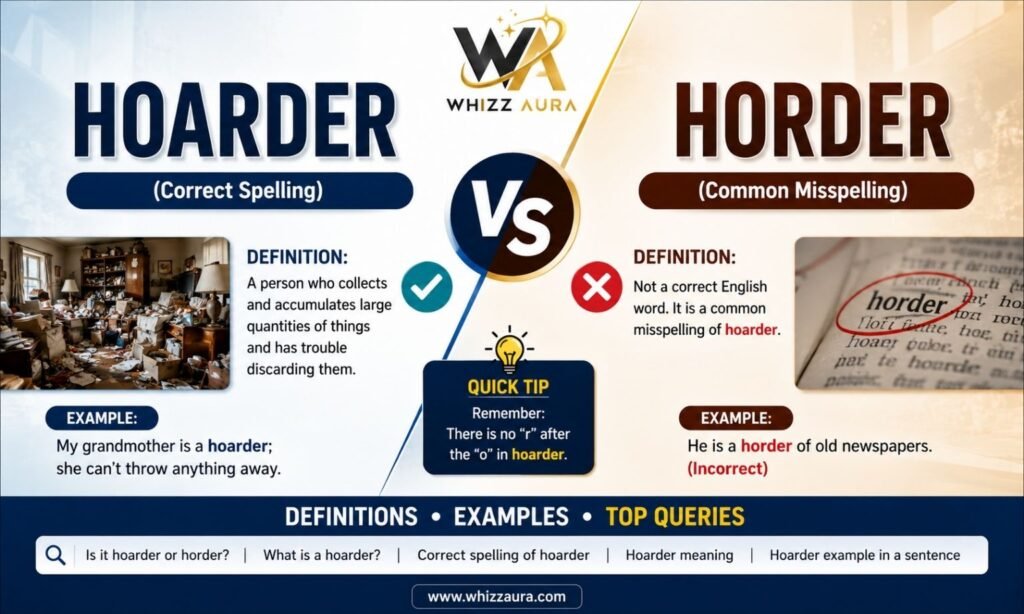
Since only one of these words is real, this section focuses on “hoarder” in depth, while confirming why “horder” never earns a place in formal writing.
Hoarder (noun): A person who collects, stores, and often refuses to discard large quantities of items, sometimes to an excessive or unhealthy degree.
- The show follows a professional organizer who helps a hoarder clean out her garage.
- He’s turned into a bit of a hoarder since he started collecting vintage comic books.
- The city hired a specialist to work with the hoarder living in the apartment upstairs.
- Being a hoarder isn’t just about clutter, it’s often tied to deeper emotional attachments.
- My grandmother was a hoarder of old photographs, keeping boxes in every closet.
Horder (not a standard word): This spelling appears occasionally in casual typing or texting, but it holds no dictionary definition and should be avoided in any formal or professional writing.
Popular user queries related to this topic include:
- Is horder a real word
- How do you spell hoarder correctly
- Hoarder vs hoarding difference
- What is a food hoarder called
- Hoarder disorder definition
British English vs American English Spelling
Good news here: this word does not change across the pond. Both British English and American English spell it the exact same way.
| Feature | British English | American English |
| Correct Spelling | Hoarder | Hoarder |
| Pronunciation Style | /ˈhɔːdə/ (non-rhotic, softer “r”) | /ˈhɔːrdər/ (rhotic, pronounced “r” sounds) |
| Common Usage | Same meaning, used identically | Same meaning, used identically |
The only real difference is how the “r” sounds when spoken, since American English pronounces it more clearly. The spelling itself never shifts, so writers on both sides of the Atlantic can use “hoarder” with total confidence.
My Memory Tricks and Tips
Here are three tricks that have genuinely helped writers I’ve worked with lock this in for good.
- The “Hoard of Gold” trick: Picture a dragon guarding a hoard of gold. The word “hoard” already has that “a” sitting right in the treasure pile, so the person doing the hoarding is a “hoarder.”
- The “Board Buddy” trick: “Hoarder” rhymes with “boarder” (someone who rents a room) and “border” shares a similar sound. Since “boarder” clearly needs that “oar” spelling, let it remind you that “hoarder” does too.
- The swap test: Replace the mystery word with “collector” in your sentence. If the sentence still makes sense, you need “hoarder,” never “horder,” since they share the same grammatical role.
Explore More Grammar Guides
Tying vs Tieing: What’s the Difference? Meaning, Usage & Examples
Anise vs Aniseed: What’s the Difference? Meaning, Usage & Examples
Channel or Chanel: What’s the Difference? Meaning, Usage & Examples
Weiner or Wiener: What’s the Difference? Meaning, Usage & Examples
Lent vs Lended: What’s the Difference? Meaning, Usage & Examples
Hoarder vs Horder: Which One Should You Use?
This one is refreshingly simple since only one option is grammatically valid.
- Use “hoarder” when describing a person who excessively collects or stores items.
- Use “hoarder” in clinical, psychological, or medical contexts discussing hoarding disorder.
- Use “hoarder” in casual conversation, writing, journalism, and business communication.
- Never use “horder” in any context, since it is not recognized in any major English dictionary.
Common Mistakes with Hoarder vs Horder
Mistake 1: Dropping the “a” entirely
❌ Incorrect: She’s a horder who never throws anything away.
✅ Correct: She’s a hoarder who never throws anything away.
Mistake 2: Confusing it with “hoarding” as a single word error
❌ Incorrect: His hording habits worry his family.
✅ Correct: His hoarding habits worry his family.
Mistake 3: Mixing it up with unrelated words like “border” or “boarder”
❌ Incorrect: The horder patrol stopped the hoarder at customs. (mixing up border and hoarder)
✅ Correct: The border patrol stopped the hoarder at customs.
Hoarder vs Horder in Everyday Examples
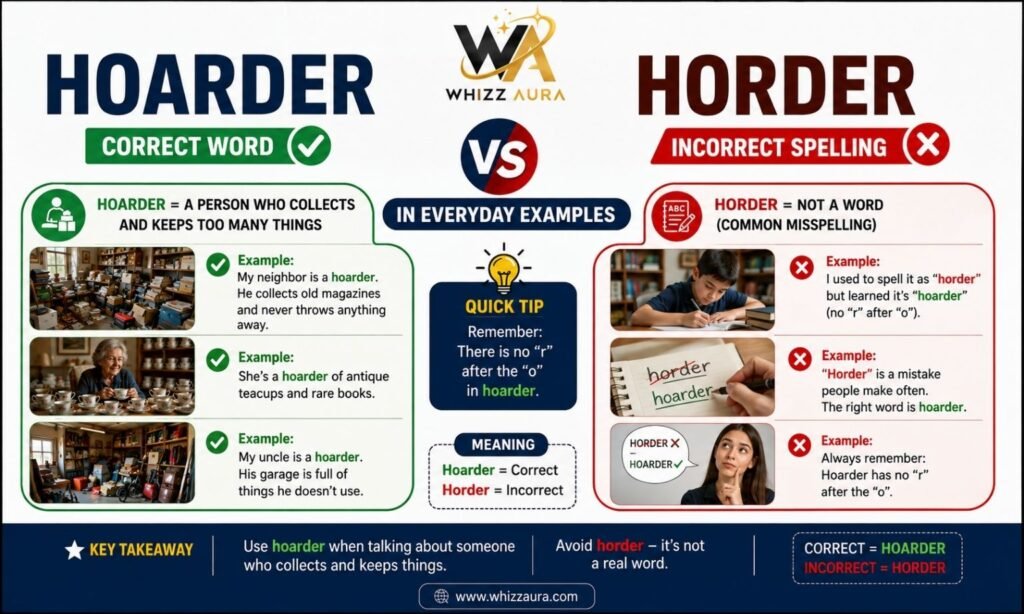
Texting: “lol my roommate is such a hoarder, her closet is insane”
Emails: “Please note that the client’s storage unit belongs to a known hoarder, so expect significant clutter during the walkthrough.”
Social Media: “Confession: I might be a plant hoarder. 47 pots and counting. 🌱”
Business Writing: "Our team recommends a decluttering consultation for clients who self-identify as hoarders before listing their property."
Comparison Table: Hoarder vs Horder
| Category | Hoarder | Horder |
| Part of Speech | Noun | Not applicable, not a word |
| Used For | Describing a person who excessively collects or stores items | Never used correctly in standard English |
| Example Sentence | “The hoarder filled every room with old magazines.” | No valid example exists |
| Memory Hook | Comes from “hoard,” think dragon’s treasure hoard | Remember: there is no “horder” in the dictionary |
Comparison Table: Hoarder vs Horder (Quick Reference)
| Question to Ask | If Yes, Use |
| Does the sentence involve someone collecting or storing excess items? | Hoarder |
| Am I unsure how to spell it and defaulting to how it sounds? | Stop and use hoarder, not horder |
| Am I writing in a formal, academic, or business context? | Hoarder is the only acceptable spelling |
Pro Tip I Learned
One editing hack completely changed how I catch spelling errors like this one: read your sentence out loud using text-to-speech software. When a computer voice reads “horder,” it often stumbles or mispronounces it strangely, which is an instant red flag that something is off. This tiny habit has saved me from embarrassing typos more times than I can count.
Quick Test I Created: Hoarder vs Horder Quiz
Fill in the blank with the correct word.
- My neighbor is a notorious ___ of old furniture.
- The documentary featured a family living with a ___ relative.
- She refuses to admit she’s turning into a ___.
- His apartment looked like something out of a ___ reality show.
- The support group helps people who identify as a ___.
- Being a ___ often comes from deep emotional attachment to objects.
- The therapist specializes in treating compulsive ___ behavior.
- My dad jokes that he’s a ___ of tools in the garage.
- The city fined the ___ for violating fire code with excessive clutter.
- She’s not messy, she’s a full-blown ___.
- The ___ kept every receipt since 1998.
- Their aunt was known around town as the neighborhood ___.
- The show profiles a different ___ in every episode.
- He denied being a ___, despite the piles of boxes.
- A professional organizer visited the ___ to help clear the home.
- The book explores what drives a ___ psychologically.
- My sister is a self-proclaimed shoe ___.
- The landlord discovered the tenant was a secret ___.
- Experts say a ___ often struggles with letting go of sentimental items.
- The article described him as a lifelong book ___.
Answer Key: (All 20 blanks are filled with “hoarder”)
Frequently Asked Questions
Is “horder” a real word?
No, “horder” is not a real word in any standard English dictionary. The only correct spelling is “hoarder.”
How do you spell hoarder correctly?
The correct spelling is “hoarder,” spelled H-O-A-R-D-E-R, derived from the verb “hoard.”
What does hoarder mean?
A hoarder is a person who excessively collects, stores, and often refuses to discard large quantities of items.
Is hoarder spelled the same in British and American English?
Yes, “hoarder” is spelled identically in both British and American English, with only minor pronunciation differences.
Why do people misspell hoarder as horder?
People often misspell it because the “oa” sound blends together in fast speech, making it sound like a simple “or” sound instead.
Conclusion
When it comes to hoarder vs horder, the answer is refreshingly clear cut. “Hoarder” is the only correct spelling, rooted in the Old English word “hord,” while “horder” simply doesn’t exist in any recognized dictionary. Once you understand that connection to “hoard,” the spelling becomes much easier to remember and much harder to forget.
Whether you’re writing a text to a friend, drafting a business email, or working on a formal report, sticking with “hoarder” keeps your writing polished and credible. Use the memory tricks, the quick swap test, and the pronunciation guide from this article any time doubt creeps in.

Shoaib Ahmad is an SEO and digital content professional with experience in creating helpful, easy-to-understand online content. At Whizz Aura, he focuses on English grammar, vocabulary, word meanings, sentence structure, and practical language tips. His goal is to make learning English simple, clear, and useful for everyday communication.





2 thoughts on “Hoarder vs Horder: What’s the Difference? Meaning, Usage & Examples”