
You typed it fast, hit send, and then that little nagging feeling hit you. Was it “experiance” or “experience”? You are not alone. This is one of the most commonly misspelled words in the English language, and it trips up native speakers just as often as English learners.
The confusion makes sense once you think about it. English spelling loves to break its own rules, and this word has a sneaky vowel pattern that just feels like it should be different. The good news is that once you understand why the mix-up happens, you will never second guess yourself again. Let’s clear up Experiance vs Experience for good.
Experiance vs Experience: Quick Answer 🎯
Quick Answer: “Experience” is the only correct spelling. 📝 “Experiance” is a common misspelling and does not exist in standard English dictionaries. ✅
Correct: ✅ She has ten years of experience in marketing.
Incorrect: ❌ She has ten years of experiance in marketing.
There is no debate here and no regional exception. “Experience” wins every single time.
Why I Found It’s Spelled This Way?
The word “experience” traces back to the Latin word “experientia,” which means “a trial, proof, or experiment.” That Latin root traveled through Old French as “experience” before landing in Middle English around the 14th century.
The spelling has stayed remarkably stable because it kept its Latin backbone intact. The “-ence” ending is a common suffix borrowed from Latin, seen in words like “difference,” “reference,” and “patience.” Once you notice that pattern, the “ence” ending starts to feel like family rather than a random rule.
“Experiance” is not a variant, a dialect spelling, or an old form. It is simply a phonetic guess that does not match the word’s actual history.
The Simple Rule for Stopping the Confusion
Here is a one second mental test you can run every single time.
Say the word slowly in your head: ex-PEER-ee-ence. Notice the ending sounds like “-ence,” not “-ance.” If you can remember that “science” and “experience” share that same “-ence” family feel, you are set.
Quick Tip: Think “Experience has Science inside its sound.” Both end in that soft “-ence” tone, never “-ance.”
Whenever you are unsure, swap in the word “sentence” mentally. You would never spell that “sentance,” and the same logic locks in “experience.”
Pronunciation Guide I Use
Getting the spelling right often starts with hearing the word correctly. Here is how “experience” actually sounds, broken down for clarity.
| Word | Phonetic Spelling | Sound Focus |
| Experience (correct) | ik-SPEER-ee-uhns | Stress falls on the second syllable, “SPEER” |
| Experiance (incorrect) | Not a recognized pronunciation | This spelling does not exist in any dictionary |
Mouth movement tip: When you say the “-ence” ending, your tongue should sit near the roof of your mouth for a soft “uhns” sound, not an open “ants” sound like in “distance.” Practice saying “experience” slowly three times and you will feel the difference in your mouth.
Experiance vs Experience: Definitions with Examples & Top Queries
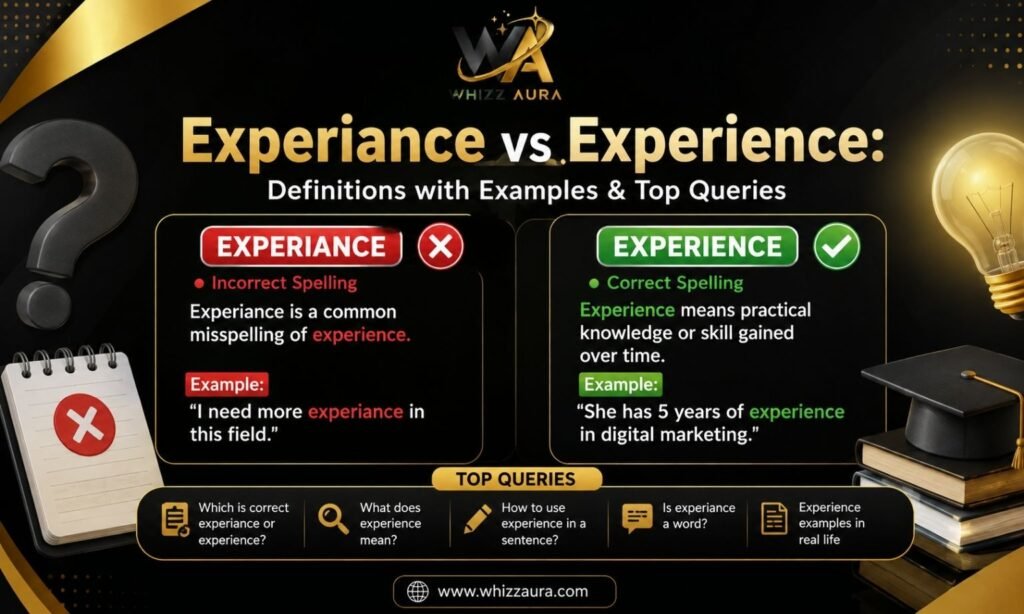
Since “experiance” is not a real word, this section focuses entirely on “experience,” its meanings, and how people search for it online.
Experience (noun) Practical contact with and observation of facts or events, or the knowledge and skill gained from doing something over time.
- I gained valuable experience working at the hospital.
- This job requires five years of experience in sales.
- Traveling alone was an eye-opening experience for me.
- Her experience with children made her the perfect teacher.
- We want every customer to have a great experience.
Experience (verb) To encounter or undergo an event or feeling firsthand.
- Many people experience anxiety before public speaking.
- Did you experience any delays on your flight?
- Children experience the world differently than adults.
- We experienced heavy rain during our hike.
- She wants to experience life in another country.
Popular user queries related to this word include:
- Is it “experiance” or “experience”
- How do you spell experience correctly
- Experience vs experiance grammar
- Why do people misspell experience
- Experience meaning and example sentences
British English vs American English Spelling
Good news here: this spelling is identical across both dialects. Unlike words such as “colour” versus “color” or “organise” versus “organize,” Experience vs Experience spelling stays the same everywhere English is spoken.
| Feature | British English | American English |
| Spelling | Experience | Experience |
| Pronunciation | ik-SPEER-ee-uhns | ik-SPEER-ee-uhns |
| Meaning | Same | Same |
| Common Misspelling | Experiance | Experiance |
No matter where your reader lives, “experience” is the only spelling you need to remember.
Explore More Grammar Guides
Tying vs Tieing: What’s the Difference? Meaning, Usage & Examples
Hoarder vs Horder: What’s the Difference? Meaning, Usage & Examples
Channel or Chanel: What’s the Difference? Meaning, Usage & Examples
Weiner or Wiener: What’s the Difference? Meaning, Usage & Examples
Lent vs Lended: What’s the Difference? Meaning, Usage & Examples
My Memory Tricks and Tips
I have tested these three tricks with students and coworkers, and they stick every time.
1. The “Science” Connection “Experience” and “science” both end in that soft “-ence” sound. If you trust yourself to spell “science” right, let that same trust carry over.
2. The Acronym Method Remember E.N.C.E: “Every Noun Can Ease” into that ending. It sounds silly, but silly things stick in memory better than boring rules.
3. The Replacement Test Swap in “patience” mentally before you finish typing. “I have patience” and “I have experience” share that identical ending pattern, so if one feels right, the other should too.
Experiance vs Experience: Which One Should You Use?
This one is simple because only one option is grammatically valid.
- Use “experience” in resumes, cover letters, and job applications.
- Use “experience” when describing personal events or emotional moments.
- Use “experience” in business writing, emails, and formal documents.
- Never use “experiance” anywhere. It is always a spelling error, not a stylistic choice.
Common Mistakes with Experiance vs Experience
Mistake 1: Phonetic Spelling People spell words the way they sound, and “ance” feels natural after certain consonant sounds.
- ❌ Incorrect: I have a lot of experiance in customer service.
- ✅ Correct: I have a lot of experience in customer service.
Mistake 2: Autocorrect Overconfidence Some people trust muscle memory over their spell checker and type fast without double checking.
- ❌ Incorrect: This was a life changing experiance.
- ✅ Correct: This was a life changing experience.
Mistake 3: Confusing It With Similar Words Words like “annoyance” and “appearance” end in “-ance,” which can bleed into how people spell “experience.”
- ❌ Incorrect: Her experiance at the concert was amazing.
- ✅ Correct: Her experience at the concert was amazing.
Experiance vs Experience in Everyday Examples
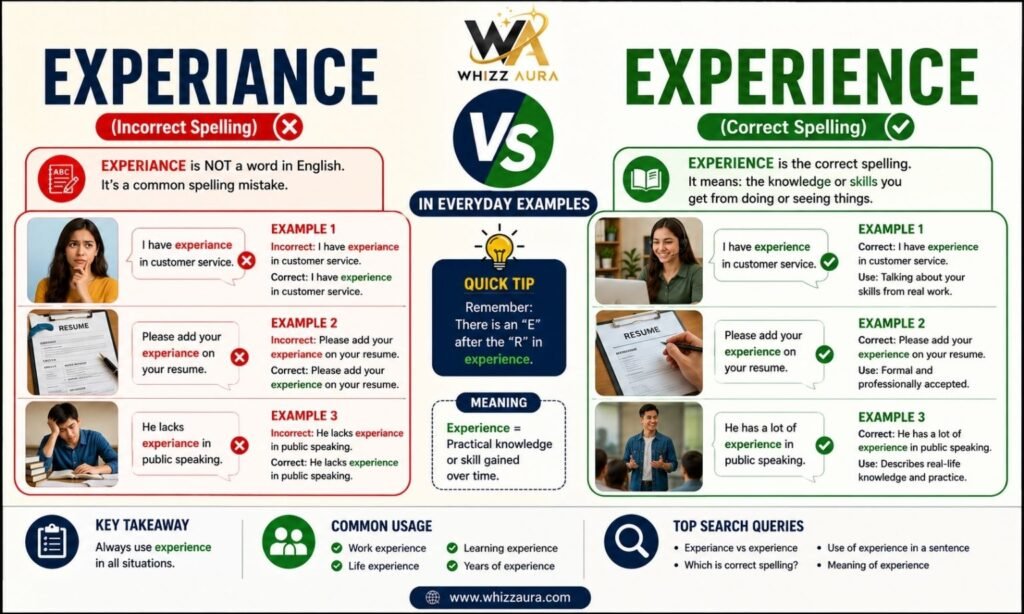
Texting: “omg that concert was such a good experience 🎶”
Emails: “Thank you for sharing your experience with our support team.”
Social Media: “Best travel experience of my life, hands down. #wanderlust”
Business Writing: “Candidates should have a minimum of three years of relevant experience.”
Comparison Table: Experiance vs Experience
| Category | Experience (Correct) | Experiance (Incorrect) |
| Part of Speech | Noun and Verb | Not applicable |
| Used For | Describing knowledge, events, or skills | Never used, common typo |
| Example | She has great experience in design. | Not a valid sentence |
| Memory Hook | Ends like “science” | Does not follow any real rule |
Comparison Table: Experiance vs Experience (Quick Reference)
| Question to Ask | If Yes, Use |
| Does it end in an “-ence” sound like “science”? | Experience |
| Are you unsure and want the safe, correct choice? | Experience |
| Have you seen this word in a dictionary? | Experience (never “experiance”) |
Pro Tip I Learned
Editing Hack: Turn on your device’s text to speech feature and have it read your writing back to you. If a spelling looks fine but sounds off, that mismatch is often where hidden errors like “experiance” hide. Reading with your ears catches what your eyes skip over.
Quick Test I Created: Experiance vs Experience Quiz
Fill in each blank with the correct spelling.
- She has years of ______ in nursing.
- This was the best ______ of my trip.
- Did you ______ any turbulence on the flight?
- His work ______ is impressive.
- We want to ______ new cultures.
- That was a scary ______ for the kids.
- My internship gave me real world ______.
- They ______ the storm together.
- Customer ______ matters more than price.
- I want to ______ life outside my hometown.
- Her teaching ______ spans two decades.
- We ______ a small delay at the airport.
- This job needs prior ______ in coding.
- It was an unforgettable ______.
- Many people ______ stage fright before a speech.
- He listed his ______ on the resume.
- Traveling solo helped her ______ independence.
- The training builds hands on ______.
- We hope you ______ great service today.
- Her ______ in finance helped her get hired.
Answer Key: (1. experience, 2. experience, 3. experience, 4. experience, 5. experience, 6. experience, 7. experience, 8. experienced, 9. experience, 10. experience, 11. experience, 12. experienced, 13. experience, 14. experience, 15. experience, 16. experience, 17. experience, 18. experience, 19. experience, 20. experience)
Frequently Asked Questions
Is “experiance” ever correct in English?
No, “experiance” is never correct. It is a common misspelling of “experience” and does not appear in any standard dictionary.
How do you remember the correct spelling of experience?
Connect it to the word “science,” since both share that same soft “-ence” ending sound.
Does British English spell experience differently than American English?
No, both British and American English spell it exactly the same way: “experience.”
What part of speech is the word experience?
“Experience” functions as both a noun, meaning knowledge gained over time, and a verb, meaning to undergo something firsthand.
Why do so many people misspell experience as experiance?
Most people misspell it because they are relying on how the word sounds rather than its actual Latin based spelling pattern.
Conclusion
The debate around Experiance vs Experience really is not a debate at all. “Experience” is the correct and only accepted spelling, while “experiance” is simply a phonetic slip that many people make without realizing it. Once you connect the word to its “-ence” family, like “science” and “patience,” the correct spelling becomes second nature.
Spelling mistakes like this one are easy to fix once you know the trick behind them. Whether you are writing a resume, an email, or a quick text to a friend, using “experience” correctly shows attention to detail and builds trust with your reader.

Shoaib Ahmad is an SEO and digital content professional with experience in creating helpful, easy-to-understand online content. At Whizz Aura, he focuses on English grammar, vocabulary, word meanings, sentence structure, and practical language tips. His goal is to make learning English simple, clear, and useful for everyday communication.