
Have you ever typed a sentence, stared at it, and thought “wait, is that even a word?” You’re not alone. The Lent vs Lended mix-up trips up native speakers and English learners alike, and honestly, it makes sense why. English verbs love to break their own rules, and “lend” is one of the biggest rule-breakers in the bunch.
Getting this right matters more than you might think. Whether you’re writing a business email, a school essay, or a text to a friend, using the wrong form can make your writing look careless, even if your grammar knowledge is actually solid. This guide breaks down everything you need to know about Lent vs Lended, so you never have to second-guess yourself again.
Lent vs Lended: Quick Answer
Lent is the correct past tense and past participle of the verb “lend.” Lended is not a standard English word, even though it feels like it should be.
✅ Correct: She lent me her umbrella yesterday.
❌ Incorrect: She lended me her umbrella yesterday.
✅ Correct: The bank has lent thousands of dollars this year.
❌ Incorrect: The bank has lended thousands of dollars this year.
Why I Found It’s Spelled / Used This Way
The verb “lend” comes from Old English “lænan,” which is related to the word “loan.” Like many old, frequently used English verbs, “lend” became what’s called an irregular verb over centuries of use.
Irregular verbs don’t follow the standard “add -ed” pattern that regular verbs use. Instead, their past tense forms often shift the vowel sound or change entirely. Think of similar verbs like “send” (became “sent”), “spend” (became “spent”), and “bend” (became “bent”). “Lend” followed that exact same pattern, turning into “lent.”
Because so many English speakers are used to adding “-ed” to make a past tense verb, the brain naturally wants to create “lended.” But irregular verbs simply don’t play by that rule, and “lend” has never had a standard “lended” form in accepted English grammar.
The Simple Rule for Stopping the Confusion
Here’s a one-second test you can use every single time. Just swap in the word “sent” (from “send”) into your sentence. If “sent” sounds natural, then “lent” is correct too, since both verbs follow the identical irregular pattern.
Quick Tip: “Send becomes sent, so lend becomes lent.” If you remember this one pairing, you’ll never write “lended” again.
Pronunciation Guide I Use
Getting the sound right helps lock in the spelling. Here’s a simple breakdown of how “lent” is pronounced.
| Word | Phonetic Spelling | Sound Focus |
| Lend | /lɛnd/ | Short “e” sound, ends with a soft “nd” |
| Lent | /lɛnt/ | Short “e” sound, ends with a crisp “t” |
Practical tip: Say the word “sent” out loud, then say “lent” right after it. Notice how your tongue taps the roof of your mouth for that final “t” sound in both words. That same mouth movement is exactly what you want for “lent,” never a soft “-ed” ending.
Lent vs Lended: Definitions with Examples & Top Queries

Lent (Correct Form)
Part of speech: Verb (past tense and past participle of “lend”)
Definition: To have given something to someone temporarily, with the expectation that it will be returned.
- I lent my brother my car for the weekend.
- The library lent out over 500 books last month.
- She has lent her expertise to several nonprofit organizations.
- We lent them our tent for the camping trip.
- He had lent money to a friend before he lost his job.
Lended (Incorrect Form)
Part of speech: None. “Lended” is not recognized as standard English in any major dictionary or style guide.
Why it shows up: People create “lended” by mistakenly applying the regular “-ed” rule to an irregular verb. It’s a common error, but it’s still considered incorrect in formal and informal writing.
Popular user queries related to this topic:
- Is “lended” a real word?
- What is the past tense of lend?
- Lent vs lended grammar rule
- Has lent or has lended, which is correct?
- Lend, lent, lent conjugation
British English vs American English Spelling 🇬🇧🇺🇸
Good news here: this is one grammar rule that doesn’t change across the pond. Both British English and American English treat “lend” as an irregular verb, and both use “lent” as the correct past tense and past participle form.
| Feature | British English | American English |
| Past tense of “lend” | Lent | Lent |
| Past participle | Lent | Lent |
| “Lended” accepted? | No | No |
| Common usage | “I lent him my pen.” | “I lent him my pen.” |
There’s no regional exception, no dialect difference, and no alternate spelling. “Lent” is universally correct, and “lended” is universally wrong.
My Memory Tricks and Tips
Here are three creative ways to lock this rule into your memory for good.
- The “Sent” Swap Trick: Remember that “send” turns into “sent,” and “lend” follows the exact same pattern to become “lent.” If one works, so does the other.
- The Letter Count Trick: “Lended” has more letters than “lent,” but grammar isn’t about adding extra letters for the past tense of this verb. Shorter and simpler wins here.
- The Religious Season Trick: The Christian season of “Lent” is spelled exactly like the past tense of “lend.” If you already know how to spell that holiday season, you already know how to spell the verb correctly.
Lent vs Lended: Which One Should You Use?
Use lent in every single situation involving the past tense or past participle of the verb “lend.”
- Use lent when describing something you gave to someone temporarily in the past.
- Use lent in perfect tenses, such as “has lent,” “have lent,” or “had lent.”
- Use lent in formal writing, business communication, academic papers, and casual conversation.
- Never use lended in any context, since it is not a recognized English word.
Explore More Grammar Guides
Habit vs Habbit: What’s the Difference? Meaning, Usage & Examples
Anise vs Aniseed: What’s the Difference? Meaning, Usage & Examples
Channel or Chanel: What’s the Difference? Meaning, Usage & Examples
Weiner or Wiener: What’s the Difference? Meaning, Usage & Examples
Putting vs Puting: What’s the Difference? Meaning, Usage & Examples
Common Mistakes with Lent vs Lended
Mistake 1: Using “lended” in past tense sentences
❌ Incorrect: He lended his notes to a classmate.
✅ Correct: He lent his notes to a classmate.
Mistake 2: Using “lended” after helping verbs like “has” or “have”
❌ Incorrect: The company has lended millions in loans.
✅ Correct: The company has lent millions in loans.
Mistake 3: Confusing “lent” with “loaned”
❌ Incorrect thinking: “Lent” and “loaned” can never both be correct.
✅ Correct clarification: Both “lent” and “loaned” are acceptable past tense forms, but “loaned” comes from the noun “loan” used as a verb, while “lent” is the traditional irregular form.
Lent vs Lended in Everyday Examples
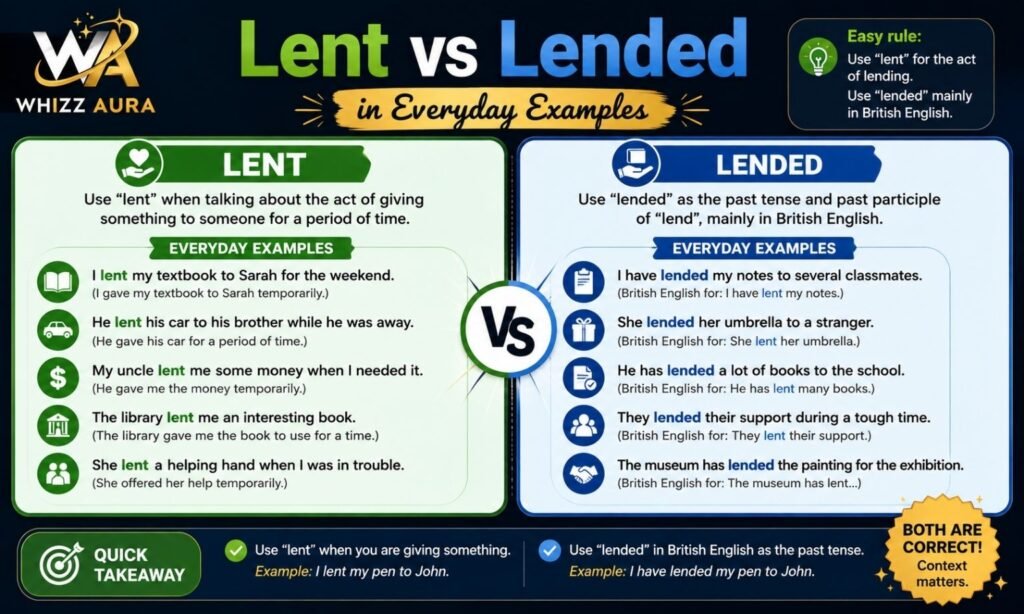
Texting: “hey can u send that charger back? i lent it to u last week lol”
Emails: “As discussed, we have lent the equipment to your team through the end of the quarter.”
Social Media: “Grateful to everyone who lent their time and skills to our community cleanup this weekend! 🙌”
Business Writing: “The firm has lent significant resources to support the merger process over the past six months.”
Comparison Table: Lent vs Lended
| Category | Lent | Lended |
| Part of speech | Verb (past tense/participle) | Not a recognized word |
| Used for | Past actions of giving temporarily | N/A |
| Example | “I lent her my jacket.” | “I lended her my jacket.” (incorrect) |
| Memory hook | Rhymes with “sent” and “spent” | None, avoid using entirely |
| Dictionary status | Standard, accepted | Not listed in major dictionaries |
Comparison Table: Lent vs Lended (Quick Reference)
| Question to Ask | If Yes → Use |
| Are you describing a past action of lending something? | Lent |
| Are you using a helping verb like “has,” “have,” or “had”? | Lent |
| Are you unsure and tempted to add “-ed”? | Stop, use “lent” instead |
| Are you writing formally or casually? | Lent, either way |
Pro Tip I Learned 💡
Whenever I’m unsure about an irregular verb, I read my sentence out loud using text-to-speech software. Hearing “lended” spoken aloud sounds jarring and unnatural almost instantly, which makes the error much easier to catch than reading silently on a screen.
Quick Test I Created: Lent vs Lended Quiz
Fill in each blank with the correct word.
- She _____ me her favorite book last summer.
- The bank has _____ over a million dollars this year.
- He _____ his car to his cousin for the trip.
- We had _____ them our tools before the storm hit.
- They _____ their support to the local charity.
- I _____ my notes to a classmate yesterday.
- Has anyone ever _____ you money before?
- The library _____ out hundreds of books last week.
- My neighbor _____ me a ladder last month.
- The company has _____ equipment to several partners.
- Grandma _____ us her recipe book for the party.
- Who _____ you that jacket?
- I have never _____ anyone my car before.
- The teacher _____ extra pencils to the students.
- She had _____ her friend some money last year.
- We _____ our tent to the camping club.
- He has _____ his skills to many volunteer projects.
- The museum _____ the painting to another gallery.
- I _____ my headphones to my coworker this morning.
- They have _____ their expertise to the new team.
Answer Key: (1. lent, 2. lent, 3. lent, 4. lent, 5. lent, 6. lent, 7. lent, 8. lent, 9. lent, 10. lent, 11. lent, 12. lent, 13. lent, 14. lent, 15. lent, 16. lent, 17. lent, 18. lent, 19. lent, 20. lent)
Frequently Asked Questions
Is “lended” a real word in English?
No, “lended” is not a standard English word. The correct past tense and past participle of “lend” is “lent.”
What is the past tense of “lend”?
The past tense of “lend” is “lent.” This applies in both British English and American English.
Is it “has lent” or “has lended”?
“Has lent” is correct. “Lended” is never used with helping verbs like “has,” “have,” or “had.”
Are “lent” and “loaned” both correct?
Yes, both “lent” and “loaned” are grammatically correct past tense forms, though “lent” is the traditional irregular verb form.
Why do people think “lended” is correct?
People often assume “lend” follows the regular “-ed” pattern used by most English verbs, but “lend” is irregular, so it becomes “lent” instead.
Conclusion
The debate over Lent vs Lended really comes down to one simple fact: “lend” is an irregular verb, and its correct past tense form is always “lent.” No matter how tempting it feels to add that “-ed” ending, “lended” simply isn’t recognized as proper English in any dictionary, style guide, or dialect.
The good news is that once this rule clicks, it sticks for good. Use the “send becomes sent, lend becomes lent” trick anytime you feel unsure, and you’ll write with confidence every time.

Shoaib Ahmad is an SEO and digital content professional with experience in creating helpful, easy-to-understand online content. At Whizz Aura, he focuses on English grammar, vocabulary, word meanings, sentence structure, and practical language tips. His goal is to make learning English simple, clear, and useful for everyday communication.