
If you have ever paused mid-sentence wondering whether to write “humorous” or “humerous,” you are not alone. This mix-up shows up constantly in emails, social media captions, and even published articles, and it trips up native speakers just as often as English learners.
The confusion makes sense once you look at it closely. Both words sound almost identical when spoken quickly, and English spelling rules are famously inconsistent about when to use “or” versus “er.” Add in autocorrect, which sometimes “fixes” the wrong word, and it is easy to see why this pair causes so much trouble.
Getting this right matters more than people think. Using “humerous” instead of “humorous” in a professional email, a resume, or a blog post can make you look careless, even if your idea was funny and your grammar was otherwise flawless. This guide breaks down the difference for good, so you never have to second-guess yourself again.
Humorous vs Humerous: Quick Answer with emojies
😄 Humorous is the correct spelling for describing something funny or amusing. 🦴 Humerus (not “humerous”) is the medical term for the long bone in your upper arm, and “humerous” is simply a common misspelling with no accepted meaning.
Correct: ✅ Her humorous speech had the whole room laughing.
Incorrect: ❌ Her humerous speech had the whole room laughing.
Correct: ✅ He fractured his humerus during the game.
Incorrect: ❌ He fractured his humorous during the game.
Why I Found It’s Spelled / Used This Way
The word humorous comes from “humor,” which traces back to Latin humor (meaning fluid or moisture) and later Old French. In medieval medicine, “humors” referred to four bodily fluids believed to control mood and temperament. Over time, “humor” shifted in meaning to describe a person’s mood, and eventually settled into meaning something funny or amusing. The adjective form simply adds the standard “-ous” suffix, giving us “humorous.”
Humerus, on the other hand, comes directly from Latin, where it referred to the shoulder or upper arm. It kept its Latin spelling almost exactly, which is why it looks and sounds so different in origin from “humorous,” even though English speakers often blend the two in casual speech.
“Humerous” is not a real word in any dictionary. It is simply a spelling error that blends the sound of “humorous” with the letters of “humerus.”
The Simple Rule for Stopping the Confusion
Here is a one-second mental test you can use every time.
Quick Tip: If your sentence is about comedy, laughter, or something funny, think “humOR” is in there, so it is humorOUS. If your sentence is about a bone or the arm, think “humerus,” like a skeleton diagram.
Try this swap test: replace the word with “funny.” If “funny” fits the sentence, you need humorous. If “funny” sounds ridiculous in that spot, you are probably talking about the arm bone, so you need humerus.
Pronunciation Guide I Use
| Word | Phonetic Spelling | Sound Focus |
| Humorous | HYOO-mer-us | Stress falls on the first syllable, “HYOO,” like “humor” |
| Humerus | HYOO-mer-us | Nearly identical sound, stress also on “HYOO” |
Here is the tricky part: these two words are pronounced almost the same way, which is exactly why people mix up the spelling. The real difference lives in the spelling, not the sound.
Mouth-movement tip: When you say “humorous,” round your lips slightly on the “or” sound in the middle, echoing the word “humor.” There is no separate trick for pronunciation since the words sound alike, so lean on spelling and context instead.
Humorous vs Humerous: Definitions with Examples & Top Queries
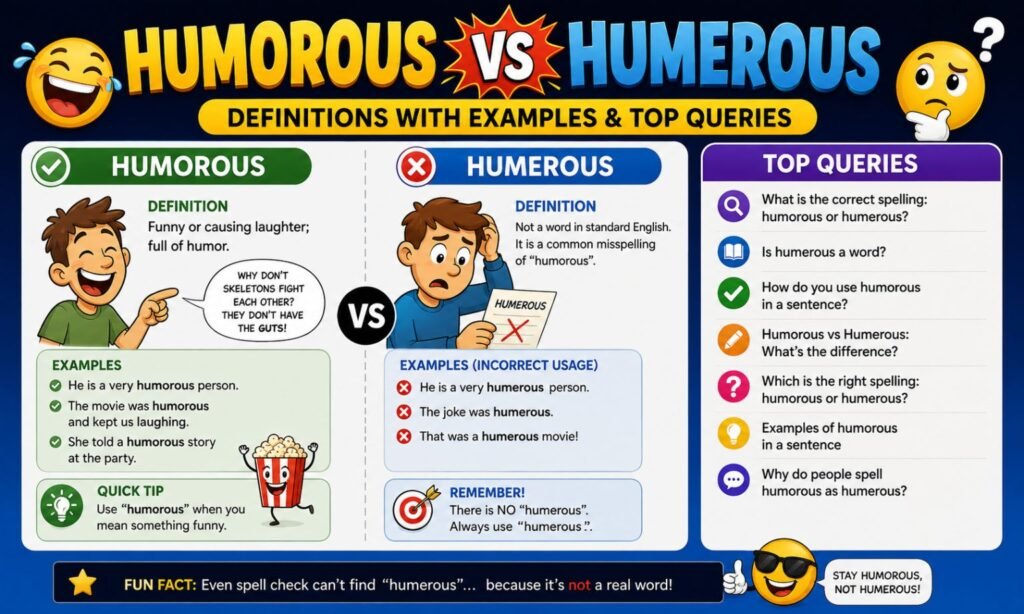
Humorous (adjective): Describing something that is funny, amusing, or intended to make people laugh.
Example sentences:
- The comedian told a humorous story about his first job.
- Her humorous tone made the meeting feel less stressful.
- The movie was humorous without being silly.
- He has a humorous way of explaining complicated topics.
- Their wedding vows were sweet and humorous at the same time.
Humerus (noun): The long bone that runs from the shoulder to the elbow in the human arm.
Example sentences:
- The x-ray showed a clean break in the humerus.
- Athletes sometimes injure the humerus during contact sports.
- The humerus connects to the shoulder blade and the forearm.
- A fall from the ladder fractured her humerus.
- The anatomy textbook labeled the humerus in bright red.
Popular user queries related to this topic:
- Is “humerous” a real word?
- Humorous vs humerous meaning
- How do you spell the arm bone word?
- Humorous synonym funny
- Humerus bone location diagram
British English vs American English Spelling
The spelling of humorous is identical in both British and American English, which is somewhat unusual since many “-or” words change to “-our” in British spelling (like “color” versus “colour”). Similarly, humerus is spelled the same way in both dialects because it is a fixed anatomical term borrowed from Latin.
| Feature | British English | American English |
| Spelling of “funny” adjective | humorous | humorous |
| Spelling of arm bone | humerus | humerus |
| Related noun (“humor/humour”) | humour | humor |
| Pronunciation | Same | Same |
Notice that while “humor” becomes “humour” in British English, the adjective humorous does not change. This is one of those quirky exceptions that trips up even careful writers.
My Memory Tricks and Tips
Here are three tricks that have helped readers lock in the difference for good.
- Trick 1: “OR” for funny. Humorous has “OR” hiding in it, just like “humor.” If you are talking about comedy, look for the “OR.”
- Trick 2: “ER” for bone, like “arm.” Humerus has “ER” in the middle, and “ER” can remind you of “emergency room,” which is where you go if you break your arm bone.
- Trick 3: The “no such word” rule. Simply remember that “humerous” does not exist in any dictionary. If you type it, spellcheck should flag it, and you should stop and pick either “humorous” or “humerus” instead.
Pro Tip: Say the sentence out loud and ask “is this about a joke or a bone?” That single question solves the mix-up almost every time.
Humorous vs Humerous: Which One Should You Use?
Use humorous when:
- You are describing a joke, story, or funny situation.
- You want to describe someone’s comedic personality or writing style.
- You are reviewing a movie, book, or performance that made you laugh.
Use humerus when:
- You are discussing human or animal anatomy.
- You are describing a bone injury, fracture, or surgery.
- You are writing in a medical, scientific, or educational context about the arm.
Never use “humerous” in any context, since it is not a recognized word in English.
Common Mistakes with Humorous vs Humerous
Mistake 1: Using “humerous” to describe something funny
Incorrect: That was such a humerous joke.
Correct: That was such a humorous joke.
Mistake 2: Confusing the bone name with the comedy word
Incorrect: The doctor pointed to his humorous on the x-ray.
Correct: The doctor pointed to his humerus on the x-ray.
Mistake 3: Assuming “humerous” is just a casual spelling variant
Incorrect: I know it’s spelled “humorous” but “humerous” is fine for texting.
Correct: “Humerous” is never correct in any setting, casual or formal.
Explore More Grammar Guides
Totaling vs Totalling: What’s the Difference? Meaning, Usage & Examples
Organizing vs Organising: What’s the Difference? Meaning, Usage & Examples
Tomorrow vs Tommorow: What’s the Difference? Meaning, Usage & Examples
Leaped vs Leapt: What’s the Difference? Meaning, Usage & Examples
Guidance vs Guidence: What’s the Difference? Meaning, Usage & Examples
Humorous vs Humerous in Everyday Examples
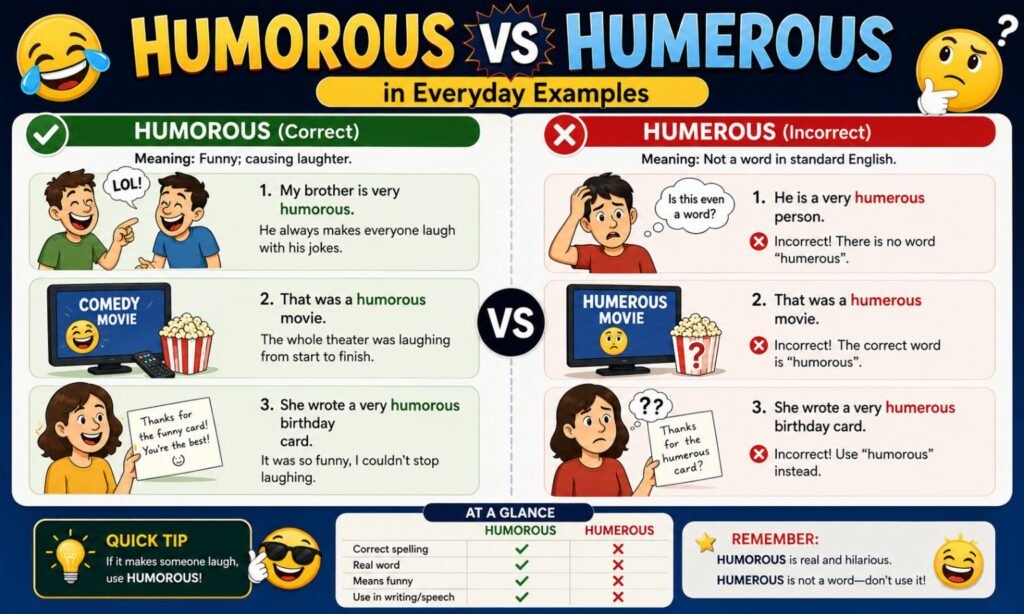
Texting: “lol your last text was so humorous, I actually laughed out loud”
Emails: “Thank you for the humorous story you shared at the start of your presentation, it really lightened the mood.”
Social Media: “This account posts the most humorous memes about Monday mornings.”
Business Writing: “The keynote speaker balanced serious data with humorous anecdotes, keeping the audience engaged throughout the session.”
Comparison Table: Humorous vs Humerous
| Category | Humorous (Option A) | Humerus (Option B) |
| Part of speech | Adjective | Noun |
| Used for | Describing something funny | Naming the upper arm bone |
| Example | “That was a humorous movie.” | “She broke her humerus.” |
| Memory hook | Has “OR” like humor | Has “ER” like emergency room |
| Real word? | Yes | Yes (as “humerus,” not “humerous”) |
Comparison Table: Humorous vs Humerous (Quick Reference)
| Question to Ask | If Yes → Use |
| Is it about a joke, comedy, or funny moment? | Humorous |
| Is it about the arm bone or anatomy? | Humerus |
| Are you unsure and just guessing at spelling? | Stop, check this guide, never write “humerous” |
| Is it a medical report or x-ray description? | Humerus |
| Is it a review, caption, or funny story? | Humorous |
Pro Tip I Learned
Editing Hack: Use your phone’s text-to-speech feature to read your writing back to you. When you hear “humorous” or “humerus” out loud, pause and check the spelling against your sentence’s meaning before moving on. This catches mistakes your eyes tend to skip over.
Quick Test I Created: Humorous vs Humerous Quiz
Fill in the blank with the correct word.
- The comedian’s ___ jokes had everyone laughing.
- She fractured her ___ falling off her bike.
- His ___ personality made him popular at parties.
- The x-ray revealed a hairline crack in the ___.
- That was the most ___ movie I have seen all year.
- The surgeon repaired the broken ___ carefully.
- Their ___ banter kept the podcast entertaining.
- The skeleton model clearly labeled the ___.
- Grandpa always tells the most ___ stories at dinner.
- Physical therapy helped restore movement in his ___.
- The article had a light, ___ tone despite the serious topic.
- The vet examined the dog’s injured ___.
- Her wedding toast was both touching and ___.
- The anatomy quiz asked students to locate the ___.
- The sitcom relies on ___ misunderstandings for laughs.
- He wore a sling to protect his healing ___.
- The birthday card had a ___ message inside.
- The radiologist noted a fracture near the ___.
- The teacher used ___ examples to keep students engaged.
- Sports injuries to the ___ are common in baseball pitchers.
Answer Key: (1. humorous, 2. humerus, 3. humorous, 4. humerus, 5. humorous, 6. humerus, 7. humorous, 8. humerus, 9. humorous, 10. humerus, 11. humorous, 12. humerus, 13. humorous, 14. humerus, 15. humorous, 16. humerus, 17. humorous, 18. humerus, 19. humorous, 20. humerus)
Frequently Asked Questions
Is “humerous” a real word?
No, “humerous” is not a real word in English. It is a common misspelling that blends “humorous” and “humerus.”
What does humorous mean?
Humorous means funny, amusing, or intended to make people laugh, and it is used as an adjective.
What is the humerus bone?
The humerus is the long bone that runs from the shoulder to the elbow in the human arm.
Why do people confuse humorous and humerus?
The two words sound almost identical when spoken, which causes writers to mix up the spelling even though the meanings are completely unrelated.
How can I remember the difference between humorous and humerus?
Remember that “humorous” contains “OR” like the word “humor,” while “humerus” refers to a bone and often comes up in medical contexts.
Conclusion
The humorous vs humerous debate really comes down to one simple fact: only “humorous” is a real, dictionary-approved word describing something funny, while “humerus” refers to the arm bone, and “humerous” is not a word at all. Once you remember that “humor” hides inside “humorous,” the confusion tends to disappear for good.
Whether you are writing a funny caption, a professional email, or a medical report, choosing the right word shows attention to detail and builds trust with your reader. Small spelling mistakes like this one can quietly undermine an otherwise great piece of writing, so it pays to slow down and double-check.

Shoaib Ahmad is an SEO and digital content professional with experience in creating helpful, easy-to-understand online content. At Whizz Aura, he focuses on English grammar, vocabulary, word meanings, sentence structure, and practical language tips. His goal is to make learning English simple, clear, and useful for everyday communication.





1 thought on “Humorous vs Humerous: What’s the Difference? Meaning, Usage & Examples”