
Have you ever typed a sentence, stared at it, and thought “wait, does that word have one T or two”? You are not alone. The putting vs puting mix-up is one of the most common spelling slip-ups in English, and it trips up native speakers just as often as learners.
The confusion makes sense once you think about it. English spelling rules around doubling consonants feel random if nobody ever explained them to you. Your fingers type fast, your brain autocorrects out loud, and suddenly “puting” slips onto the page looking almost right.
Here’s why it matters. A misspelled word in a text to a friend is harmless. But in a resume, email, or business report, it signals carelessness. This guide clears up putting vs puting for good, with rules, tables, tricks, and a quiz so the correct spelling sticks in your memory permanently.
Putting vs Puting: Quick Answer 🎯
“Putting” is the only correct spelling. ✅ “Puting” is always a misspelling, no matter the context, tense, or sentence. ❌
- ✅ Correct: She is putting the dishes away.
- ❌ Incorrect: She is puting the dishes away.
Quick takeaway: If you ever see “puting” written anywhere, including in your own draft, add a second T immediately.
Why I Found It’s Spelled / Used This Way
The word putting comes from the base verb “put,” which traces back to Old English “putian,” meaning to push or thrust something into place. Over centuries, “put” settled into its short, simple modern form.
When English speakers add “-ing” to short verbs that end in a single consonant preceded by a single vowel, the spelling rule requires doubling that final consonant. That is exactly what happens with put, becoming putting.
This doubling rule protects the pronunciation. Without the second T, “puting” would visually suggest a long U sound, like in “cuting” or “muting,” instead of the short, punchy vowel sound in “put.” The extra letter is not decorative. It is functional.
The Simple Rule for Stopping the Confusion
Here is a one-second mental test you can run every single time.
Ask yourself: does the base word end in one vowel plus one consonant, and is the stress on that final syllable? If yes, double the consonant before adding “-ing.”
“Put” fits perfectly. One vowel (U), one consonant (T), and it’s a one-syllable word, so the stress rule is automatically satisfied.
Pro tip: Compare it to “hit” becoming “hitting” or “run” becoming “running.” Same pattern, same doubling, same logic. If those look normal to you, “putting” should too.
Pronunciation Guide I Use
Pronunciation confusion is part of why people misspell this word. Here is a clean breakdown.
| Word | Phonetic Spelling | Sound Focus |
| Putting | /ˈpʊt.ɪŋ/ | Short “u” sound, like in “book” or “foot” |
| Puting (incorrect) | Not a real word | N/A, this spelling does not exist in standard English |
Practical tip: Say the word “push” out loud, then swap the “sh” for a “t” sound. That short, rounded vowel is exactly what belongs in “putting.” Your lips should stay relaxed, not stretched, which is a giveaway that you are using the correct short vowel and not a long “oo” sound.
Putting vs Puting: Definitions with Examples & Top Queries
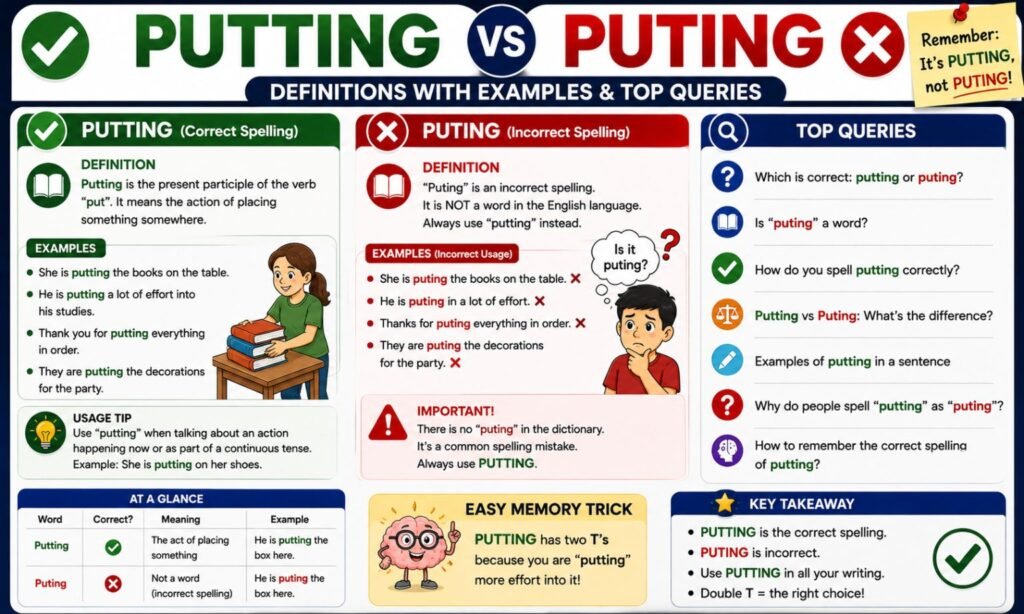
Putting is the present participle and gerund form of the verb “put,” meaning to place something somewhere, or, in golf, the act of tapping a ball into the hole.
Five example sentences using “putting” correctly:
- He is putting his keys on the counter every night.
- Putting off your homework will only make things harder later.
- She spent the afternoon putting up holiday decorations.
- The golfer practiced his putting for two hours.
- We are putting together a plan for the new project.
Puting has no definition. It does not appear in any English dictionary, including Merriam-Webster, Oxford, or Cambridge. It is simply a spelling error that occurs when someone forgets to double the T.
Popular user queries related to putting vs puting include:
- Is “puting” a real word?
- How do you spell putting correctly?
- Putting vs puting in golf terms
- Why does putting have two Ts?
- Putting or puting on Instagram captions
Explore More Grammar Guides
Totaling vs Totalling: What’s the Difference? Meaning, Usage & Examples
Humorous vs Humerous: What’s the Difference? Meaning, Usage & Examples
Friend vs Freind: What’s the Difference? Meaning, Usage & Examples
Gauge Vs Guage: What’s the Difference? Meaning, Usage & Examples
Guidance vs Guidence: What’s the Difference? Meaning, Usage & Examples
British English vs American English Spelling
Good news here: this one is simple. The spelling of putting is identical in both British English and American English. There is no regional variation, unlike words such as “colour” versus “color.”
| Feature | British English | American English |
| Correct spelling | Putting | Putting |
| Pronunciation | /ˈpʊt.ɪŋ/ | /ˈpʊt.ɪŋ/ |
| “Puting” accepted? | No | No |
Because “put” is a core, ancient English verb, both dialects inherited the same doubling rule and never diverged on it.
My Memory Tricks and Tips
Here are three tricks that help the correct spelling stick for good.
- The “Two Feet” Trick: Picture someone “putting” their two feet down firmly, one for each T. Two feet, two Ts.
- The Rhyme Test: “Putting” rhymes with “cutting” and “butting.” All three double the consonant the same way, so if you can spell one, you can spell all three.
- The Golf Green Trick: Golfers talk about “putting greens,” and every golf magazine, scorecard, and broadcast spells it with two Ts. If it is good enough for professional golf, it is good enough for your email.
Putting vs Puting: Which One Should You Use?
- Use putting whenever you need the present participle or gerund of “put,” in any writing context: emails, essays, texts, or reports.
- Use putting for the golf term describing the short stroke used near the hole.
- Never use puting. It is not a word in any dictionary, formal or informal.
- If autocorrect ever suggests “puting,” that is a bug or typo suggestion, not a valid alternative spelling.
Common Mistakes with Putting vs Puting
Mistake 1: Dropping the second T out of habit.
- ❌ Incorrect: I am puting my coat on.
- ✅ Correct: I am putting my coat on.
Mistake 2: Assuming “put” follows the same rule as “-e” ending verbs.
- ❌ Incorrect: She is puting effort into the project.
- ✅ Correct: She is putting effort into the project.
Mistake 3: Typing fast on mobile and skipping the double letter.
- ❌ Incorrect: We’re puting the meeting on hold.
- ✅ Correct: We’re putting the meeting on hold.
Putting vs Puting in Everyday Examples
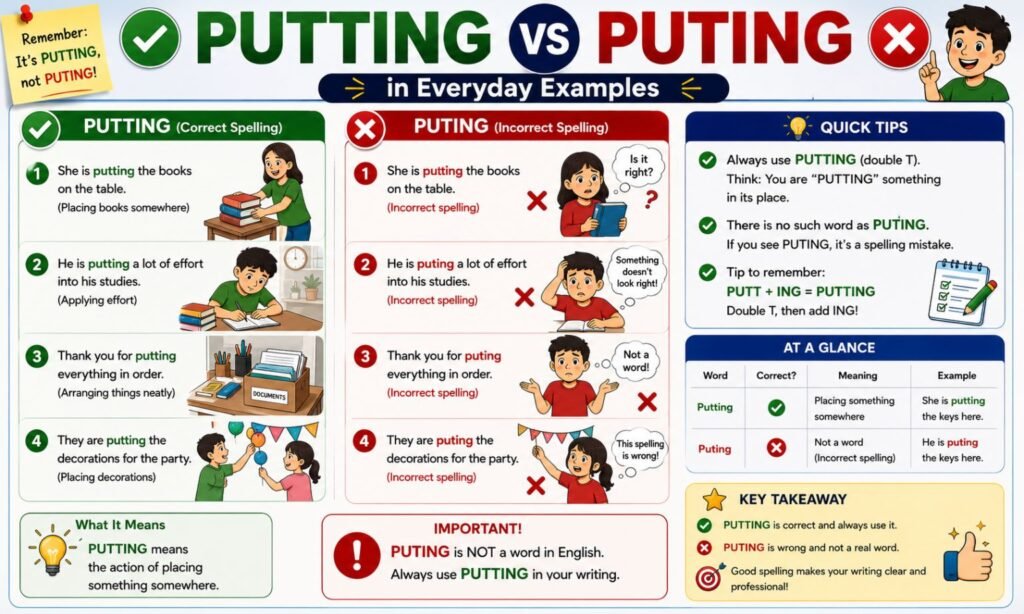
Texting: “Just putting the kids to bed, call you in 10!”
Emails: “I am putting together the quarterly report and will send it by Friday.”
Social Media: “Putting my new skincare routine to the test this week! 🧴”
Business Writing: “The committee is putting forward a revised budget proposal for Q3 approval.”
Comparison Table: Putting vs Puting
| Category | Putting | Puting |
| Part of speech | Verb (gerund/present participle) | Not applicable, misspelling |
| Used for | Placing objects, golf stroke, phrasal verbs | Never used correctly |
| Example | She is putting the mail on the table. | Not a valid example |
| Memory hook | Two feet, two Ts | N/A |
Comparison Table: Putting vs Puting (Quick Reference)
| Question to Ask | If Yes → Use |
| Am I writing the “-ing” form of “put”? | Putting |
| Am I describing the golf stroke? | Putting |
| Did I only type one T out of habit? | Fix it, use Putting |
| Is “puting” ever correct in any context? | No, never use it |
Pro Tip I Learned
Read your sentence out loud, backward, word by word. When your eyes are not following the natural flow of the sentence, spelling errors like a missing second T jump out immediately because your brain stops autocorrecting for meaning and starts focusing purely on the letters.
Text-to-speech tools work well too. If a tool mispronounces “puting” with a long U sound, that mismatch is your signal something is wrong.
Quick Test I Created: Putting vs Puting Quiz
Fill in the blank with the correct spelling.
- She is _____ her shoes on.
- The golfer practiced his _____ all morning.
- We are _____ off the trip until next month.
- He kept _____ things in the wrong drawer.
- I’m _____ together a birthday playlist.
- They are _____ up a new fence this weekend.
- Stop _____ it off, just do it now.
- She’s _____ extra effort into this project.
- The team is _____ the plan into action.
- He’s _____ his phone on silent during meetings.
- We’re _____ the couch in the living room.
- She kept _____ her hair up all day.
- The chef is _____ the final touches on dinner.
- I was _____ gas in the car this morning.
- They’re _____ the finishing touches on the house.
- He’s _____ a lot of pressure on himself.
- We are _____ our differences aside.
- She’s _____ the baby down for a nap.
- The manager is _____ new policies in place.
- I’m _____ my phone away for the night.
(Answer key: All twenty blanks are filled with “putting.”)
Frequently Asked Questions
Is “puting” ever correct in English?
No, “puting” is never correct. It is a common misspelling of “putting” and does not appear in any standard dictionary.
Why does “putting” have two Ts?
“Putting” doubles the T because the base word “put” ends in a single vowel and single consonant, which triggers the consonant-doubling rule before adding “-ing.”
How do you spell the golf term for putting?
The golf term is spelled “putting,” with two Ts, exactly the same as the everyday verb form of “put.”
What is the correct spelling, putting or puting?
The correct spelling is “putting.” “Puting” is a spelling error and should always be corrected to “putting.”
Does British English spell it differently from American English?
No, British English and American English both spell it “putting,” with no regional variation.
Conclusion
The putting vs puting debate really is not a debate at all. “Putting” is the only correct spelling, backed by a clear consonant-doubling rule that applies across both British and American English. “Puting” simply does not exist as a word, no matter how it is used.
Now that you know the one-second mental test, the pronunciation pattern, and a few memory tricks, this mistake should never sneak into your writing again. Whether you are texting a friend, writing a business email, or talking about your golf game, you can spell it with confidence every time.

Shoaib Ahmad is an SEO and digital content professional with experience in creating helpful, easy-to-understand online content. At Whizz Aura, he focuses on English grammar, vocabulary, word meanings, sentence structure, and practical language tips. His goal is to make learning English simple, clear, and useful for everyday communication.