
If you have ever typed “labeling” into an email, then paused and wondered if it should have two L’s, you are not alone. This mix-up trips up writers, students, and even seasoned professionals every single day, and it usually happens because spell-check tools flag one version while your college textbook used the other.
The confusion around labeling vs labelling is not a sign that you skipped English class. It is simply a case of two different English dialects going their separate ways over the last two centuries. American and British English took slightly different paths when it came to doubling consonants, and this word got caught in the middle.
Labeling vs Labelling: Quick Answer 🎯
Quick Answer: “Labeling” is the correct spelling in American English, while “labelling” is the correct spelling in British, Australian, and Canadian English. Both words mean the same thing: the act of attaching a label to something.
✅ Correct (American): She is labeling the boxes before the move.
✅ Correct (British): She is labelling the boxes before the move.
❌ Incorrect: She is labbeling the boxes before the move.
Why I Found It’s Spelled / Used This Way
The root word here is simple: label, which came into English from Old French in the 14th century, originally referring to a narrow strip of cloth or paper. The spelling split happened much later, and it has nothing to do with the word itself. It comes down to a general rule about doubling consonants before adding a suffix like “-ing” or “-ed.”
In the early 1800s, American lexicographer Noah Webster set out to simplify and standardize American spelling. He trimmed extra letters from many words to make them more phonetic and consistent, which is why Americans write “traveling” instead of “travelling,” and “labeling” instead of “labelling.”
British English, on the other hand, kept the older convention of doubling the final consonant (the “L”) when adding a suffix, regardless of where the stress falls in the word. This is why British English still uses “labelling,” “travelling,” and “cancelling” with two L’s.
The Simple Rule for Stopping the Confusion
Here is a one-second mental test you can use every time you are not sure which spelling fits.
Quick Swap Rule: Think of your audience’s location. If you are writing for American readers, use one L (“labeling”). If you are writing for British, Australian, or Canadian readers, use two L’s (“labelling”).
If you still are not sure who your audience is, default to American spelling (“labeling”) since it is the version most commonly used in global business and tech writing, including tools like Google Docs set to US English.
Pronunciation Guide I Use
Here is the good news: both spellings sound exactly the same when spoken out loud. The pronunciation difference is essentially zero, so you cannot “hear” your way to the right spelling. You have to rely on the dialect rule instead.
| Word | Phonetic Spelling | Sound Focus |
| Labeling | LAY-buh-ling | Stress falls on the first syllable (“LAY”) |
| Labelling | LAY-buh-ling | Stress falls on the first syllable (“LAY”) |
Mouth-movement tip: Say the word slowly and notice your tongue barely touches the roof of your mouth for a single, quick “L” sound in the middle. Whether you write one L or two, your mouth only makes that L sound once when you speak.
Labeling vs Labelling: Definitions with Examples & Top Queries
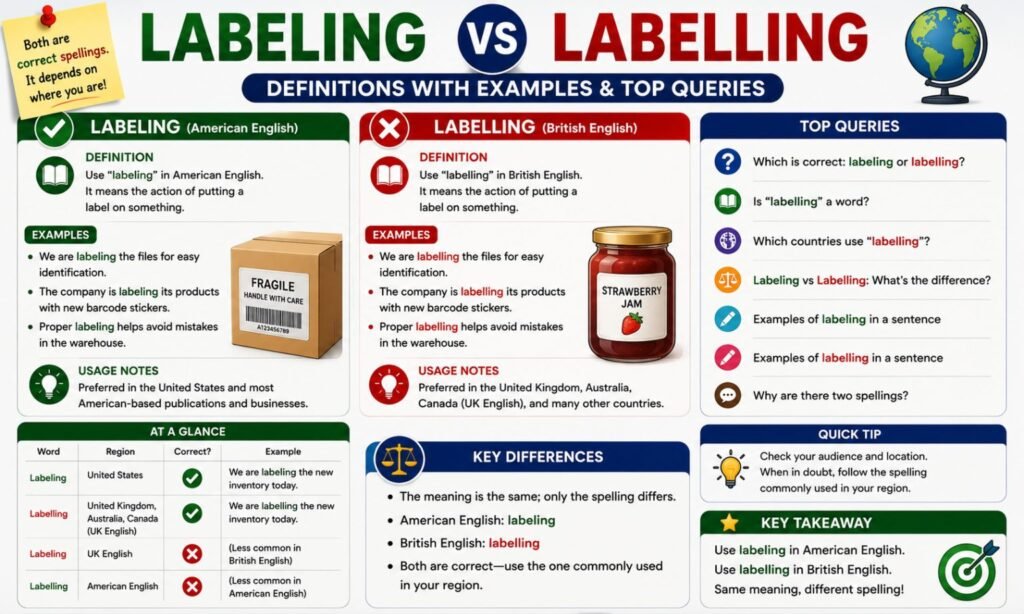
Both words share the exact same meaning and function. They are simply regional spelling variants of the same verb form.
Labeling (American English) Part of speech: Present participle / gerund of the verb “to label”
- I spent my Saturday labeling the spice jars in the kitchen.
- The factory uses machines for labeling every product before shipping.
- Labeling food allergens clearly can prevent serious health risks.
- She was labeling her students’ folders by color.
- Proper labeling of hazardous materials is required by law.
Labelling (British English) Part of speech: Present participle / gerund of the verb “to label”
- The team spent the morning labelling the new stock.
- Labelling laws in the UK require clear ingredient lists.
- He is labelling his suitcase so it stands out at the airport.
- Careful labelling helps avoid mix-ups in the warehouse.
- The nurse was labelling each sample before sending it to the lab.
Popular user queries related to this topic:
- Is it labeling or labelling in English?
- Labeling vs labelling AP style
- Which spelling does Canada use, labeling or labelling?
- Labeling vs labelling in Word documents
- Correct spelling of labelling for UK English
Explore More Grammar Guides
Totaling vs Totalling: What’s the Difference? Meaning, Usage & Examples
Humorous vs Humerous: What’s the Difference? Meaning, Usage & Examples
Friend vs Freind: What’s the Difference? Meaning, Usage & Examples
Gauge Vs Guage: What’s the Difference? Meaning, Usage & Examples
Putting vs Puting: What’s the Difference? Meaning, Usage & Examples
British English vs American English Spelling
This is a true regional spelling difference, not a case of one version being “wrong.” Both are accepted as correct within their respective English dialects.
| Feature | British English | American English |
| Spelling | Labelling (two L’s) | Labeling (one L) |
| Root word | Label | Label |
| Consonant doubling rule | Doubles final L before suffix | Keeps single L before suffix |
| Common in | UK, Australia, Canada (often) | United States |
| Style guides | Oxford, Cambridge | AP, Chicago Manual of Style |
My Memory Tricks and Tips
Here are three tricks that make this spelling stick for good.
- The “America is Efficient” trick: Americans like to save letters. Fewer letters, one L. Think “America = one less letter.”
- The Double Britain trick: Britain has a long, layered history, and British spelling tends to “double down” on consonants. Two L’s for two centuries of tradition.
- The Travel Test: If you already know “traveling” (American) versus “travelling” (British), apply the exact same pattern here. These two word pairs follow identical rules.
Tip: Pick one country’s spelling system for your document and stick with it the whole way through. Mixing “labeling” and “labelling” in the same piece looks like an editing mistake.
Labeling vs Labelling: Which One Should You Use?
- Use labeling if you are writing for a US-based audience, company, or publication.
- Use labeling if your style guide is AP or Chicago Manual of Style.
- Use labelling if you are writing for a UK, Irish, Australian, or (often) Canadian audience.
- Use labelling if your style guide is Oxford or Cambridge.
- Use labeling as your default when writing for an international or mixed audience, since it is the more globally recognized tech and business standard.
- Check your document’s language setting (US English vs UK English) before submitting any formal writing.
Common Mistakes with Labeling vs Labelling
Mistake 1: Mixing spellings in the same document ❌ Incorrect: The team focused on labeling the products, and the labelling process took two days. ✅ Correct: The team focused on labeling the products, and the labeling process took two days.
Mistake 2: Adding an extra letter that doesn’t belong ❌ Incorrect: She is labbeling the containers. ✅ Correct: She is labeling the containers. (or labelling, in British English)
Mistake 3: Assuming there is a meaning difference ❌ Incorrect thinking: “Labelling means something more formal than labeling.” ✅ Correct understanding: Both words mean exactly the same thing. Only the region changes.
Labeling vs Labelling in Everyday Examples
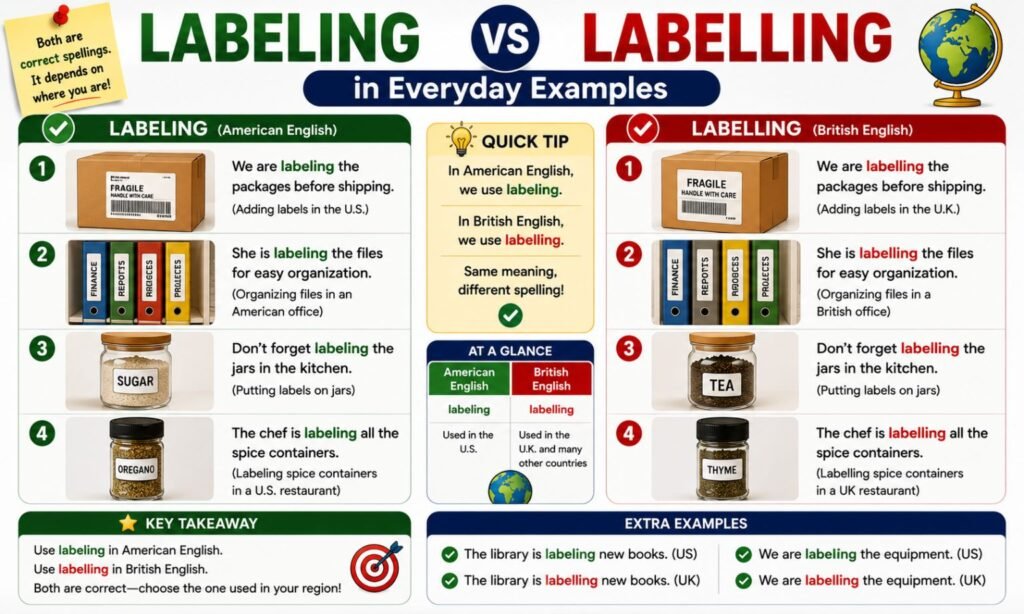
Texting: “Can you finish labeling the moving boxes before I get home?”
Emails: “Please confirm the labeling requirements for the new product line before Friday’s deadline.”
Social Media: “Spent my whole weekend labelling jars for the farmers market! 🍯 #smallbusiness”
Business Writing: “All shipments must comply with FDA labeling regulations prior to distribution.”
Comparison Table: Labeling vs Labelling
| Category | Labeling | Labelling |
| Part of speech | Verb (gerund/participle) | Verb (gerund/participle) |
| Used for | American English writing | British/Australian English writing |
| Example | Labeling the files by date | Labelling the files by date |
| Memory hook | One L, one country (US) saves letters | Two L’s, traditional British spelling |
Comparison Table: Labeling vs Labelling (Quick Reference)
| Question to Ask | If Yes → Use |
| Is my audience American? | Labeling |
| Is my audience British, Australian, or Canadian? | Labelling |
| Does my style guide say AP or Chicago? | Labeling |
| Does my style guide say Oxford or Cambridge? | Labelling |
| Am I unsure of my audience’s location? | Labeling (safer global default) |
Pro Tip I Learned
Pro Tip: Set your word processor’s language and dictionary to match your target audience before you start writing, not after. Then run a “Find and Replace” search for the opposite spelling at the very end. This catches any stray spellings that slipped in from autocorrect or muscle memory, and it takes less than thirty seconds.
Quick Test I Created: Labeling vs Labelling Quiz
Fill in the blank with the correct spelling based on the audience noted in parentheses.
- She spent the afternoon _____ the wine bottles. (American)
- The factory’s _____ system needs an upgrade. (British)
- He is _____ each folder by project name. (American)
- Proper _____ prevents shipping errors. (British)
- The _____ process took three full days. (American)
- _____ regulations differ across the EU. (British)
- I am _____ these jars for the bake sale. (American)
- The nurse was _____ the samples carefully. (British)
- _____ mistakes can cause recalls. (American)
- The team is _____ new inventory today. (British)
- Clear _____ helps customers choose products. (American)
- She prefers _____ everything by hand. (British)
- The app automates the _____ of photos. (American)
- _____ laws protect consumers. (British)
- We finished _____ the last box. (American)
- He struggled with the _____ software. (British)
- Accurate _____ builds customer trust. (American)
- The interns handled the _____ today. (British)
- _____ each shelf took longer than expected. (American)
- The company updated its _____ standards. (British)
Answer Key: 1. labeling, 2. labelling, 3. labeling, 4. labelling, 5. labeling, 6. Labelling, 7. labeling, 8. labelling, 9. Labeling, 10. labelling, 11. labeling, 12. labelling, 13. labeling, 14. Labelling, 15. labeling, 16. labelling, 17. labeling, 18. labelling, 19. Labeling, 20. labelling
Frequently Asked Questions
Is labeling or labelling correct?
Both are correct. “Labeling” is standard in American English, while “labelling” is standard in British English.
Why does British English use two L’s in labelling?
British English follows an older spelling convention that doubles the final consonant before adding a suffix, regardless of syllable stress.
Does Canada use labeling or labelling?
Canadian English often uses “labelling” with two L’s, though usage can be mixed due to strong American influence.
Is labeling used in professional or legal writing?
Yes, “labeling” is the standard spelling in US legal, medical, and regulatory documents, including FDA guidelines.
Can I use either spelling in the same document?
No, you should pick one spelling based on your target audience or style guide and use it consistently throughout the entire document.
Conclusion
The debate over labeling vs labelling really comes down to geography, not grammar rules you need to memorize from scratch. American English trimmed the extra L thanks to Noah Webster’s spelling reforms, while British English held onto its traditional double-consonant pattern.
Once you know your audience, the choice becomes automatic. Writing for the US? Go with “labeling.” Writing for the UK, Australia, or often Canada? Use “labelling.” Either way, the meaning never changes, and both spellings are completely correct within their own dialects.

Shoaib Ahmad is an SEO and digital content professional with experience in creating helpful, easy-to-understand online content. At Whizz Aura, he focuses on English grammar, vocabulary, word meanings, sentence structure, and practical language tips. His goal is to make learning English simple, clear, and useful for everyday communication.