
Have you ever paused mid-sentence, fingers hovering over the keyboard, unsure whether to type “the new law will take effect” or “the new law will take affect”? You’re not alone. This is one of the most common mix-ups in the English language, and it trips up students, professionals, and even seasoned writers.
The confusion makes sense once you understand why it happens. “Effect” and “affect” sound nearly identical when spoken quickly, and both words deal with change and outcomes. But using the wrong one in a contract, an email to your boss, or a school essay can make you look careless. This guide clears up the confusion for good, so you’ll never second-guess yourself again.
Take Effect or Take Affect: Quick Answer
Quick Answer: The correct phrase is always “take effect.” ✅ “Take affect” is grammatically incorrect and should never be used, no matter the context.
✅ Correct: The new tax policy will take effect on January 1st.
❌ Incorrect: The new tax policy will take affect on January 1st.
Remember this: “effect” is a noun in this phrase, meaning a result or outcome. “Affect” is almost always a verb, meaning to influence something. Since “take” needs a noun after it, “effect” is the only correct choice.
Why I Found It’s Spelled / Used This Way?
Both words trace back to Latin roots, which is part of why they look and sound so similar. “Effect” comes from the Latin effectus, meaning “accomplishment” or “result,” built from ex- (out) and facere (to make or do).
“Affect” comes from the Latin affectus, meaning “to influence” or “to act upon,” built from ad- (toward) and facere (to do). So both words share the same root verb, facere, but they branched off with different prefixes and different jobs in English grammar.
Over centuries of use, English speakers settled into a pattern: “effect” became the go-to noun for outcomes, and “affect” became the go-to verb for influence. The phrase “take effect” locked in during legal and formal writing, where laws, rules, and contracts needed a noun to describe when a result would begin.
The Simple Rule for Stopping the Confusion
Here’s a one-second mental test you can use every single time. Ask yourself: “Am I talking about a result (a thing) or an action (influencing something)?”
If you mean a result, use “effect.” If you mean an action of influencing, use “affect.”
💡 Quick Swap Test: Try replacing the word with “result” or “outcome.” If it still makes sense, you need “effect.” If it sounds strange, you probably need “affect.”
Since “take effect” always describes something starting or becoming active, the noun “effect” fits perfectly. There is no correct sentence in standard English where “take affect” belongs.
Pronunciation Guide I Use
Even though these words are spelled differently, their pronunciation is close enough to cause real confusion in speech. Here’s how I break it down.
| Word | Phonetic Spelling | Sound Focus |
| Effect | ih-FEKT | Short “ih” sound at the start, stress on second syllable |
| Affect | uh-FEKT | Soft “uh” (schwa) sound at the start, stress on second syllable |
🗣️ Mouth-Movement Tip: For “effect,” your lips barely move on the first syllable, almost like a quick “ih.” For “affect,” relax your mouth completely into a lazy “uh.” Saying both slowly a few times helps train your ear to hear the tiny difference.
Take Effect or Take Affect: Definitions with Examples & Top Queries
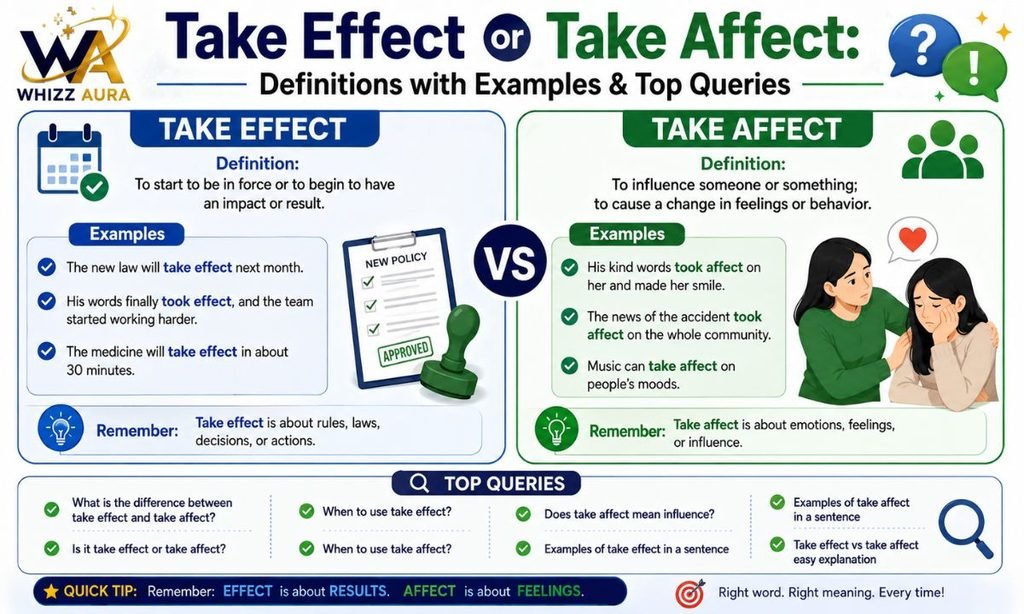
Effect (noun): A result or outcome caused by something else. It’s the thing that happens because of an action.
Example sentences:
- The effect of the storm was widespread flooding.
- Her speech had a powerful effect on the audience.
- The medicine’s side effects included drowsiness.
- The new curfew will take effect at midnight.
- Sound effects made the movie feel more real.
Affect (verb): To influence or produce a change in something or someone.
Example sentences:
- The weather can affect your mood.
- Lack of sleep will affect your concentration.
- The decision will affect thousands of employees.
- Loud noises affect his ability to focus.
- Her kind words deeply affected me.
Top user queries related to this keyword:
- Is it Take Effect or Take Affect
- How to remember effect vs affect
- Take effect meaning in a sentence
- Does the law Take Effect or Take Affect
- Effect vs affect grammar rule
British English vs American English Spelling 🇬🇧🇺🇸
Good news here: the spelling and usage of “take effect” are identical in both British and American English. There is no regional variation for this particular phrase.
| Feature | British English | American English |
| Correct phrase | take effect | take effect |
| Incorrect phrase | take affect | take affect |
| Pronunciation | ih-FEKT | ih-FEKT |
| Usage in law/contracts | Standard | Standard |
Unlike words such as “colour” versus “color,” this phrase doesn’t change across dialects, so you can use it confidently no matter which English-speaking audience you’re writing for.
My Memory Tricks and Tips
Here are three tricks that have helped thousands of writers lock in the difference for good.
- The “A is for Action” trick: Affect starts with A, and Action starts with A. Since affect is almost always a verb (an action word), this simple letter match helps you remember its job.
- The RAVEN trick: Remember Remember Affect Verb Effect Noun. This classic acronym has helped generations of students keep the two straight.
- The “Effect = End result” trick: Both “effect” and “end result” start with a vowel-consonant blend and describe a finished outcome. Whenever you’re describing something that already happened or will happen as a result, effect is your word.
Take Effect or Take Affect: Which One Should You Use?
Use “take effect” in these situations:
- When describing a law, rule, or policy that becomes active
- When writing legal, business, or formal documents
- When talking about a contract’s start date
- When describing when a decision officially begins
Never use "take affect" in any situation. It is not a recognized phrase in standard English grammar, even though "affect" itself is a valid word in other contexts, like "the news will affect our plans."
Explore More Grammar Guides
In Person vs In Person: What’s the Difference? Meaning, Usage & Examples
Cocoon or Cacoon: What’s the Difference? Meaning, Usage & Examples
Carrer vs Career: What’s the Difference? Meaning, Usage & Examples
Defence or Defense: What’s the Difference? Meaning, Usage & Examples
You Too or You To: What’s the Difference? Meaning, Usage & Examples
Common Mistakes with Take Effect or Take Affect
Mistake 1: Confusing the noun and verb roles
- ❌ Incorrect: The changes will take affect next week.
- ✅ Correct: The changes will take effect next week.
Mistake 2: Using “affect” when describing a noun outcome
- ❌ Incorrect: The affect of the new rule was immediate.
- ✅ Correct: The effect of the new rule was immediate.
Mistake 3: Using “effect” when you actually mean to influence something
- ❌ Incorrect: The rain will effect our picnic plans.
- ✅ Correct: The rain will affect our picnic plans.
Take Effect or Take Affect in Everyday Examples
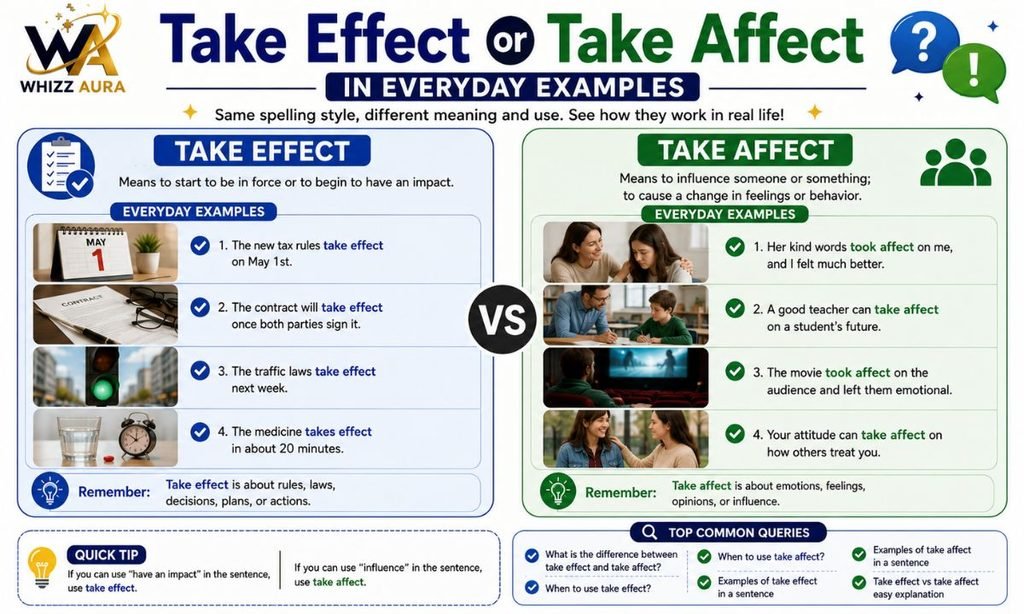
Texting: “Heads up, the new school schedule takes effect Monday!”
Emails: “Please note that the updated privacy policy will take effect on September 1st.”
Social Media: “Big news: our new return policy takes effect this weekend! 🎉”
Business Writing: “This amendment shall take effect immediately upon signature by both parties.”
Comparison Table: Take Effect or Take Affect
| Category | Effect | Affect |
| Part of speech | Noun (mostly) | Verb (mostly) |
| Used for | Describing a result or outcome | Describing influence or change |
| Example | The effect was noticeable. | The news will affect her mood. |
| Memory hook | Effect = End result | Affect = Action |
Comparison Table: Take Effect or Take Affect (Quick Reference)
| Question to Ask | If Yes → Use |
| Am I describing a result or outcome? | Effect |
| Am I describing an action that influences something? | Affect |
| Is this phrase about a law, rule, or policy starting? | take effect |
| Can I replace the word with “result”? | Effect |
| Can I replace the word with “influence”? | Affect |
Pro Tip I Learned 💡
One trick that changed how I edit forever: read your sentence out loud and swap in “influence” for the word in question. If the sentence still makes sense, you need “affect.” If it sounds off, you need “effect.” Text-to-speech tools are also great for catching this mistake, since hearing the sentence often reveals errors your eyes skip right past.
Quick Test I Created: Take Effect or Take Affect Quiz
Fill in the blank with the correct word (effect or affect).
- The new law will take ___ next month.
- Her mood can ___ the whole team.
- The medicine had a strong ___ on him.
- Loud music can ___ your focus.
- The policy changes take ___ tomorrow.
- His words had a lasting ___.
- Stress can ___ your sleep.
- The rule will take ___ immediately.
- The storm’s ___ was devastating.
- Diet can ___ your energy levels.
- The new curfew takes ___ tonight.
- Smoking can ___ your lungs.
- The side ___ were mild.
- Her smile can ___ anyone’s day.
- The contract will take ___ on signing.
- Sunlight can ___ your mood positively.
- The special ___ in the film were amazing.
- The decision will ___ everyone in the office.
- The ban takes ___ this Friday.
- Sleep can greatly ___ concentration.
Answer Key: (1. effect, 2. affect, 3. effect, 4. affect, 5. effect, 6. effect, 7. affect, 8. effect, 9. effect, 10. affect, 11. effect, 12. affect, 13. effect, 14. affect, 15. effect, 16. affect, 17. effect, 18. affect, 19. effect, 20. affect)
Frequently Asked Questions
Is it “take effect” or “take affect”?
It is always “take effect.” “Take affect” is grammatically incorrect and not used in standard English.
What does “take effect” mean?
“Take effect” means that something, like a law or policy, becomes active or official starting at a certain time.
Is “affect” ever correct after “take”?
No. “Affect” is a verb and cannot follow “take” in this phrase, since “take” requires a noun.
How do I remember the difference between effect and affect?
Remember that “affect” starts with A like “Action” (it’s a verb), while “effect” describes an “End result” (it’s a noun).
Does British English spell “take effect” differently than American English?
No, the spelling and usage of “take effect” are identical in both British and American English.
Conclusion
Getting “take effect” right isn’t just a small grammar detail, it’s a mark of clear, professional writing. Whether you’re drafting a business contract, sending a text to a friend, or writing a school paper, using the correct phrase shows attention to detail and builds trust with your reader.
Remember the core rule: “effect” is a noun that describes a result, and it’s the only word that correctly follows “take.” “Affect” is a verb about influence, and it never pairs with “take” in standard English.

Shoaib Ahmad is an SEO and digital content professional with experience in creating helpful, easy-to-understand online content. At Whizz Aura, he focuses on English grammar, vocabulary, word meanings, sentence structure, and practical language tips. His goal is to make learning English simple, clear, and useful for everyday communication.





3 thoughts on “Take Effect or Take Affect: What’s the Difference? Meaning, Usage & Examples”