
If you’ve ever typed a sentence about shoelaces or a game score and paused with your fingers hovering over the keyboard, you’re not alone. The Tying vs Tieing debate trips up even confident writers, because English spelling rules feel like they’re working against you here. Your brain wants to keep that “e” from “tie,” but the rule says otherwise.
This confusion matters more than you’d think. A misspelled word in a resume, a business email, or a school essay can make a reader pause and question your attention to detail. Getting Tying vs Tieing right isn’t about being a grammar snob. It’s about writing with confidence so your message lands the way you intended.
Tying vs Tieing: Quick Answer 🎯
📌 Only “tying” is correct. “Tieing” is a common misspelling and is never considered proper English, in either American or British spelling conventions.
✅ Correct: She is tying her shoes before the race.
❌ Incorrect: She is tieing her shoes before the race.
✅ Correct: He’s tying the boat to the dock.
❌ Incorrect: He’s tieing the boat to the dock.
Why I Found It’s Spelled / Used This Way
The word “tie” comes from Old English “tēag” or “tēah,” meaning a rope, cord, or band used for fastening. Over centuries, this evolved into the Middle English “tien,” and eventually settled into the modern spelling “tie.”
The confusion around Tying vs Tieing comes from a spelling rule collision. English usually drops the silent “e” before adding “-ing” (like “make” becoming “making”). But when a word ends in “ie,” English does something different: it swaps the “ie” for a “y” before adding “-ing.”
That’s why “die” becomes “dying,” “lie” becomes “lying,” and “tie” becomes “tying.” This “ie to y” swap is a small but consistent pattern in English spelling, and once you spot it, you’ll never forget it.
This rule exists specifically to avoid awkward double vowels like “tieing,” which would break the normal flow of English pronunciation and spelling logic.
The Simple Rule for Stopping the Confusion
Here’s a one-second mental test you can use every single time: if a word ends in “ie,” drop the “e” and change the “i” to a “y” before adding “-ing.”
Think of it as a quick swap: ie → y + ing.
- tie → ty + ing → tying
- die → dy + ing → dying
- lie → ly + ing → lying
If you remember this one swap rule, Tying vs Tieing stops being a mystery. There is no version of English where “tieing” is the accepted spelling.
Pronunciation Guide I Use
Pronunciation isn’t actually where people struggle with this word pair, since “tieing” isn’t a real word to pronounce. But knowing the correct sound helps reinforce the correct spelling in your memory.
| Word | Phonetic Spelling | Sound Focus |
| Tying | TAHY-ing | Long “i” sound, like “eye,” followed by a soft “ing” |
| Tieing (incorrect) | N/A | Not a recognized English word or sound pattern |
Mouth-movement tip: Say “tie” out loud, then simply add “ing” without inserting any extra vowel sound. Your mouth naturally moves from an open “ah” shape into the “ing” ending, with no pause for an extra “e.”
Tying vs Tieing: Definitions with Examples & Top Queries
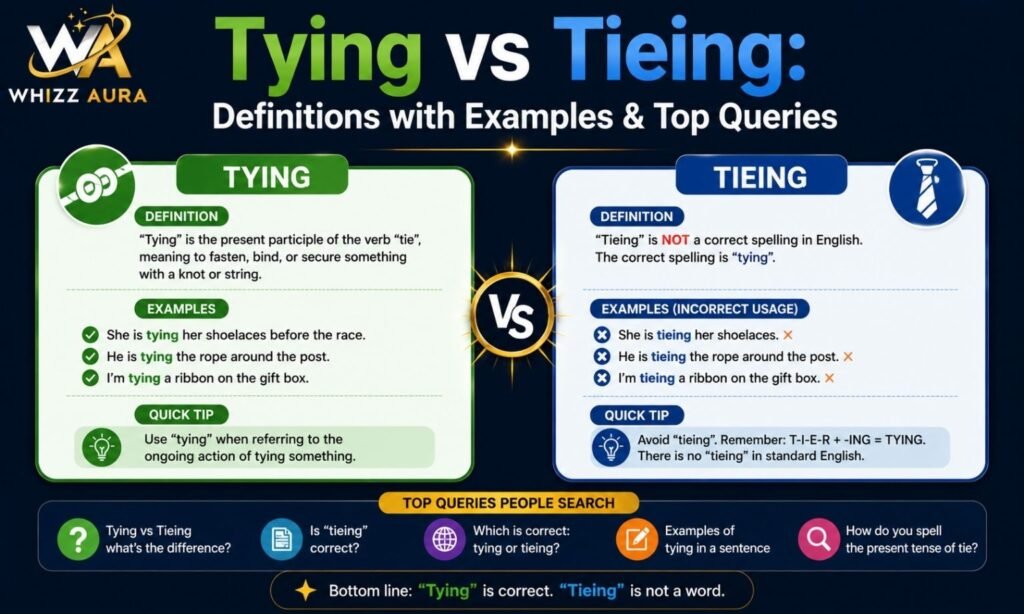
Tying is the present participle (verb form) of “tie.” It describes the ongoing action of fastening, securing, or connecting something with a cord, string, rope, or similar material. It can also describe a game or contest ending in equal scores.
Five example sentences using “tying”:
- My daughter is finally tying her own shoelaces.
- The two teams ended up tying the match at 2-2.
- He spent the morning tying fishing flies for the trip.
- Tying the ribbon into a bow takes practice.
- Their final answer ended up tying with another contestant’s.
Tieing is not a recognized English word. It appears frequently online due to spelling confusion, but no dictionary, from Merriam-Webster to Oxford, lists it as a valid spelling of “tying.”
Five example sentences correcting the common misuse:
- Wrong: “I’m tieing my apron.” Right: “I’m tying my apron.”
- Wrong: “The scores are tieing.” Right: “The scores are tying.”
- Wrong: “She’s tieing the knot.” Right: “She’s tying the knot.”
- Wrong: “We’re tieing up loose ends.” Right: “We’re tying up loose ends.”
- Wrong: “He’s tieing his tie.” Right: “He’s tying his tie.”
Popular user queries related to Tying vs Tieing:
- Is “tieing” a real word?
- How do you spell tying correctly?
- Tying or tieing shoelaces?
- Why isn’t it “tieing” like other -ing words?
- Tying the knot spelling
Explore More Grammar Guides
Habit vs Habbit: What’s the Difference? Meaning, Usage & Examples
Anise vs Aniseed: What’s the Difference? Meaning, Usage & Examples
Channel or Chanel: What’s the Difference? Meaning, Usage & Examples
Weiner or Wiener: What’s the Difference? Meaning, Usage & Examples
Lent vs Lended: What’s the Difference? Meaning, Usage & Examples
British English vs American English Spelling
Good news here: this is one area where Tying vs Tieing doesn’t create a transatlantic headache. The correct spelling, “tying,” is identical in both British and American English.
| Feature | British English | American English |
| Correct spelling | Tying | Tying |
| Incorrect spelling | Tieing | Tieing |
| Pronunciation | TAHY-ing | TAHY-ing |
| Rule applied | ie → y + ing | ie → y + ing |
Unlike words such as “colour/color” or “organise/organize,” this word pair follows the exact same spelling rule worldwide.
My Memory Tricks and Tips
Here are three memory tricks I personally use and recommend to writers who keep second-guessing themselves.
- The “Y for Why” trick: Ask yourself “why does this word need a y?” The answer is always because “ie” words swap to “y” before “-ing.” Picture a small “y” replacing the “ie” like a costume change.
- The Twin Test: Remember that “tying” rhymes with “dying” and “lying.” If you know how to spell those two words, you already know how to spell “tying.”
- The No Double Vowel Rule: English almost never stacks “ie” directly before “ing.” If you catch yourself writing “ieing,” stop and swap it for “ying” instead.
Tying vs Tieing: Which One Should You Use?
- Use tying any time you’re describing the act of fastening something, like shoes, ribbons, knots, or ropes.
- Use tying when talking about a game, score, or competition ending in a draw.
- Never use tieing in any context. It is not accepted in formal writing, casual writing, or professional documents.
- If you’re unsure while typing quickly, pause and apply the ie → y + ing swap before hitting send.
Common Mistakes with Tying vs Tieing
Mistake 1: Adding the extra “e” out of habit.
Incorrect: “She was tieing her hair back.”
Correct: “She was tying her hair back.”
Mistake 2: Assuming the standard “-ing” rule applies.
Incorrect: “The game is tieing at halftime.”
Correct: “The game is tying at halftime.”
Mistake 3: Autocorrect and predictive text reinforcing the error.
Incorrect: “We’re tieing the package for shipping.”
Correct: “We’re tying the package for shipping.”
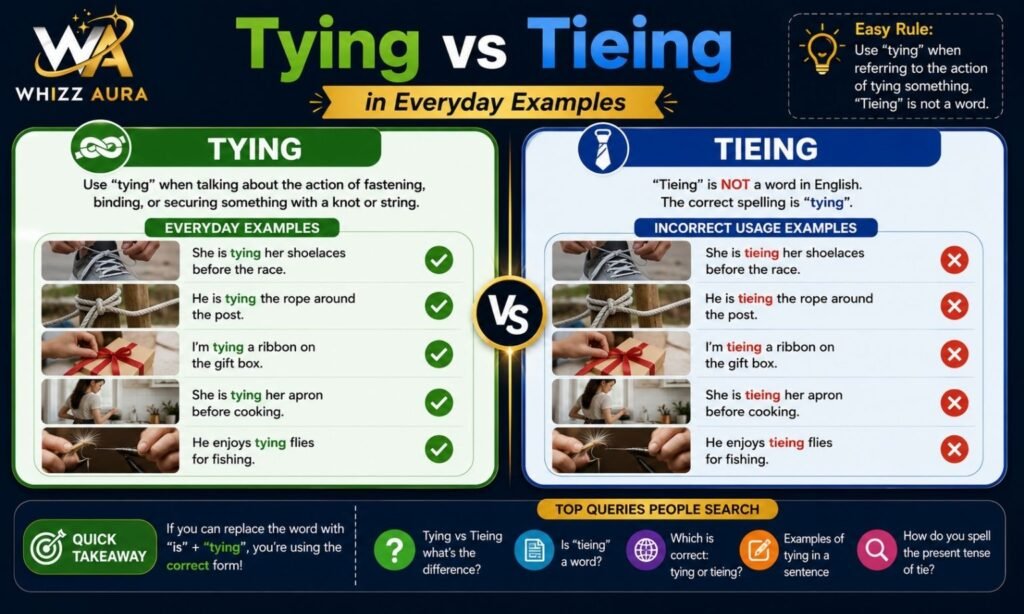
Tying vs Tieing in Everyday Examples
Texting: “omw, just tying my shoes, be there in 5!”
Emails: “I’m currently tying up a few loose ends on the report and will send it by 3 PM.”
Social Media: “Tying the knot this weekend! So excited to marry my best friend. 💍”
Business Writing: “Our team is tying the quarterly results to last year’s performance metrics for comparison.”
Comparison Table: Tying vs Tieing
| Category | Tying | Tieing |
| Part of speech | Verb (present participle) | Not a valid word |
| Used for | Fastening, securing, drawing/matching scores | N/A |
| Example | She is tying her shoes. | Incorrect in all contexts |
| Memory hook | ie → y + ing, like “dying” and “lying” | Remember: no such spelling exists |
Comparison Table: Tying vs Tieing (Quick Reference)
| Question to Ask | If Yes → Use |
| Does the base word end in “ie”? | Swap to “y” before adding “-ing” (tying) |
| Are you unsure how to spell an -ing verb from “tie”? | Use “tying,” never “tieing” |
| Did autocorrect suggest “tieing”? | Override it and type “tying” |
Pro Tip I Learned
One editing hack I swear by is using text-to-speech software to read my writing back to me. If a word looks even slightly off, like “tieing,” hearing it flagged or mispronounced by the software is often the fastest way to catch the mistake before hitting publish.
Quick Test I Created: Tying vs Tieing Quiz
Fill in the blank with the correct spelling.
- She is _______ her shoelaces.
- The two runners ended up _______ for first place.
- He’s _______ a knot in the rope.
- We’re _______ up the loose ends of the project.
- The dog is _______ itself in a leash.
- I’m _______ my tie before the interview.
- They kept _______ the game every quarter.
- The kids are _______ balloons to the mailbox.
- She was _______ ribbons around the gifts.
- He’s _______ his boots tightly.
- The teams are _______ at three points each.
- Stop _______ your napkin into knots.
- We are _______ the boat to the dock.
- She’s _______ her hair into a bun.
- He kept _______ and untying the string.
- The score ended up _______ again.
- I’m _______ the bandage carefully.
- They’re _______ the flag to the pole.
- She’s _______ the bow on the package.
- We were _______ our records with the competition.
(Answer key: All 20 blanks are correctly filled with “tying.”)
Frequently Asked Questions
Is “tieing” a real word?
No, “tieing” is not a real word in English. The correct spelling of the present participle of “tie” is always “tying.”
Why does “tie” become “tying” instead of “tieing”?
English spelling rules require words ending in “ie” to swap the “ie” for a “y” before adding “-ing,” which is why “tie” becomes “tying.”
Is “tying” spelled the same in British and American English?
Yes, “tying” is spelled identically in both British and American English with no regional variation.
What other words follow the same rule as tying?
Words like “dying” (from die) and “lying” (from lie) follow the same ie-to-y spelling pattern before adding “-ing.”
How can I remember the difference between tying and tieing?
Remember that “tying” rhymes with “dying” and “lying,” and if you can spell those correctly, you already know how to spell “tying.”
Conclusion
At the end of the day, Tying vs Tieing comes down to one simple, memorable rule: words ending in “ie” swap that ending for a “y” before adding “-ing.” Only “tying” is correct, in every dialect of English and every writing context, from texts to formal business reports.
Once you connect “tying” to familiar words like “dying” and “lying,” this spelling becomes second nature. You’ll stop second-guessing yourself and start writing with confidence, whether you’re tying your shoes, tying up a project, or tying the knot.

Shoaib Ahmad is an SEO and digital content professional with experience in creating helpful, easy-to-understand online content. At Whizz Aura, he focuses on English grammar, vocabulary, word meanings, sentence structure, and practical language tips. His goal is to make learning English simple, clear, and useful for everyday communication.





5 thoughts on “Tying vs Tieing: What’s the Difference? Meaning, Usage & Examples”